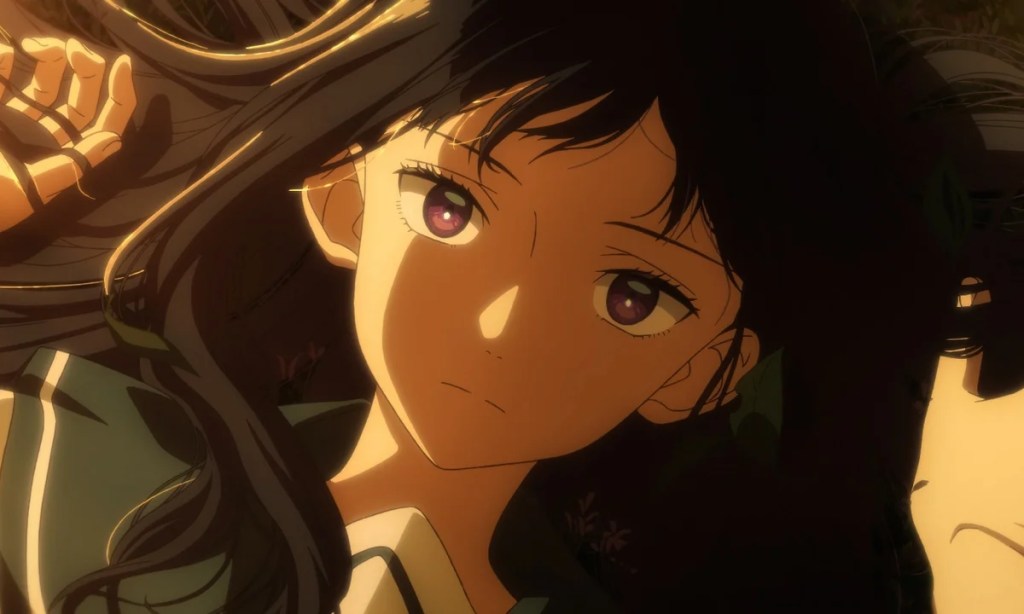
In the middle of a forest, teenagers Tohno Kaoru (Suzuka Oji) and Hanashiro Anzu (Iitoya Marie) discover the mysterious “Urashima Tunnel”. Time in the tunnel moves at a drastically slower rate than in the world outside, and while it may grant the traveller what they most desire the cost may be too high to bear.
Taguchi Tomohisa’s The Tunnel to Summer, the Exit of Goodbyes is a low-key romantic anime with a supernatural flair and a slow, measured place. While it lacks the immediacy and emotional effect of the decade’s best animated features, it does feature a pair of interesting characters and carries a worthwhile punch to the audience’s feelings. While it may not capture much mainstream attention outside of Japan, it is undoubtedly worth sampling. Viewers in synch with its emotional beats will find it very rewarding. The broader audience may wind up a little underwhelmed.
The film, which Taguchi adapts from Hachimoku Mei’s light novel, represents the first non-serial or franchised work that he has directed. After a lot of work for the Persona and Digimon franchises, it is nice to see him extend himself into more self-directed and independently composed works. While the film may seem a little too pedestrian overall, there are a number of isolated scenes and moments that stand out as particularly incisive and well-observed. Perhaps they do not add up to something exceptionally impressive, but each does seem commendable in isolation.
I wonder if part of the problem is that the film’s core creative element – the magical Urashima Tunnel – feels rather under-developed and under-used. It has potential far beyond its use in the story, and as it stands it seems obscure and confusing in comparison to its importance to the plot. Visually it is compellingly realized with a mixture of CGI and cel animation, and a great use of colour; it is only narratively that the device struggles. Fuuki Harumi contributes an evocative musical score.
Kaoru and Anzu are engaging characters, and well developed in Taguchi’s screenplay. In particular Kaoru’s troubled relationship with his alcoholic father and the tragedy that has damaged both their lives is well handled and dramatic. Vocal performances are decent across the board.
Ultimately there is a lot of the emotion and character in this film that resembles Shinkai Makoto’s Your Name (2016): the separated youthful romance, the use of displaced time, and so on. The Tunnel to Summer arguably suffers in the comparison, but then again Your Name was a masterful and hugely memorable work. Taguchi’s work here is solid, but never manages to hit the same level of impact.
This is a decent and admirable film, but it never fully embraces the potential of its premise. It is enjoyable to watch, but there is an inevitable disappointment that comes from recognising where it could have been so much better.



Leave a Reply