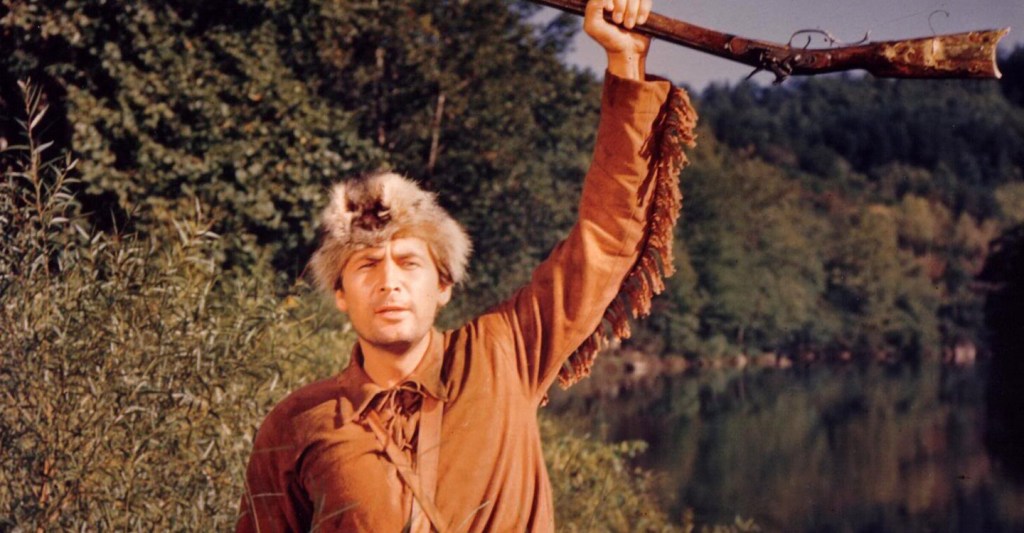
If we are discuss the western genre in 1955 America, sooner or later we must address the proverbial ‘elephant in the room’: Walt Disney’s Davy Crockett. To understand that, there is a need to talk about something that was having a massive effect on American cinema that year, which was broadcast television.
Full-scale commercial television arrived in the USA in 1947, although by the end of that year only 220,000 TV sets had been sold. By 1953 the new medium had grown significantly, with 45-50% of American households estimated to contain a TV. In March 1954 Walt Disney Productions signed a deal with the fledgling ABC network to produce a one-hour anthology series titled Disneyland. For the network it was a valuable asset with which to build its audience. For Walt Disney himself, it was a new stream of revenue that he could funnel directly into his proposed Disneyland theme park that would open just over a year later. The first seven episodes, broadcast from October 1954, presented compilations of pre-existing short films, behind-the-scenes documentaries of upcoming features, and an edited-down version of Disney’s 1951 animated film Alice in Wonderland.
For the eighth episode, Disneyland featured its first original television production, the historical adventure film “Davy Crockett: Indian Fighter”. Directed by Norman Foster and starring Them! (1954) co-star Fess Parker, it adapted events of the 1813 Creek Indian Wars. Two more episodes followed in early 1955, detailing Crockett’s experiences in the United States Congress, and then his death at the 1836 Battle of the Alamo. All three episodes were enormously successful, and likely became television’s first-ever pop culture phenomenon. Two more episodes were quickly commissioned, set before the Alamo, and the original three were re-edited and packaged together into the Walt Disney feature Davy Crockett: King of the Wild Frontier.
While ABC had broadcast Davy Crockett in black-and-white, Disney had filmed them in colour. This meant that, while moviegoers without television could see the stories for the first time, television-owners would be tempted to revisit them – and pay for a ticket – just to see them replayed in colour. The two new episodes were packaged in an identical fashion to make the feature film Davy Crockett and the River Pirates in 1956. By the end of 1955, almost 65% of American households had a television, while the country had spent more than USD$300 million on Davy Crockett merchandise. Check out the 1955 family dinner scene in Robert Zemeckis’ Back to the Future (1985): there’s juvenile actor Jason Hervey as Lorraine’s younger brother Milton wearing a coonskin hat. It is a pitch-perfect historical reference most viewers overlook.
Coming to King of the Wild Frontier as a film rather than as three television episodes makes it a slightly unusual experience, not simply because of its portmanteau narrative structure but also because each of its parts feel like a quite different story. The first is pure adventure, while the second is a somewhat simplistic but earnest political drama, and the third is essentially fatalistic tragedy. There is a real inevitability about the climactic third, since absolutely everybody watching both at home and in the cinema would have known what happened.
Fess Parker cuts a solid frame as the uncomplicated hero Crockett, and he is well paired with Buddy Ebsen (later to star in the Beverly Hillbillies). An assortment of supporting actors deliver decent performances, including William Bakewell, Basil Ruysdael, and Hans Conreid. It is hard not to notice how male it all is. While that is an accusation that could be levelled at most westerns from any year, even those released in 1955 tended to feature at least one or two prominent female characters.
It is the first segment that proves the most interesting, because like a growing number of westerns in the mid-1950s it begins to interrogate the portrayal of Native Americans in the genre, humanises them, and makes a deliberate shift away from using them as one-dimensional fodder for white cowboys to shoot and escape. Davy Crockett even features Onieda actor Pat Hogan in the key role of Chief Red Stick, in addition to a number of Native Americans among its extras. When I started to deliberately watch through 1955’s westerns, I never really thought about which film would be the most progressive in terms of indigenous representation. I can promise if I had, I would not have nominated the Walt Disney one.
Davy Crockett was not the only television drama seeking a broader audience in 1955. In May Allied Artists Pictures distributed four features into the B-movie market – Phantom Trails, Timber Country Trouble, The Titled Tenderfoot, and The Matchmaking Marshal – that all comprised episodes of the TV series The Adventures of Wild Bill Hickock. In this case there was no pop culture phenomenon attached – just a production company trying to better exploit its own products.
The western was already establishing itself on television in 1955, and would continue to dominate drama series through to the 1960s. Gunsmoke had premiered three years earlier, in 1952, and would continue for a record-breaking 19 seasons. Have Gun Will Travel and Maverick would both arrive in 1957, and Bonanza in 1959. It had a pronounced effect: with audiences able to get their western fix for free on television several times a week, it became progressively more difficult to entice them into theatres for the same genre. Davy Crockett: King of the Wild Frontier feels rather like a crossover point.


Leave a Reply