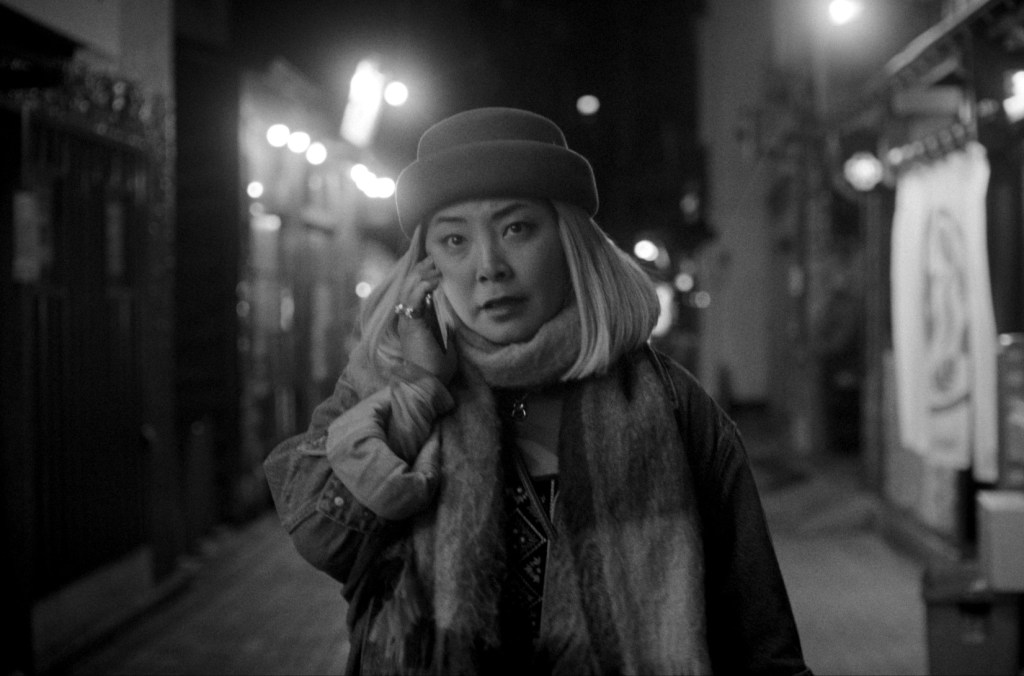
Mayumi Yoshida’s Akashi is a truly wonderful dramatic film. It is a Canadian production, albeit one shot in Japan and performed in Japanese. Yoshida, who moved to Vancouver as a young adult, clearly draws on some personal experience in putting together her first feature. In addition to writing and directing, she also plays the lead. It is a tremendous achievement: intelligent and thoughtful, charming and emotive, and strikingly composed.
Yoshida plays Kana, a Japanese fine artist. Ten years ago she emigrated to Canada. Now she returns home to Tokyo for the funeral of her grandmother (Kino Hana), discovering family secrets, reconnecting with the boyfriend who stayed behind in Japan, and re-assessing her life choices.
It is entirely coincidental that, of the last five films I have reviewed, three of them have been Japanese-language dramas about women finding their own place in the world. Yukiko a.k.a and Fujiko were both broadly effective works. Akashi outclasses them both in every respect. I think it benefits enormously from Yoshida’s perspective: half steeped in her own ethnicity, half viewing Japanese culture with one foot planted firmly in Canada. It is also significant, I think, that Yoshida is a woman writing and performing her own story. Yukiko and Fujiko, whatever their merits, were both directed by men.
The film is mostly presented in a crisp black-and-white. Most modern films that adopt this route unavoidably express some sort of arthouse pretension. Here it serves a specific narrative purpose. The family secret with which Kana must reckon is that her grandfather had an affair. More than that; for decades he sustained a heartfelt, honest romantic affection for a woman that was not his wife. The grandmother knew and accepted it. So did the lover’s own husband. It is a surprisingly gentle infidelity, based on understanding and acceptance but also retrained by societal pressures. These scenes, presented in flashback, are filmed in brilliant colour. They feel positively soaked in love and longing, in a manner reminiscent of Wong Kar-wai’s great In the Mood for Love (2000). The modern day scenes, which lack that vivid colour, feel dulled and melancholic by comparison. It is a hugely effective way with which to affect and guide the audience’s emotions. More than effective: it is masterful.
There is a wonderful family dynamic showcased in the present-day sequences, one that comes packed with familiar bickering siblings, runaway nostalgia, doting parents, and inside jokes. Thanks to both script and cast Kana’s family feel incredibly real.
The flashbacks regarding failed romance and missed chances are reflected in the present-day story thread in which Kana reconnects with Hiro (Tajima Ryo), an old boyfriend. When she left for Canada he promised to come with her – and then stood her up at the airport. That somewhat damaged relationship, combining ongoing affection and hurt, is played as sensitively and intimately as the rest of the film.
This is a wonderful slice of cinema that is hugely worth tracking down. It is currently screening across Canada, starting in Vancouver, and with any luck will expand globally over the coming months. God knows it deserves it.




Leave a Reply