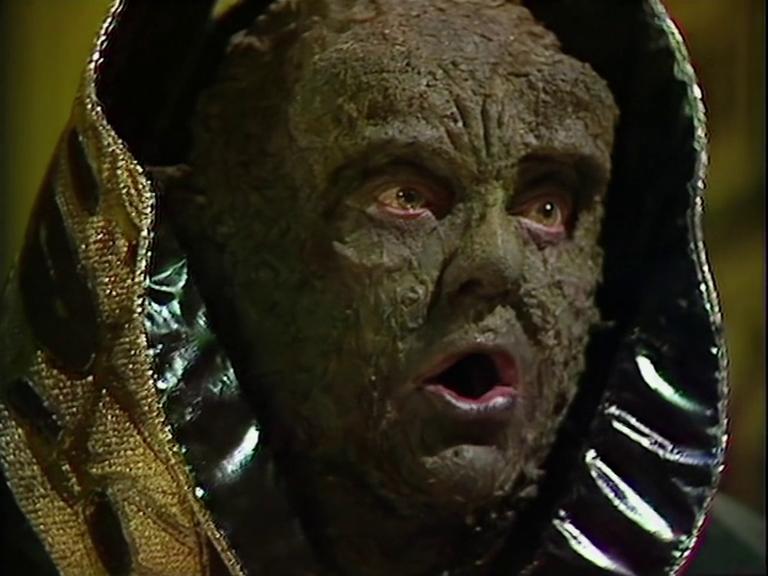
First broadcast 26 January 1982.
I was a very young child when I started watching Doctor Who. My earliest memory of the series was the Doctor’s companion Romana being interrogated by Daleks in “Destiny of the Daleks”. It was the following season, Tom Baker’s last in the title role, that I remember actively watching from the first episode. With Season 19, and Peter Davison’s first year as the Doctor, I was a fully committed enthusiast and recording each episode onto VHS to rewatch them over and over again.
The reason that I bring this up is because if I try to think back on the scenes that really stuck in my memory in childhood, one of them is from this episode: the fourth and final instalment of “Four to Doomsday”. The Doctor is trapped in open space between Monarch’s spaceship and the Doctor’s TARDIS, and uses a thrown cricket ball to give himself the momentum to reach his own ship. It is a smart use of popular science at a level children will understand, it ties into the new Doctor’s visible love of cricket, and it felt a particularly dramatic scene at the time. Given the remarkably limited production budgets of the time, it is impressive that director John Black pulled it off as well as he did.
There is not the largest amount of plot left in this final episode. The Doctor isolates a sample of Monarch’s killer virus, ostensibly to find a counter-acting agent, but instead uses it against Monarch himself. The android survivors commandeer the spaceship and go looking for a new home planet. Nyssa collapse unconscious in the TARDIS; a side-effect of the whole uncertainty of keeping or dropping the character left her with a contract two episodes short – apart from brief appearance in parts 1 and 4 of the next serial she’s absent and resting for the duration.
When viewed together, the four parts of “Four to Doomsday” seem remarkably old-fashioned. One wonders if writer Terence Dudley had seen the series at all in recent years, as there is a lot that could easily be rewritten to fit into Doctor Who‘s earliest years. The production team of Season 19 were starved of completed scripts at the beginning of recording, so it is easily imaginable that they went with what was finished without editing it too aggressively.
It is a strange story, in that keeps a relatively slow pace and changes the villain’s motives at the last half-hour for no particularly sound reason. The pace actually worked well to build atmosphere in part 1. In part 4 it does leave the characters with rather too little to do.



Leave a Reply