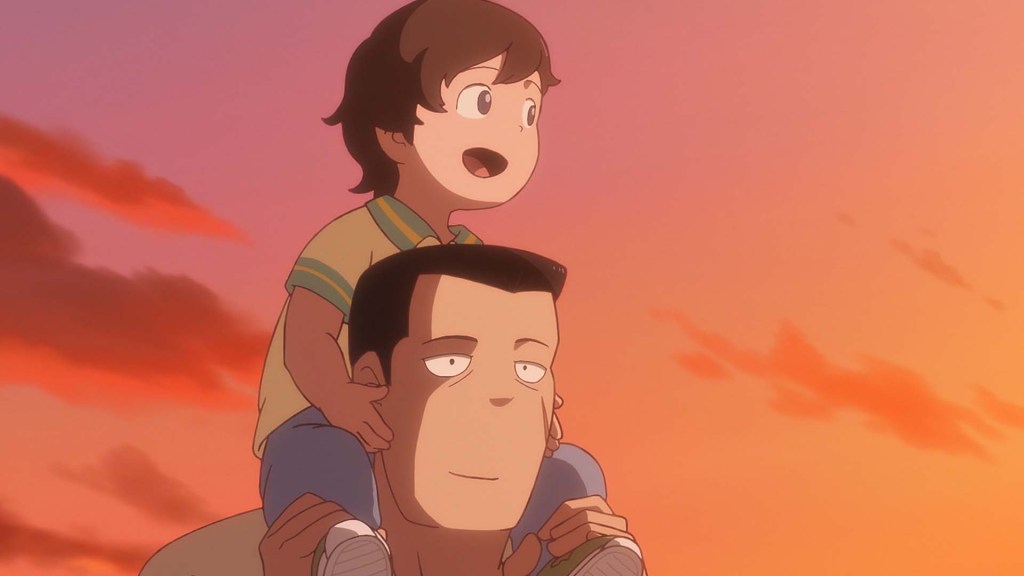
Let me tell you about an anime feature whose protagonist commits a homicide and spends the rest of his life in a maximum security prison, all because he finds it easier than admitting he loves someone.
Elderly yakuza Akutsu (Kobayashi Kaoru) lies in a prison cell, slowly dying of old age. His only companion is a talking balsam flower, which mocks and goads him as he tells it his life story. In flashbacks set in a 1987 seaside town, Akutsu shares his home with a woman named Nana (Mitsushima Hikari) and her newborn son Kensuke. At the same time he becomes a pawn inside an organised crime conflict that forces him into greater criminal risk.
Director Kinoshita Baku and writer Konomoto Kazuya reunite following their popular series Oddtaxi with this distinctive and unusual anime film. It is distinctly different from their series, which was populated with a range of anthropomorphic animals, and adopts a rather old-fashioned aesthetic that is lower on realism and detail than a typical anime feature but has a style that grows on the viewer as it goes. The simplicity of its visual are a contrast with the more grounded, direct style of character and storytelling. In a very realistic and somewhat melancholic narrative, they allow themselves a single creative flourish: the animated, talking flower with which Akutsu shares his life story.
The Last Blossom adopts a rigid and familiar structure, raising questions and open story elements in its earlier scenes before pulling them together into closed answers during the climax. In many ways it is an elegant and satisfying structure, but it also runs a constant risk of feeling mechanical. The spontaneous moments that might enliven another film feel relatively thin on the ground. One can applaud its intimate scale and relatively low stakes – something animated films often eschew in favour of lavish eye candy – but at the same time The Last Blossom feels a little too restrained.
The central romance between Akutsu and Nana is where that restraint is felt the most. Akutsu goes through a gradual and clear transition over the course of the film, from caring for Nana and Kensuke out of a sense of duty to caring for them out of genuine affection, but it is all gruffly expressed and excessively stoic. Without small moments of energy to spark between its leads, the film is left unnecessarily morose and limited. The same goes for Akutsu’s yakuza lifestyle and community, which feels too directly expressed and lacks any inventive wrinkles or distinctive detail. When Kensuke falls ill, and Akutsu is suddenly in need of a huge sum of money to save his life, the solution feels perfunctory precisely when it should feel urgent and involving.
The talking balsam flower, which is precisely the sort of creative wrinkle that the film demands, unfortunately comes across as a little too acerbic and cynical. One wants to like it, but too often one wants to uproot it and tear it to pieces as well.
There is an admirable contemplative quality to The Last Blossom, and it does tell a broadly satisfying story, but it also feels like a production that stops at eighty per cent and does not quite find its way through the final twenty. It is good, but it is only good.



Leave a Reply