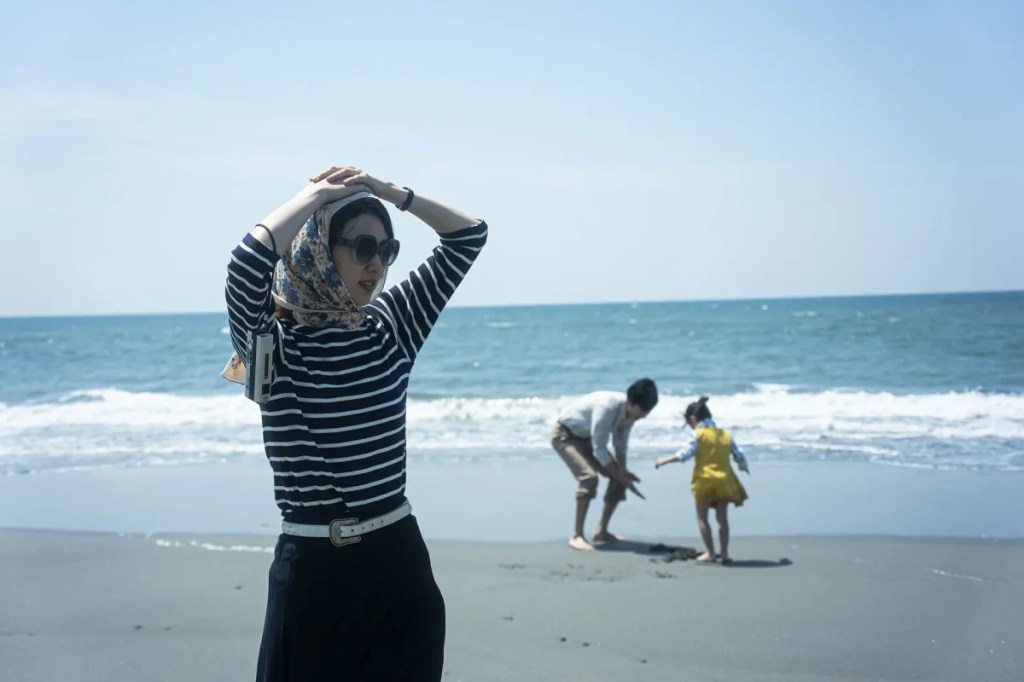
Fujiko (Katayama Yuki) is married into a family of criminals and swindlers, and forced to give birth to her daughter Mari during a hospital blackout. When her new in-laws conspire to take Mari away from her, she breaks out on her own – taking her child and raising them as a single mother.
Kimura Taichi’s black comedy Fujiko tracks the rise of women’s liberation in 1970s and 1980s Japan, and he tracks it through the personal experience and misadventure of a single woman. Some of the things that happen to poor Fujiko are genuinely shocking for a 21st-century viewer, but they are also deeply absurd. One might laugh, and then feel bad that they did.
The film picks up in 1982, with a slightly urgent Fujiko trying to sell insurance to a bored hospital cook (a welcome Lily Franky from Shoplifters). She tells him her life story, whether he wants to listen or not, and the bulk of the film’s narrative plays out in flashback. After a slightly upsetting first act, in which Fujiko is married out to, and then exploited by, a low-level criminal family, the rest of the film relates her ongoing battle to make a single living while resisting societal pressures to give up, quit work, and marry at the earliest opportunity.
The film is a largely episodic affair, breaking the narrative down into discrete mini-stories of Fujiko’s experiences. While some individual sections are very funny and entertaining, the film struggles as a whole without a tighter structure to pull everything together. The end result is rather uneven, and the satisfaction of each individual chapter fails to accumulate onto the next.
It is well staged and shot, capturing both its historical period and geographical setting: Shizuoka, located between Tokyo and Nagoya. There is also an excellent use of music throughout the film, combining rock and jazz tones with the participation of composer Thomas Yardley and musicians Tsuneta Daiki (King Gnu) and Daoud Popal (Kikagaku Moyo). Its impact hits a peak during the film’s somewhat unusual climax; it is a shame that for all of its general effectiveness, the film never quite manages to articulate the importance of music to the story – or to Fujiko.
Katayama Yuki has the weight of the film on her shoulders, playing the title character with deep sympathy and charm. It is important we like Fujiko and barrack for her, otherwise there would be little chance to engage with her struggles at all. Takeshita Keiko is an easily recognisable archetype as Fujiko’s hard-nosed mother Chiyo, who chides and supports her in turn and aggressively carves out her own sphere of authority in a very sexist, male-dominated culture. Comedian and actor Ogata Issey is a highlight among the supporting cast, playing another popular archetype: the gruff restauranteur with a heart of gold. He is warm and funny, overcoming any limitations in the screenplay to deliver something deeply enjoyable.
Generally decent qualities make this a broadly enjoyable work, but its drawbacks and minor failures inevitably niggle. It ultimately falls a little short of guaranteeing an audience – particularly outside of Japan among the foreign festival audiences.



Leave a Reply