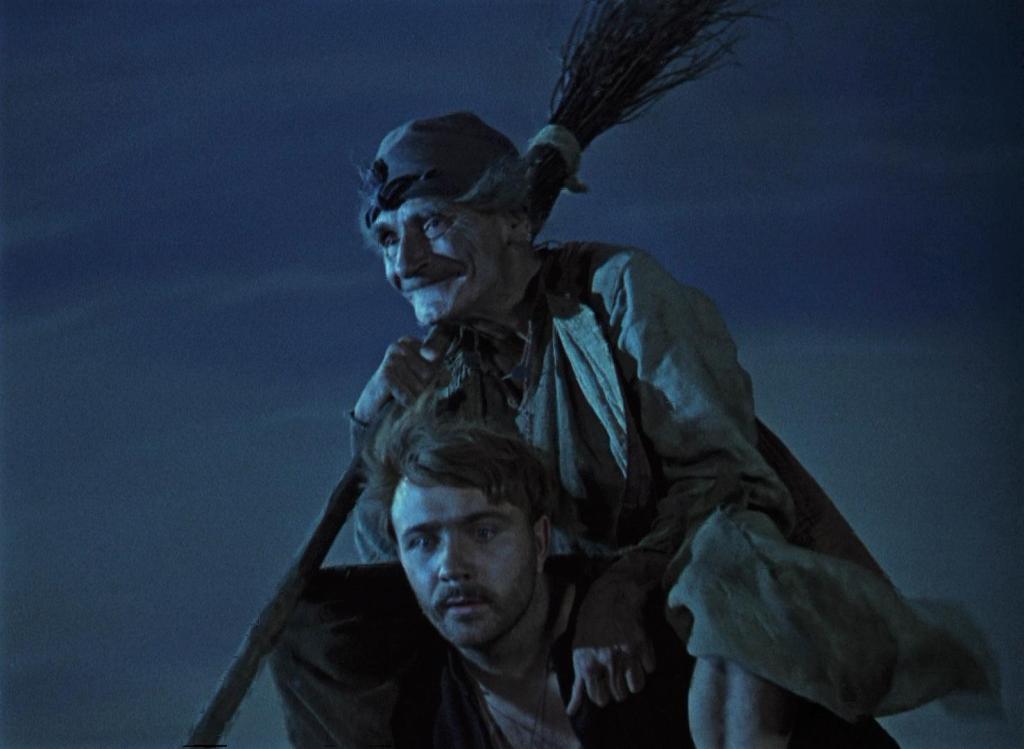
A fearful priest-in-training is forced into a three-night encounter with a terrible witch in Viy, a now-renowned Soviet horror film from 1967. While its more ridiculous moments may seem comical to us now, it is nonetheless a genre masterpiece. It combines then-innovative visual effects, eye-popping fantasy design, and energetic, immensely watchable direction.
Three students of a Kyiv seminary get lost on their way home for vacation. Seeking shelter in an old woman’s house, one of the three – Khoma Brutus (Leonid Kuravlyov) discovers that the woman is secretly a witch and barely escapes with his life intact. Returning to the seminary, he is immediately instructed to travel to a military officer’s estate to give her last rites to his daughter. When Khoma arrives the girl has already died and, while praying for her soul over three nights, he learns she is the same witch he thought he had avoided before.
These days Viy is best known for its extensive physical effects, developed and staged by the legendary Aleksandr Ptushko. He does a tremendous job throughout. Elements that have dated over time still boast a strong sense of quality and integrity. Others still stand up today. As the film progresses they gradually reveal more and more ambition, all the way up to an unexpectedly exaggerated climax. What makes the work particularly impressive is its consistency: Ptushko develops a vivid fictional environment for Khoma’s ordeal, so that no matter how old the film becomes it still presents itself with a uniform aesthetic and tone.
The film as a whole is directed by Konstantin Yershov and Georgi Kropachyov. They build an effective cast of characters, each of whom gives a spirited, heightened performance that accentuates the story’s folkloric nature. The film is based on Nikolai Gogol’s 1835 novella, which despite his claims to its historical origins was almost certainly entirely invented by him. The book is well adapted to the screen. It feels like something old and mythic. The witch and her various companions aggressively feel like something out of the Middle Ages or earlier.
Leonid Kuravlyov puts visible effort into making Khoma a believable and relatable character. It is not just an experience he goes through, but an ordeal. He struggles through the first night through bravery, and the second through drink, and it is the third that forms the climax of the film. He dominates the film, both through the script’s focus and also through his commendable, driven performance. It is great stuff.
Natalya Varley makes a striking impact as the apparently-dead daughter who is actually a powerful witch. Even more impactful is the witch’s true form as a somewhat grotesque crone, played by male actor Nikolai Kutuzov from under excellent prosthetic make-up. The character is unsettling in the hands of both actors, and even after decades remains rather frightening to watch.
At 76 minutes it is a tight, aggressive-paced work that has been stripped of all narrative fat and driven by a strong momentum. It is clearly classified as a Soviet classic for a reason: this is effective, tense, hugely imaginative horror from one of history’s great film industries.



Leave a Reply