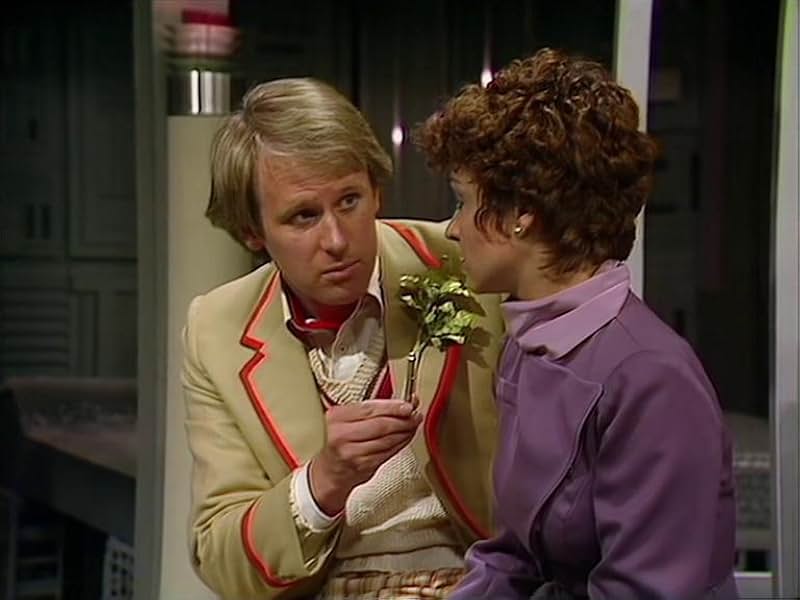
First broadcast 19 February 1982.
As Monarch’s ship makes its way towards the Earth, the Doctor (Peter Davison) discovers that this is not its first voyage to the planet – and that three billion Urbankans lies preserved on slides onboard. The kidnapped humans from Monarch’s previous sojourns reveal a shocking secret.
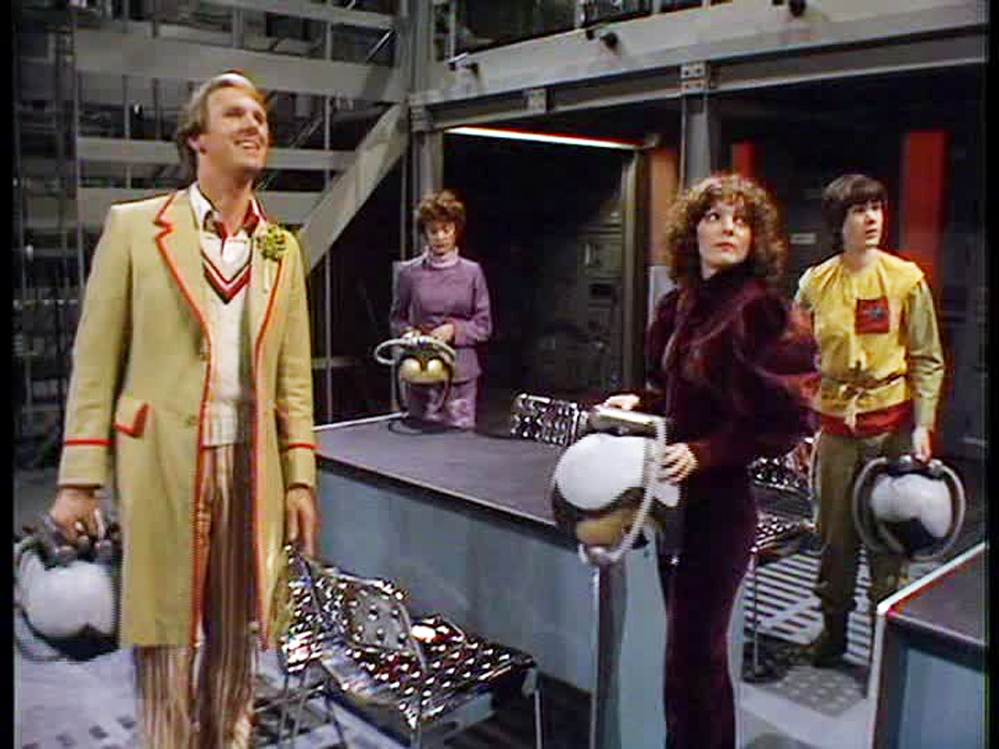
There are some grand science fiction ideas underpinning “Four to Doomsday”, although they are remarkably flimsy and tend to fall apart with just a tiny amount of thought. That said, writer Terence Dudley manages to instill a remarkable sense of scale within a very limited context: just a handful of guest stars and a limited number of sets, and yet the conversations relate to tens of thousands of years and billions of alien invaders. There is an oft-told joke about BBC budgets – I have no idea where it originated – where a hypothetical TV adaptation of the Zulu uprisings would consist of two men peering out of a tent saying ‘goodness, there are thousands of them out there’. “Four to Doomsday” really is that joke put into practice.
It is odd that Dudley went for such an outlandish premise for his first Doctor Who scripts, because as a producer his science fiction work included both Doomwatch and Survivors. As a creative on grounded, character-based speculative fiction for television, he was actually genuinely great. “Four to Doomsday” does not reflect his strengths, and that is a deep shame. Of course he was unable to write a serial set on present-day Earth, because that would enable Tegan to return home and exit the show.
It is worth taking a moment to consider Tegan (Janet Fielding), one of Doctor Who‘s longest-running companions and yet never one that gets mentioned in the same breath as other long-running characters like Sarah-Jane, Jamie, or Ace. Perhaps a reason for that is the original set-up of Tegan in the series. She enters the TARDIS by mistake on her way to work. She is an unwilling participant in the events of “Logopolis”. Within a day of meeting the Doctor he has regenerated into a different person entirely. She effectively spends the events of “Castrovalva” in crisis mode. Here in “Four to Doomsday”, the Doctor has promised to take her to Heathrow Airport to get on with her life and landed her on an alien spacecraft instead. She is understandably upset.
It all makes sense in the context of her character, and Janet Fielding plays her very well. She benefits from decent direction by John Black, who also directed Season 18’s wonderful “The Keeper of Traken”. The problem is that a character who does not want to be there is not a particularly entertaining one for the audience. For the Doctor, Nyssa, and Adric, “Four to Doomsday” is an adventure; for Tegan it is a distressing obstruction – and her distress runs throughout the entire year. She was clearly developed as an echo of Doctor Who‘s original companions Ian Chesterton and Barbara Wright, who entered the TARDIS by mistake all the way back in the 1963. Ian and Barbara were at least allowed to have a sense of wonder about their travels – Tegan is never really granted that for herself.
Her experiences in Season 19 also set the tone for her entire tenure through Seasons 20 and 21. Even when she voluntarily rejoins the Doctor in 1983’s “Arc of Infinity” the over-arching sense of discomfort and trauma run as an undercurrent through her remaining episodes. When she leaves for good at the end of “Resurrection of the Daleks”, it is because the horrors of her time and space journey have grown too much for her. It does not exactly make for enjoyable viewing.


Leave a Reply