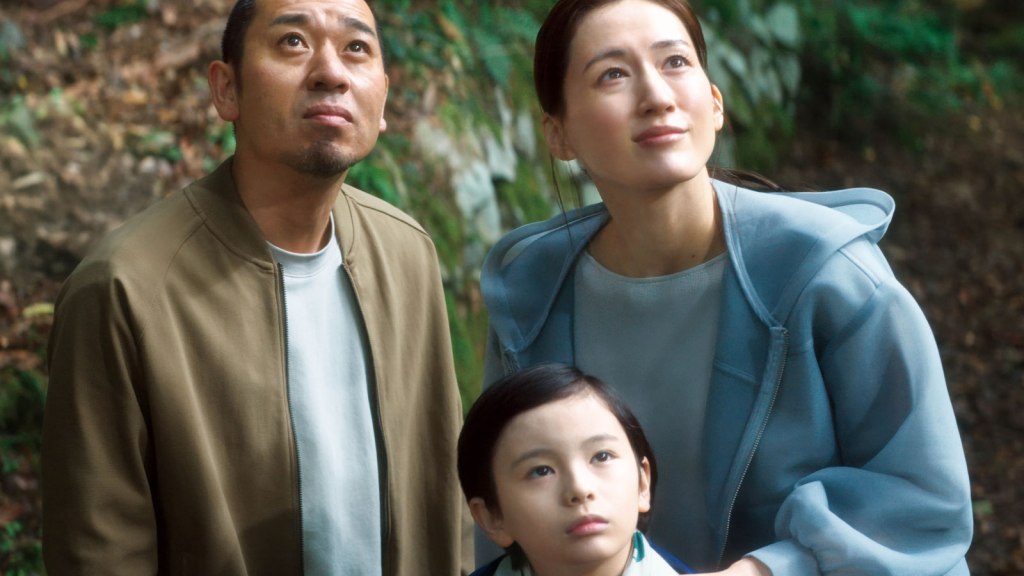
There is a select group of filmmakers that become so widely acclaimed by critics and audiences that, when they direct a movie that might not reach the high standards of their typical work, it can almost feel like a betrayal. Here we are with Japan’s Kore-eda Hirokazu, whose insightful dramas focused on families both born and found have been among the most popular with critics and festival audiences, and whose latest effort Sheep in the Box simply fails to impress in the same way.
For those of us catching the film at this year’s Melbourne International Film Festival there has been a bit of warning, since his film was not exactly showered with praise when it premiered back in Cannes. All the same, there was perhaps a small hope that the French critics had been unfair on the film. It is, after all, his first genre work in a long time, and a near future science fiction film was perhaps never going to be assessed as enthusiastically as a straight drama. Here we are, however, and for a director whose work usually hits an array of year’s best lists Sheep in the Box is a tremendous disappointment.
Otone (Ayase Haruka) and Kensuke (Yamamoto Daigo) are a couple grieving the death of their seven-year-old son Kakeru (Kuwaki Rimu). When they are offered the opportunity to trial living with a robot replica of their son, Otone is keen to take up the opportunity while Kensuke is far more reluctant.
Sheep in the Box steps into well-furrowed ground with its tale of a robot child coming to express and explore its own humanity. English language viewers will be reminded immediately of Steven Spielberg’s A.I. Artificial Intelligence (2001), and indeed Kore-eda’s film seems to copy much of that film’s strong sentimentality. In Japan, of course, the idea goes back much further to Tezuka Osamu’s popular manga and anime Tetsuwan Atomu (aka Astroboy). Despite decent performances from the film’s three leads, a lacklustre screenplay does not find any original or innovative angle on the material. The result feels underwhelming and derivative.
A larger problem is that, even within what feels like an overly derivative area – even Kore-eda himself covered similar emotional territory in his bleak fantasy Air Doll (2009) – there is a crippling indecision over where to take the story. At times the film seems to want to use the robot Kakeru as an avenue to explore human grief, at other times to examine the degree to which we are all a sum of our memories, and at yet others to tell a story of emerging artificial intelligence and the birth of a digital species. As the film progresses it even reveals a particularly dark aspect to the original Kakeru’s death, and it seems the narrative is headed in the direction of a murder mystery. Ultimately it dabbles in all potential storylines, but fully commits to none of them. The film ends on an overly saccharine note that is soaked in wasted opportunities.
Kore-eda remains a brilliant writer and director, but in this case the elements fail to bond together and the entire enterprise – quite regrettably – falls apart.
Sheep in the Box is screening at the 2026 Melbourne International Film Festival. Click here for more information.



Leave a Reply