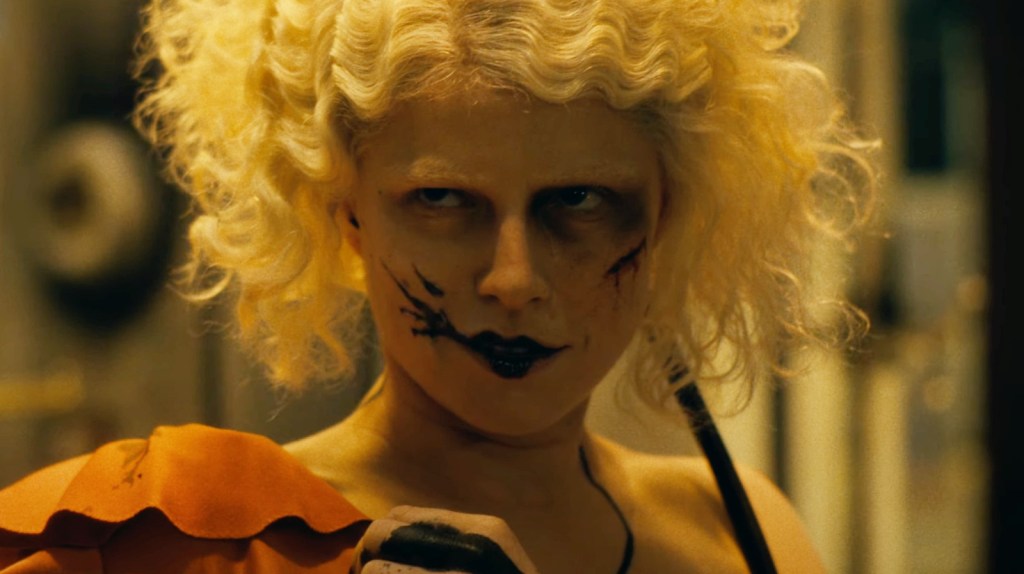
Maggie Gyllenhaal’s sophomore feature The Bride! was a commercial failure upon its release earlier this year. Critically it seemed divisive, with some reviews praising its considerable sum of ideas and others disliking its inconsistent tone and rough-hewn edges.
I suppose the advantage of seeing a film after its initial release is that one can take the film in with the benefit of other people’s reactions alongside it. It is clear that in this case almost everybody is right about Gyllenhaal’s film. It is an expressive burst of creativity, drawing on multiple influences and brimming with invention. At the same time it struggles to maintain a cohesive shape, has narrative problems throughout, and suffers from some oddly weak performances. It is the old “curates egg” picture: the good bits are good, the bad bits bad, and for the viewer to find out how they respond to it they are simply going to have to watch it like everybody else. I am not sure how much the critics are going to help with this one.
Ida (Jessie Buckley) is a woman living in 1936 Chicago who is spontaneously possessed by the ghost of Mary Shelley, promptly embarrasses local crime boss Lupino, and is pushed to her death down a flight of stairs. Across town, Frankenstein’s monster (Christian Bale) visits the mad scientist Dr Cornelia Ephronius (Annette Bening) and asks her to revive a corpse so that he can finally have a companion.
When an amnesiac Ida is brought back to life, “Frank” claims her as his bride and the two are propelled by a prejudicial world to engage in a state-to-state crime spree, pursued by police detective Jakes Wiles (Peter Sarsgaard) and his assistant Myrna Malloy (Penélope Cruz).
Gyllenhaal showcases a lot of ideas across The Bride!, and remixes a large number of clear influences in developing a genre pastiche. It is, to me at least, undeniably bold filmmaking, and New Line Pictures should be commended for taking a risk on such a creative high-wire act. Of course the problem with risks is that they can fail just as easily as they succeed, and the finished film is one hell of an unruly mess. The odd decision to include a running thread of Mary Shelley’s ghost (also played by Buckley) influencing and commenting on Ida’s actions complicates the story in unhelpful ways. It also does not reflect the real-life Shelley with any great accuracy, and indeed directly contradicts her more than once. Similarly Gyllenhaal’s treatment of Frankenstein’s monster owes a lot more to James Whale and subsequent Hollywood representations than anything that Shelley ever wrote.
When the film indulges in stereotypes, like Skarsgaard and Cruz’s detectives, it quickly becomes over-familiar and tiresome. Scenes involving Frank’s growing obsession with cinema and movie star Ronnie Reed (Jake Gyllenhaal) are much more effectively played. A story thread in which Ida’s actions inspire a cult movement of criminal women has huge potential, but the film ends with those elements unresolved and under-played.
It is interesting that a film dominated by issues of men subjugating women still focuses so heavily on Ida’s existence as a bride to Frankenstein, seemingly unable even in rebellion to escape male control. Jessie Buckley’s lead performance is bold but oddly mannered and artificial. The Bride is interestingly designed, with a shock of bleached hair inspired by Elsa Lanchester’s classic Bride of Frankenstein look and a black smear across her face. Unlike Frankenstein’s monster she is not visually scarred, and seems purposefully sculpted even after death for a male gaze. It’s another influence piled on top of influences, of course, and in this case reimagines Ida as a punk rock figure. It immediately brought to mind Germaine Greer’s controversial analysis of Hole lead singer Courtney Love’s smeared lipstick as a sort of “rape chic”. It signifies the sexualised violence that killed Ida in the first place, which seems quite powerful, but still leaves her carefully sculpted for that same patriarchal gaze. It instinctively feels messy and problematic.
That, to me, is The Bride! in a nutshell: it is a mess of good ideas, mixed in with some bad ones, and it bursts with energy in fits and starts. Some have seen the film and found an underrated masterpiece. I do not necessarily think they’re wrong. Others have seen a colossal misfire. I do not necessarily they that they’re wrong either.


Leave a Reply