Pity the Walt Disney Animation Studio, where original ideas just cannot seem to cut a break. Of all the great animation houses of the world, theirs has always been the most commercially successful and globally impactful – and that would be true if you included their Mickey Mouse and Silly Symphonies shorts alone. In the last decade, however, their features have been largely dominated by sequels: Ralph Breaks the Internet ($530m in revenue), Frozen 2 ($1.4b), Moana 2 ($1.1b), and Zootopia 2 (a jaw-dropping $1.9b). Original films, which is where Disney builds the valuable intellectual property that powers their theme parks and merchandise (a.k.a. the parts of the business where they make most of their money), have done much less well with audiences.
Raya and the Last Dragon and Encanto (both released in 2021) were victims of the COVID-19 pandemic. Don Hall’s Strange World (2022) was both a critical failure and a box office disaster. Wish (2023), commissioned to celebrate Disney’s centenary, lost the company money. This week sees the release of Disney’s latest animated feature: Hexed, directed by Jason Hand and Fawn Veerasunthorn. All signs in the market are that Disney have another loss-making disaster on their hands.
That’s rather unfair, since despite flaws in story and structure there’s quite a bit in Hexed to recommend. Certainly on the face of things it most closely resembles Encanto in terms of recent films, in that both are somewhat idiosyncratic variations on Disney’s general formula that have a small dedicated audience scrawled all over them. Ten years from now there will be a persistent cult of Hexed-lovers that will incessantly express affection for it the way that I harp on about Disney’s Hunchback of Notre Dame (1996, which makes it 30 this year; you should rediscover it). As for the general audience, it is all-but-certain they will largely pass this one by. A long future on streaming service Disney+ likely awaits.
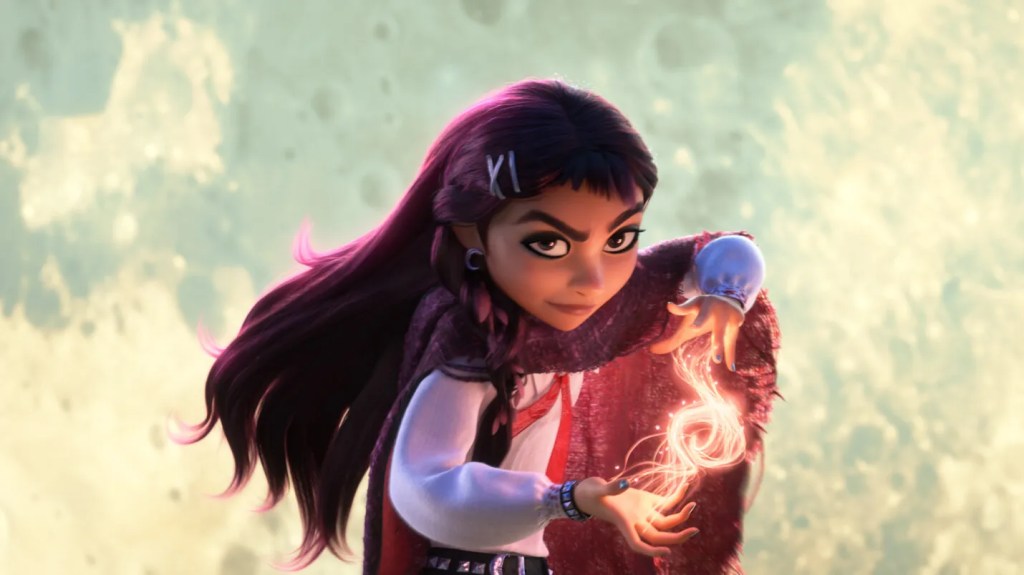
Hexed, if you’re interested: Ohio high-schooler Billie Doe (Hailee Steinfeld) is transported to a magical realm named Hexe, populated by all manner of witches, wizards, and animal familiars. There she discovers that she has magical powers of her own, that her mother Alice (Rashida Jones) has lied to her about it all of her life, and that Hexe is ruled by her despotic grandmother Celeste (Jodie Foster).
It is a great set-up with a strong focus on female characters, and performed by a great trio of actors. It is sweet to hear Foster’s contribution in particular, since Hexed represents a return to the studio where she first made a career in the likes of Napoleon & Samantha (1972), Freaky Friday (1976), and Candleshoe (1977). Steinfeld is particularly adept at the voice acting game, giving Billie a tremendous amount of energy and humour.
The world of Hexe is packed with charming detail and likeable new characters, headlined by the three-eyes, multi-armed cat familiar Beef R. Crummchuk. He is improbably but delightfully voiced by Walton Goggins of The Shield and Justified fame, and is my personal highlight of the entire film. Other characters are delightful, including an animated dog-like cauldron, an agoraphobic owl (Henry Winkler) and a talking book and quill pen (Stephen Fry and Tracy Ullman).
The premise, cast, and characters are all great. The technical execution story structure, and some design elements, meanwhile, suffer and struggle. Let us take them in turn.
The beat-for-beat sequence of events that make up Hexed feel over-familiar, including plot twists and surprises that can be easily recognised by anyone familiar with the last 20 years of Disney features. It is not that Disney is running to a formula per se, but the company does rely on a finite number of tropes and patterns and has an increasing need to refresh its tool-box. The story of Hexed is not bad at all, but it is predictable, and the audience has seen it done before and done better.
Much of the design work in the film is actually rather inspired, but its human characters are not: all uniformly sculpted out of thin frames, and largely very white. Billie in particular suffers from looking particularly generic, and is plagued by the dreaded Katie Holmes-style smirk that dogged Dreamworks characters in the early 2000s. This one seems a particular shame, because it’s Billie who is front and centre on the posters and the trailers. She fails to sell the movie.
Technically the animation regularly feels too cramped and busy. Things on screen regularly become rather crowded and frantic, making the action sequences difficult to easily follow. It is this visual treatment that contributes the most to Hexed feeling like a decent film rather than a genuinely great one. It also makes it harder for the film to develop properly iconic shots and moments: without enough clear, vivid moments to pick from, it makes the entire production harder to sell. One can compare Hexed to Clements and Musker’s outstanding Moana (2016) to understand the difference: both featured likeable characters and original settings, but where Moana regularly felt vivid, mythic, and iconic, Hexed just feels like many other different cartoons. You may like it – I certainly did – but I do not anticipate too many people loving it.
Next year the WDAS is back in sequel mode with their licensed-to-print-money Frozen 3. Their next chance to find a winning formula for an original property is in 2028, when the company releases Fawn Veerasunthorn’s Clay. I really hope she can learns some lessons from Hexed to make her next film even better. Sadly, even if she does, it is down to Disney itself to make original stories popular with audiences again. For almost 20 years the studio has been aggressively training its audience on sequels, remakes, and pre-proven IP. Back in the 1990s, during the heyday of the “Disney renaissance”, it was the studio itself that was the draw card. Audiences would flock to see The Little Mermaid, Beauty and the Beast, Aladdin, and The Lion King not because they knew the characters and stories but because they did not. The discovery of new ideas was the core appeal of the Disney brand, and if the studio simply eases off from eating its own tail of properties it can find that appeal again.


Leave a Reply