Traditional animation hit a pretty sensational high in the early 1990s. Walt Disney were coasting from one hit to another, with the likes of Beauty and the Beast, Aladdin and The Lion King breaking one box office record or another. America’s other leadng studios were scrambling to get in on the act themselves. Universal and Amblin Entertainment had already found success with An American Tail (1986) and The Land Before Time (1988), and continued releasing animated features including An American Tail II (1991), We’re Back! (1993) and Balto (1995). MGM tested the waters with 1992’s Tom and Jerry: The Movie. Warner Bros released a critically acclaimed Batman animated feature in 1993, titled Mask of the Phantasm.
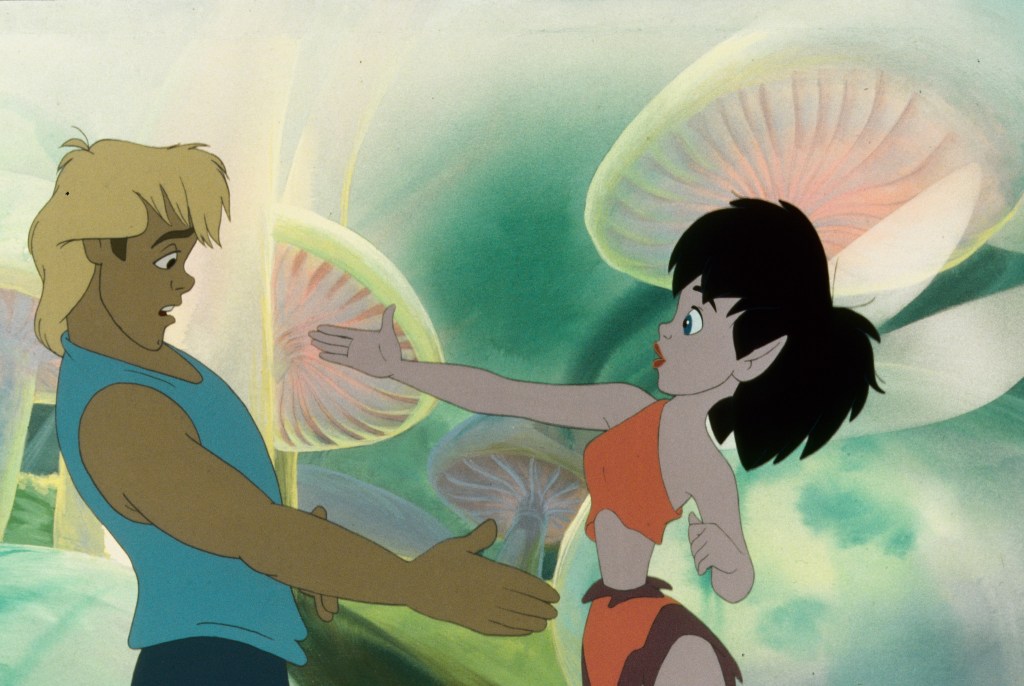
One of the non-Disney animated features of this time that seems to get mentioned a lot is FernGully: The Last Rainforest. A modest hit for 20th Century Fox in 1992, it found itself a long and lucrative life on home video. A lot of people born in the early 1980s seem to remember it with great affection, at least in my home country of Australia.
FernGully was originally going to be released in November 1991, but somebody at Fox wisely noticed Disney’s upcoming juggernaut Beauty and the Beast and pushed their own film back to April 1992. The film was a bit of a gamble on Fox’s part – animated films had not been too successful for them in the past, and expensive flops like 1977’s Raggedy Ann and Andy and 1983’s Fire and Ice must have made them positively terrified of how much money they were about to lose.
Thankfully for Fox, FernGully was a modest success. It grossed about US$30 million during its worldwide theatrical run, and sold very well on home video. The floodgates now open, Fox was quick to follow up with a string of animated features: 1993’s Once Upon a Forest and 1994’s The Pagemaster (neither of which were commercially successful) and 1997’s smash hit Anastasia. On the back of Anastasia’s success, Fox contracted that film’s directors (Don Bluth and Gary Goldman) to produce the costly sci-fi animation Titan AE – the failure of which pretty much burst the bubble of traditional animation at Fox for good. Ironically, given they were made to challenge Disney’s supremacy in the animation game, all of these films are now owned by Disney.
A young logger working an Australian rainforest is shrunk to miniscule size, and encounters an entire civilization of forest-based fairies. With their assistance, he fights against the loggers that once employed him and the pollution-based entity Hexxus.
It is a fairly straightforward but relatively pleasant movie. In many ways it is a critic’s nightmare. You can rave at length about the films you love. You can write endlessly pithy put-downs about the films you hate. The ones in the middle, that simply do what they are supposed to and finish without outlasting their welcome, are absolute monsters to write about.
I suspect that FernGully is one of those films you need to have seen at the right age and at the right time to be able to make any real impact at all. If you were too old in 1992 it would have seemed twee. If you try to watch it today it seems hopefully old-fashioned and visually outdated. Given the rapid increase in CGI within traditionally animated films, FernGully must have been one of the last completely “old-school” animations that Hollywood made. Perhaps it is worth watching for that.
You would never really guess it from watching, but FernGully is actually an Australian co-production. FAI Films, which made this one release before being bought out by Fox, was an Australian firm. The director, Bill Kroyer, is American. The voice cast, including Samantha Mathis and Christian Slater, mostly speak with American accents. Those who don’t sound American sound British, including Tim Curry as Hexxus. There are a few visual concessions to the film’s north-east Australian setting, but to be honest that all flies out of the window in the face of its decidedly European-looking fairy folk. There was a far more interesting film to be made here, but admittedly it would probably have been a much harder sell for an American audience.
One notable aspect of the film is its showy use of celebrity voices. A lot of attention was paid by the entertainment media to Robin William’s presence in the film as a comedy sidekick bat. This seemed quite a novelty at the time, although Williams would shortly repeat the trick – with a better character and performance – in Disney’s Aladdin. Today the use of famous actors in animated features is par for the course. It’s more important to have a famous name for the poster than it is to have a talented voice artist. Sometimes the two requirements delightfully coincide, as with the use of Jim Carrey and Steve Carell in Horton Hears a Who. Other times, such as with the use of Cameron Diaz in the Shrek franchise, the famous actor adds nothing that dozens of less expensive performers couldn’t have provided.
The history of cinema is rarely one of epoch-changing revolutions. In my experience it tends to be incremental, with successive productions each making small advances and innovations. Watching back through the evolution of genre and form is like slowly assembling a jigsaw puzzle piece by piece. FernGully is a reasonably adequate work, but more interesting than the film itself is how it slots into the larger picture.


Leave a Reply