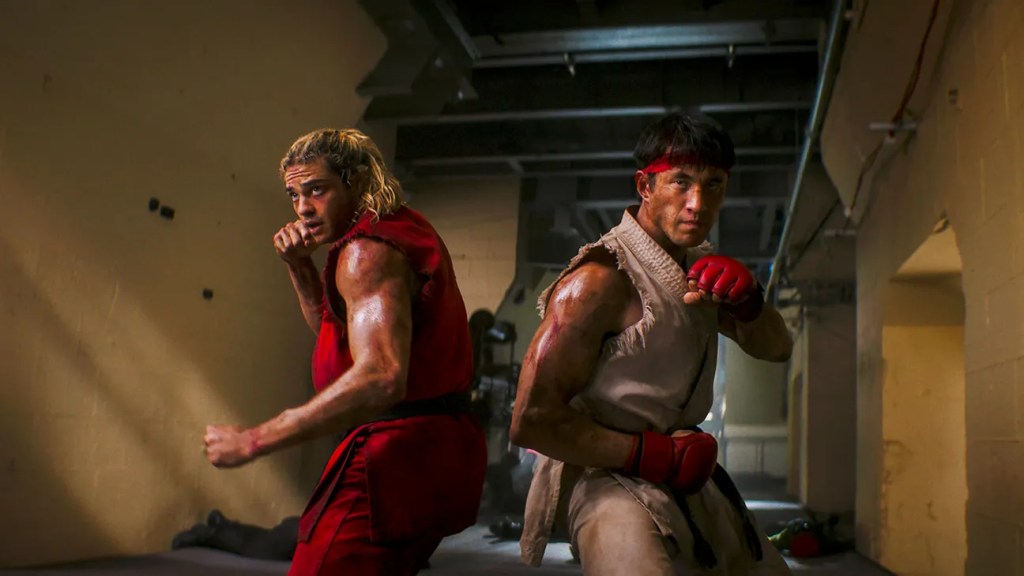
If I had a dollar for every time in 2026 a Hollywood studio used 4 Non Blondes’ 1993 song “What’s Up” for comedic effect in an action movie – okay, so I would only have two dollars, but it is genuinely weird that both Masters of the Universe and Street Fighter try the same joke, and it is fairly depressing that the joke’s not funny in either film.
That isn’t the only similarity either: both films take a nostalgia-fuelled pop culture artefact, already adapted to live-action cinema before (twice in Street Fighter‘s case), and present them in a wobbly, uncertain fashion where it’s unclear what the intended tone and audience are supposed to be. Some viewers seemed to really enjoy Masters of the Universe – more power to them – and I suppose it is inevitable that some will enjoy Street Fighter. They are welcome to it, as they are welcome to wallow in the oily filth of bottom-drawer cinema.
Of course with Street Fighter we have been here before, more recently with Andrzej Bartkowiak’s forgettable The Legend of Chun-Li (2006) but originally with Steven E. De Souza’s legendarily awful 1994 effort. That film is surprisingly watchable for the late Raul Julia’s demented final performance, taking risible dialogue and transforming them into the most quotable of bon mots. ‘For you,’ Julia purred, ‘the day Bison graced your village was the most important day of your life. But for me, it was Tuesday.’
This new Street Fighter, directed by Kitao Sakurai and shot in my sunny home town of Melbourne Australia, actually makes a reference to that line but fouls it up. You cannot make fun of something that was already funny.
The cast of Street Fighter 2026 certainly act like they are in a comedy. It is a pity that T.J. Fixman and Sakurai’s screenplay doesn’t actually contain any jokes. I feel for the actors: it cannot be easy featuring in a film that demands they be kooky and self-deprecating in one scene, and gushingly earnest in the next. Key flashbacks that provide most of their motivation are rendered as an anime-style cartoon. The film is ostensibly set around a world fighting championship, but weirdly avoids showcasing most of the fights.
What action there is is perplexingly captured in medium shots and close-ups, so wherever there is some decent fight choreography the audience isn’t going to see it. That really seems the nail in the coffin: if a viewer cannot rely on a film titled Street Fighter to reliably deliver some street fights, its collective artists and technicians really need to give up and go home. One scene briefly replicates the look of a side-scrolling fighting game, which would be a neat touch had it not been done repeatedly already by all manner of films and streaming television series.
Everywhere else the film is a panicky riot of colour and fast editing, put together as if it knows its only chance is to distract its audience with cheap theatrics. The film’s soundtrack is packed to the margins with old school pop and rock tunes – the film is set in 1993, the year Super Street Fighter II was released in the arcades. It also incorporates some of the original videogame compositions, which may please original game fans. No part of the soundtrack sticks around for long. It is simply constant noise to accompany constant visual movement.
Callina Liang deserves some praise for her valiant performance as Chun-Li, as does Andrew Koji as Ryu. Vidyut Jammwal’s CGI-enhanced take on Indian martial artist Dhalsim is probably the film at its most game-accurate. Everybody is either over-acting or sleepwalking. David Dastmalchian, weirdly, seems to be doing both at the same time.
The film stumbles along for a dreary 120 minutes, without a clear narrative focus, and it ends without actually providing a satisfactory climax. It just sort of stops, mercifully maybe, but also so abruptly that it feels like nobody bothered to shoot a third act. Its producers seem over-confident of there being a sequel. Heaven help us if there is.
Street Fighter opens today in Australia and tomorrow (16 October) in the USA.


Leave a Reply