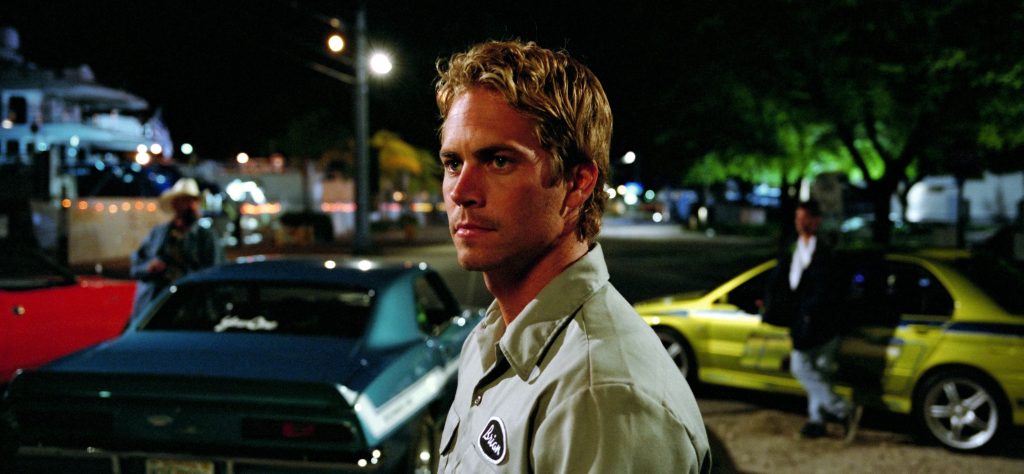
The commercial success of The Fast and the Furious led Universal Pictures to immediately move on developing a sequel. When Vin Diesel proved unavailable (he was committed to another sequel, The Chronicles of Riddick) the studio was faced with a choice: wait for his schedule to open up, or move on without the original film’s most popular element. For whatever reason, Universal went with the latter. The result is a much weaker half-sequel: Paul Walker returns as former police officer Brian O’Conner, but nobody else does.
The film picks up Brian’s story in Miami, where he is hiding from the police while earning cash in local street races. The FBI track him down, and he is presented with an offer: help infiltrate a local drug kingpin’s operation, and have his criminal record expunged. To aid in his mission, Brian brings in former childhood friend Roman Pearce (Tyrese Gibson) with whom he masquerades as a fast-driving courier for the villainous Carter Verone (Cole Hauser).
On the one hand, it is a story that does not steal so obviously from another film, as The Fast and the Furious did from Point Break. On the other, it is a painfully generic and stereotypical undercover police narrative. It exists as a coathanger on which director John Singleton can drape a series of high speed car chases. There are no surprises or unexpected wrinkles. Every character does what similar characters have done in similar films for decades. There is no clear narrative purpose for 2 Fast 2 Furious. All sequels ultimately exist to make somebody some money, but in this case there really is no creative reason for the film to be made.
Singleton is a bizarre choice of director, or rather 2 Fast 2 Furious is a bizarre choice for John Singleton. Not only the first person of colour to be nominated for a Best Director Oscar, but its youngest ever nominee too, he made a huge impact with his 1991 drama Boyz n the Hood and followed it up with a range of features including Poetic Justice (1991), Higher Learning (1995), and Baby Boy (2001). While his 2000 remake of Shaft demonstrated a shift into the action genre, that film still worked with strong racial conflict themes. Here the film is about as two-dimensional as it gets.
The bottom line is that, while The Fast and the Furious was a reasonably competent action film, 2 Fast 2 Furious feels less like cinema and more like a cartoon. All of the fast-driving sports cars are vividly coloured like a child’s Hot Wheels collection. Scenes of racing are styled with CGI backgrounds and glowing colours that actually foreshadow some of the work the Wachowskis did on Speed Racer (2008). Some of the performances – model-turned-actor Devon Aoki is an easy target – feel less like humans and more like two-dimensional drawings.
Late in the film one of the characters makes a passing reference to the 1970s television series The Dukes of Hazzard, and honestly the comparison is not far off the mark. This is tremendously lightweight stuff, with cartoon physics and seemingly indestructible characters. At its best the film is charming nonsense. At its worst, it is simply a bad movie. It is a marvel that Universal proceeded with another sequel after this. It is unimaginable at this point that they would make another nine films.



Leave a comment