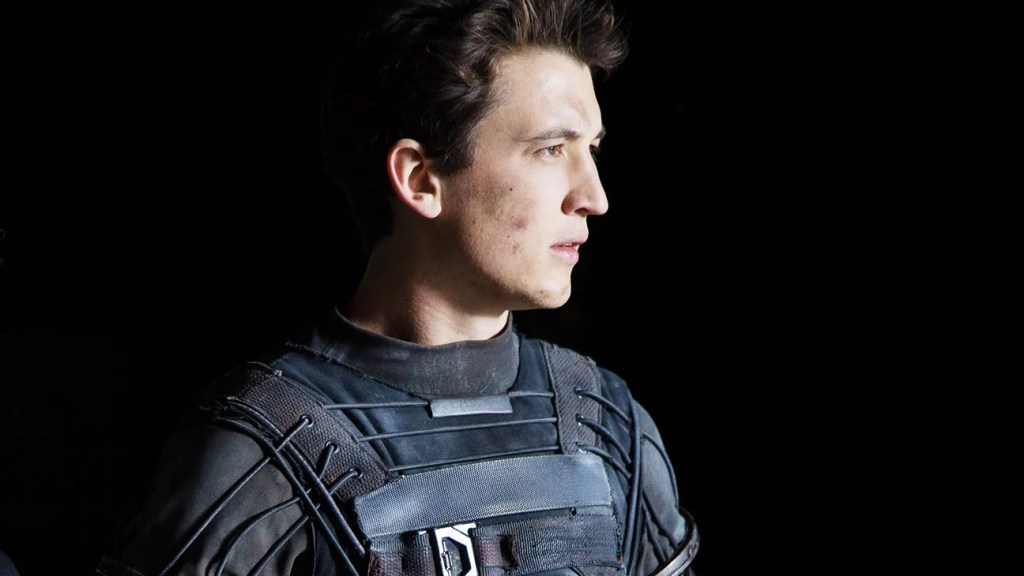
The Fantastic Four strike me as a near-cursed piece of intellectual property. They are foundational characters for Marvel Comics, but to my mind have dated terribly. Various writers of the comic books have found approaches that have made them at least interesting and more contemporary, but those versions that worked the best often seemed to be the ones that diverted the most from the source material.
In terms of cinema, somebody seems to have a go at adapting the superhero team once a decade or so: in 1994, 2005, again in 2015, and most recently in 2025. The most recent effort, Matt Shakman’s The Fantastic Four: First Steps (2025), at least had the backing of the entire Marvel Cinematic Universe to make it stick with audiences. While we will have to wait and see how they go in the next few years, it seemed worth jumping back 10 years to take a look at the previous attempt: the one produced by 20th Century Fox and directed by Josh Trank (Chronicle).
A group of smart young scientists collaborate to build an inter-dimensional transport that links the Earth to a mysterious alien planet bubbling with green energy. When they travel across to explore this strange world, an unexpected and terrible disaster transforms them all, giving each of them super-human powers. For Ben Grimm (Jamie Bell) it means turning into an enormous rock monster. For Johnny Storm (Michael B. Jordan) it means the ability to fly and burst into flames. For his sister Sue Storm (Kate Mara) it means turning invisible and generating force fields. For young scientist Reed Richards (Miles Teller) it means the ability to stretch his limbs to ridiculous lengths – and a world of guilt.
There is little escaping the fact that the Fantastic Four are relatively absurd and fairly goofy. Shakman’s film broadly succeeded by embracing the style and setting his film in a stylised 1960s setting – high on nostalgia and now on emotional realism. Trank essentially does the opposite: he takes something silly and tries to give it gravitas and a mean patina of trauma. In all honesty his take feels like that of a director with something to prove. It seems desperate for its audience to treat its characters seriously.
Trank spends so long aggressively pursuing a Christopher Nolan-esque semi-realist take on the characters that he forgets to spare time for a story. The film is quite literally 70 minutes of set-up, 20 minutes of climax, and 10 minutes of credits. To its credit, the first 20 minutes or so are actually rather good. We are introduced to Reed Richards, child genius, and his best friend Ben Grimm. It sets up a friendship that should power the rest of the film, but sadly it doesn’t ever really gel back together. We cut to Reed as a graduating high school student, where he’s picked up to help develop an interdimensional teleporting device with the help of Sue and Johnny Storm. Michael B. Jordan is a great choice for Johnny – aka the Human Torch – because he’s an immensely charismatic actor, but the film as presented gives him nothing to do.
I write ‘the film as presented’ deliberately: Fantastic Four is one of those disastrous Hollywood productions in which the director and studio fought, the shoot was reportedly plagued with problems, and the ending only exists as seen on screen due to an enormous studio-enforced reshoot. This troubled process shows in the finished film, since the narrative is all over the place, the pace is wildly haphazard, and the climax really does not tonally match the rest of the movie. One could blame the studio, or director Josh Trank, or possibly even the writers, but in the end it’s irrelevant whose fault it is: all you need to care about as a viewer is whether or not the film is good. It isn’t.
The actors are all talented, but they’re wasted. The story is mostly very predictable, and takes a very long time for things to happen. Once the heroes build their teleporting machine they try it out, and when disaster strikes on the other side they are all transformed into super-powered people. One member of their team, Victor (Toby Kebbell), gets left behind. He returns for the truncated climax, calling himself “Doom” and exhibiting deadly telekinetic powers. Once again Trank flees from the possibility his film might seem goofy: it transforms Victor Von Doom into a sulking twentysomething scientist, because a genius Eastern European despot hidden behind a steel mask is too off-the-wall for Trank’s dark, gritty take on the concept. A comics-accurate Doctor Doom would be as great as a comics-accurate Galactus. Ironically the best screen Doom to date is still the one from the terrible Roger Corman film.
That Roger Corman-produced debacle remains a guilty, awkwardly amusing pleasure. The 2005 attempt directed by Tom Story is wobbly as all hell, as is its sequel, but they at least have an earnest quality to them. Matt Shakman finally had the courage to present the Four as-is without diminishing their most idiosyncratic qualities. That leaves Trank’s attempt as the cynical, desperately self-aware one. It is the one that, more than anything, seems ashamed to be a Fantastic Four film at all. Long-term? This is the version audiences are going to almost entirely forget.


Leave a Reply