Tangles, a new animated feature directed by Leah Nelson and based on the graphic memoir by Sarah Leavitt, just might be the best film of the year. It is only August, so we cannot gift it the crown yet, but when the time comes to declare a year’s best – or at least a personal favourite – it will definitely form part of that conversation. It premiered at Cannes, is currently screening as part of the Melbourne International Film Festival, and will get its North American premiere in Toronto next month.
Leavitt’s memoir details her mother’s diagnosis with Alzheimer’s at the age of 55, and both her and her family’s journey with the disease over the subsequent years. Leavitt (voiced by Broad City‘s Abbi Jacobson) is a lesbian artist based in San Francisco, and during a visit home to Maine he grows concerned about how her mother Midge (Julia Louis-Dreyfus) is behaving. Her academic father Rob (Bryan Cranston) denies that anything is wrong, but as time passes and Midge’s symptoms grow more obvious the entire family must come to a reckoning over what is going on.
An excellent and high profile voice cast deliver a tremendous performance throughout, managing to deliver both the slightly heightened delivery required from an animated film as well as a grounded realism that handles the sobering subject matter with honesty and respect. Jacobson and Louis-Dreyfus are particularly strong, and the supporting cast includes Seth Rogen, Pamela Adlon, Sarah Silverman, and Samira Wiley.
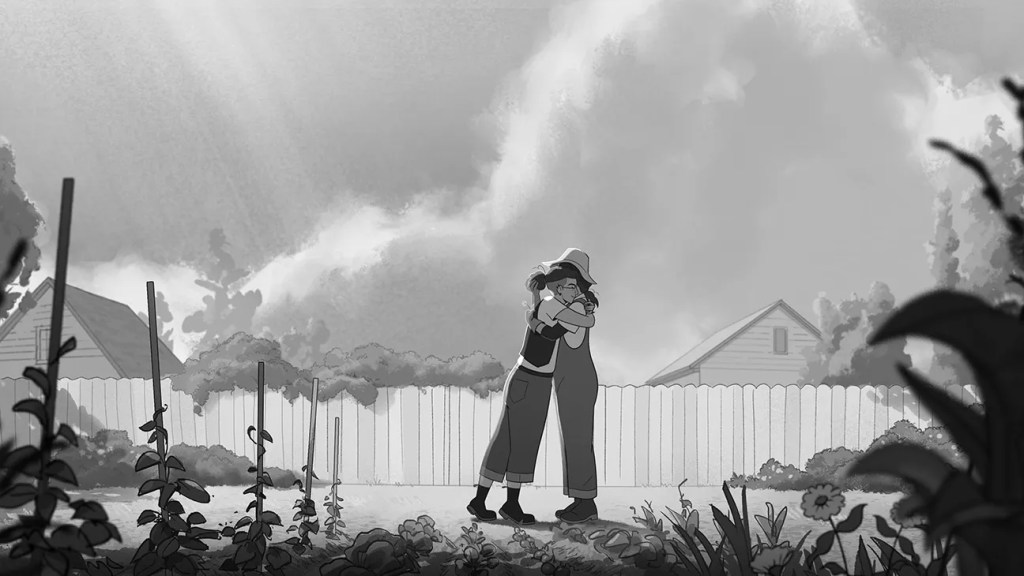
It is interesting that Leah Nelson, despite basing her film on Leavitt’s graphic novel, chooses to employ a radically different art style for the film. Leavitt’s own style has a deliberately naïve, child-like aesthetic, whereas Nelson’s film goes for something a little more cartoonish. It is a smart choice, making the animation much more digestible for a mainstream audience. Nelson also chooses to present the film in black and white, which – perhaps counter-intuitively – makes the characters and situations feel even more universal and easy with which to identify.
An unexpected seam of comedy runs through the film, and is perfectly pitched. It is not just necessary to leaven the more depressing moments: my own personal experience of grief and the grieving process is that there can be a lot more inappropriate, unexpected humour that one would think. There is also a superb representation of queer identity and everyday life, that is both a strong source of the funnier moments, as well as a very realistic representation.
The central drama of the film, however, including the fear of disease, the terror of diagnosis, grieving the loss of a person through a slow, cruel degenerative process, losing a parent, and losing a spouse – these things are rendered with a dreadful authenticity and a demonstrable wealth of personal experience. In each and every scene Tangles gets it right.
All of us I am sure have experienced our share of personal tragedy and trauma. My own experiences, while never involving Alzheimer’s, mirror Leavitt and Nelson’s representations so closely that sitting through their film felt actively traumatic. Each scene is like a fresh wound. Each moment of emotional honesty genuinely hurts. There is a tremendous sense of catharsis here, and the abstract nature of animated cinema ensures that the widest audience possible can recognise their own experiences in those of Sarah and her mother. That abstraction works in other ways as well, enabling the film to express internal frustrations, declining mental health, and memories in a subjective and metaphorical fashion. It enables insights and representations that simply would not be easily done in a live-action format.
This is powerful, intelligent filmmaking of the highest possible quality. It is a strong demonstration of just how versatile animation can be.


Leave a Reply