
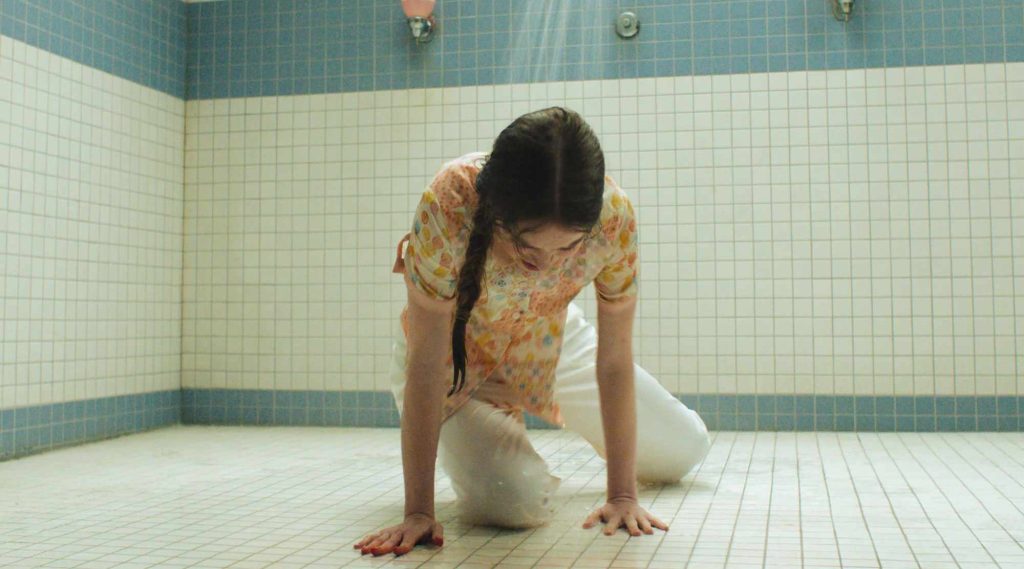
Chang Cheng (Troy Liu), a deaf Taiwanese teenager, transfers to a new school. Expecting to find a supportive environment, he instead finds a group of boys sexually assaulting one on the female students. His attempts to intervene uncover a spiralling culture of criminal assault among the students and a conspiracy of silence among the staff.
Ko Chen-Nien’s bleak drama The Silent Forest adapts a real-life sexual abuse scandal at a Taiwanese special needs school. While it is a film produced with noble intentions, and some considerable dramatic weight, its casting across the board of non-deaf actors to play the deaf and hearing-impaired students makes it a difficult work to recommend. This would be true even if the film’s origins were fictional, but by excluding deaf performers in a true story The Silent Forest commits the sin of speaking for a disabled community instead of allowing that community to speak for itself.
This choice is a deep shame, because in all other regards the film is a laudable achievement. Ko and Lin Pin-chun’s screenplay deals with difficult issues that are challenging to watch occur, and it largely represents them without succumbing to sensationalism or melodrama. The key scenes of child abuse are troubling to watch, but of course they should be. It is a brave choice to be so frank – but, obviously, not explicit – and risk alienating viewers in return for fully expressing how horrible it all is.
Troy Liu acts as the film’s viewpoint and emotional centre, and he plays Cheng’s growing frustration and rage very effectively. It is telling that every attempt to do the right thing and report a growing number of crimes pulls him further and further into trouble. Buffy Chen Yan-fei powerfully plays a more challenging character in Bei Bei, a girl who is being repeatedly assaulted by classmates with no apparent escape. If there is a most valuable performance to the film, it is Korean import Kim Hyun-bin as abuse ring-leader Xiao Guang. It would be easy to make the character a two-dimensional villain or a simple antagonist. Instead, as the film goes on, his is the most expansively developed character of all. He is a complex person, excellently performed, who defies easy answers from the film and audience.
The Silent Forest boasts particularly strong sound design, notably in its use of silence among the deaf characters. Luming Lu’s musical score is used sparingly and cleverly. The discomfort in the silences, for a primarily hearing audience, are regularly very uncomfortable.
It is regrettable that a film that handles its subject matter with such maturity, and which fosters both strong performances and innovative technical qualities, should stumble so badly in its casting – and let down the very people it should be supporting. I can appreciate the qualities on show, and understand the critical acclaim it received upon release, but as someone both hearing-impaired and disabled, I cannot in good faith recommend the film. The Silent Forest is deeply frustrating.



Leave a Reply