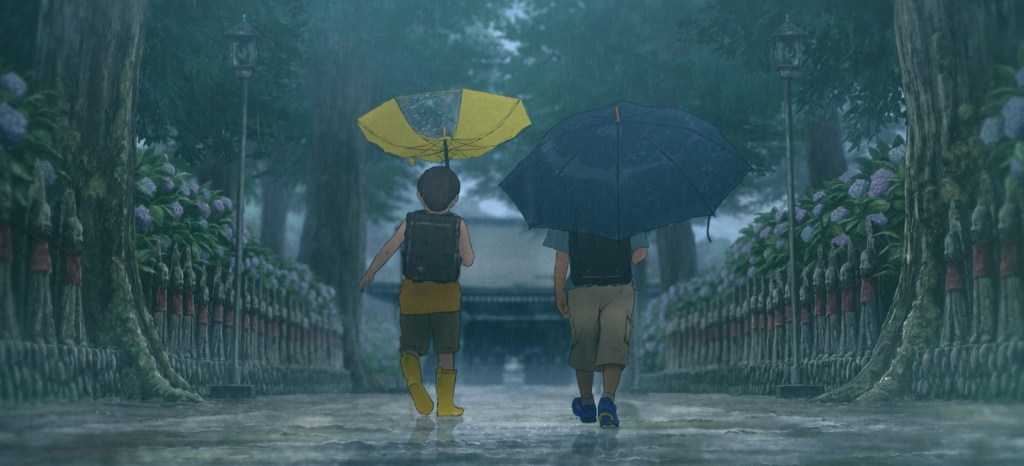
Two young boys, Tsubasa (Maki Yuto) and Gyotaro (Nakagome Tasuku), befriend one another in primary school. One is quiet and bookish, the other outgoing and rebellious. When Gyotaro’s uncontrolled exuberance finally wears Tsubasa down, the latter is forced to make a choice that has repercussions for the rest of their lives.
We Are Aliens, a new animated feature written about directed by Kadowaki Kohei, is not, in fact, about aliens. It is about the arbitrary cruelty of children, which can seem alien some times I suppose. It is undertaken with a grounded realism that one does not typically associate with an animated film, to a degree where some might question why Kadowaki animated it at all. Of course, as any serious fan of the medium will attest, there is a world of creative opportunities in an animated film that simply are not available in live-action. Scenes that would be more objective are transformed into the wildly subjective. It provides an insight into the deep emotions of the piece.
They are deep emotions at work as well. The damaging psychological effects that can be caused in the school yard are still largely untapped in cinema, and by playing out these events in animation Kadowaki can tell them with a directness and a power that would be near-impossible using juvenile actors in a live picture. It is this that is the best justification of We Are Aliens being animated. Anyone coming to the film having been a victim of childhood bullying, teasing, or ostracision may actually find some of the film too difficult to navigate. Kadowaki captures its potential effects in a manner that rings with truth and is raw to sit through. It is superbly captured and played out, and is unexpectedly peppered with moments of comedy, but the gut-punches come they are impactful.
While the film’s visual aesthetic does have its origins in Japanese animation, extensive use of CGI, sketchy hand-drawn realism, and rotoscoping (animation drawn over live-action footage) gives a particularly distinctive look. It is the heavy use of line work in the character’s faces that has the greatest effect, pushing them into exaggeration and outright grotesquerie.
The screenplay is intelligent and effective, with a smart use of recurring themes, non-linear storytelling, and foreshadowing. It tracks its characters from childhood into adulthood as well, which requires strong design work to allow them to age while remaining immediately recognisable as well. The film employs some smart use of colour in that regard, as well as quality vocal performances when Tsubasa and Gyotaro become adults (and voiced by Bando Ryota and Okayama Amane respectively).
It seems, when it comes to animated cinema in 2026, that We Are Aliens just might be one of the films to beat. A wide Japanese release is due on 25 September. Hopefully other countries get to see it as well. This is a stunning achievement, and a hugely powerful act of filmmaking.
We Are Aliens is screening at the Melbourne International Film Festival. Click here for more information.




Leave a Reply