A hip-hop idol group aids a super-powered alien to return to its home dimension in Demo Tanaka’s Lyrical School’s Close Encounter of the Third Kind (2016). It is an ultra-low-budget musical comedy, shot on digital video and released direct-to-video in Japan. At the end of the day it is a promotional tool for the band, one of a number of corporate idol ensembles that pepper Japan’s pop culture landscape. It is also a weirdly engaging, oddly inventive little confection. It is never going to discover an audience beyond the one it already has. In all honesty it does not ultimately warrant one, but it remains a fun diversion for fans of such a niche product.
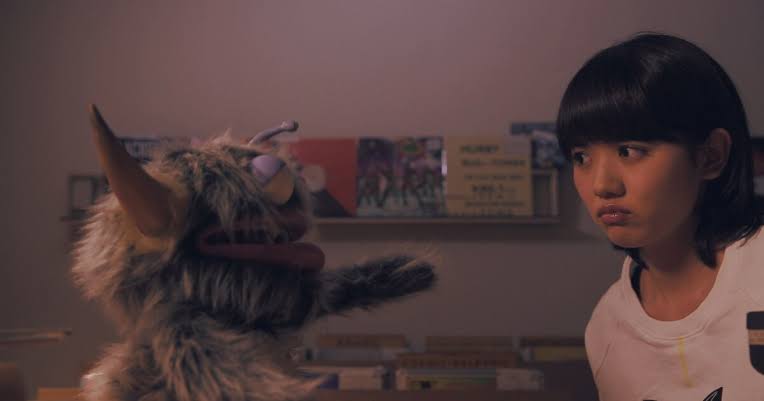
The film opens with hip-hop group Lyrical School – Ayaka, Mei, Yumi, Ami, Minan, and Hime – working behind the counter of a small record store. What seems to be a shabby soft toy in the corner of the shop turns out to be Bam-Sam, a self-described “higher-dimensional cosmic consciousness” who can walk and talk, and is seeking a means of returning safely to his original dimension. To do that he needs to recharge his powers, and that will require him listening to high-volume sound at a particular frequency. The easiest way to achieve that is with a hip-hop concert, leading the girls of Lyrical School into a hunt for a venue, funding to stage an event, and an audience to see them sing.
It is interesting to see the film is directed by Demo Tanaka, who is a veteran of low-budget and independent Japanese cinema – but as an actor rather than a director. Tanaka has appeared in a string of gore-filled indie works including Tokyo Gore Police (2008), Helldriver (2010), and Zombie Ass: Toilet of the Dead (2011). Anybody hoping he brings those film’s elements of blood and gore will be disappointed; he does, on the other hand, bring a clear independent sensibility to the work. It is knowingly artificial, idiosyncratically constructed, and very self-aware.
Supporting roles in the film are largely filled by rappers and DJs from Japan’s hip-hop circuit, including Zen-La-Rock, Chillstaski, and Tokyo No. 1 Soul Set’s Bikke. They are clearly non-actors – the members of Lyrical School are clearly not experienced actors either – and it gives the entire film a very loose and shambolic tone throughout. It’s funny and entertaining, but it is also kind of terrible. Bam-Sam is realised on screen with a dreadfully unconvincing puppet, and it’s low-technology touches like this that add immeasurably to the film’s charm.
Of course it all comes to a climax with a Lyrical School mini-concert held on a Tokyo rooftop. I suspect this is the main draw for fans, and they are an amiable bunch. Their music sits somewhere in the middle of genuine half-decent hip-hop and the sort of candy-flavoured commercial J-pop typified by more famous idol groups like Morning Musume and AKB48. There is even a Japanese-language cover of Madonna’s “Holiday” buried in there.
This is one weird little pop culture obscurity.




Leave a Reply