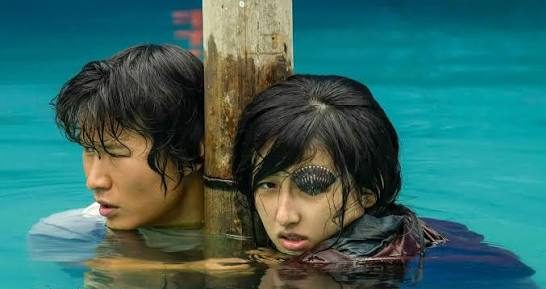
Two young women meet on a floating fishing village along the Chinese coast. Ah Xi (Zhang Weili) has been non-verbal since her mother’s suicide. Lin Momo (Zhang Zifeng) is recovering from a sexual assault. Despite the conflicting pressures around them, and the growing risk of a typhoon, the two women make an intimate personal connection that may restore both of their lives.
Li Yu’s drama After Typhoon is an impressive film for a number of reasons, but I think the most significant one is the close bond that Li develops between her two protagonists. The two Zhangs – Weili and Zifeng – provide a powerful and heartfelt core to the picture, presenting a very personal and realistic friendship that feels very close and almost romantic. Each bring their own trauma to the encounter, and each enables the other to resolve their crises by film’s end. It seems particularly impressive in the case of Zhang Weili, making her screen debut after a successful career as a mixed-martial arts fighter. There is possibly an extent to which her role has been tailored for her, but it is a strong role and an incredible performance.
Both storylines palpably expose the way that Chinese society – and particularly the patriarchal forces within it – damage and manipulate the experiences of young women within it. In the case of Momo, a sexual assault victim at the hands of a university professor, her family has exerted growing pressure on her to drop any pursuit of criminal charges in return for a large cash settlement. In the case of Xi, the local rumour mill has destroyed the reputation of her dead mother and left her with few friends. It is through a new friendship with Momo that she begins to find some solace.
Xi and Momo’s story is presented in front of a splendid backdrop of fishing villages, coastal bays, and stunning ocean vistas. It does not simply fix their story with a strong sense of place – although it does very effectively do that. It also gives the film a visual texture quite distinct from what one usually sees. There is an inherent fascination in seeing how these fishing communities live, work, and operate. A broad range of supporting characters help enliven this environment, notably the so-called Oyster Lady (Li Xinjie) who quietly smokes drugs in her house to distract from the death of her husband.
Another striking element to the film is Chen Shu’nan (Yao Chen), the wife of the university professor that allegedly assaulted Momo. She visits the village to give Momo a cash payment and persuade her to drop her accusations. She acts as a powerful indication of how women can turn on one another, and do the work of an oppressively patriarchy on men’s behalf. It is commendable that she is realised as a fully fleshed-out character, despite her adversarial role.
The central drama of After Typhoon is certainly a familiar one, and it does not progress its central feminist argument any further than what is expected, but a combination of setting, attractive photography, and strong performances do let it stand out from the crowd. The film performed weakly in Chinese cinemas in 2025; without a boutique home video release or belated festival run, it is likely to remain obscure overseas.





Leave a Reply