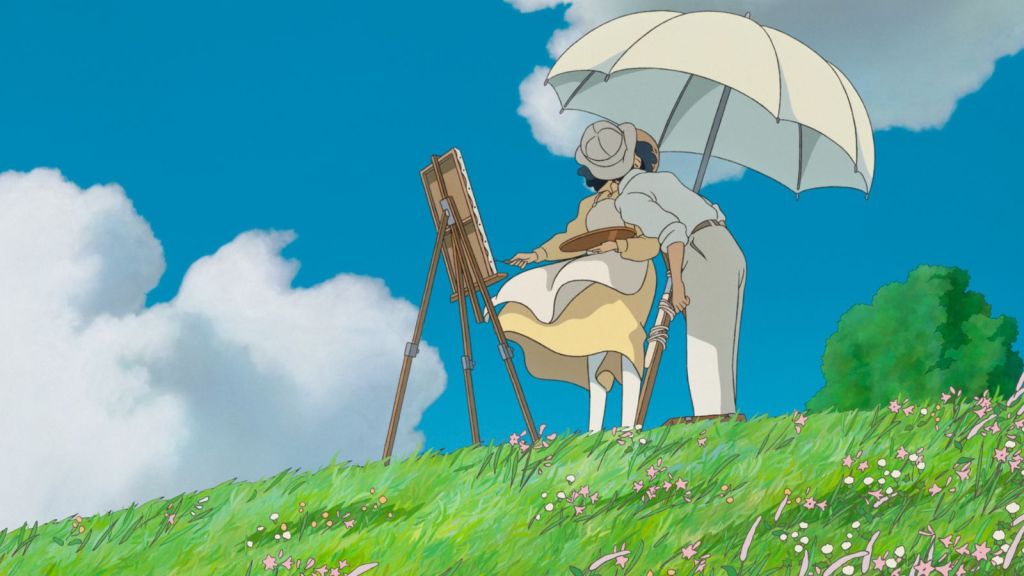
There was a certain mystique to Miyazaki Hayao’s 2013 film The Wind Rises when it was released. The widely acclaimed filmmaker, often heralded as the greatest director of animated films ever, had announced his retirement and The Wind Rises was to be his last feature. Of course it was not the first time he had announced his retirement, and like all of the previous announcements this one did not ultimately hold either. His subsequent feature The Boy and the Heron was released in late 2023.
Despite this, there is still a strong air of finality about The Wind Rises. It stands apart from the director’s other feature films in being a straight drama, and lacking much of the fantastical flourishes that typify his body of work. It is a biographical film about aeroplane designer Horikoshi Jiro, and is deeply infused with tones of both melancholy and finality. The first time I watched it I did not fully appreciate it; either the film has mellowed with age or I have. I now consider it a distinctive master work.
The film tracks Jiro from his childhood through his studies in aeronautical engineering, his work for Mitsubishi constructing fighter planes, and his romance with eventual wife Nahoko. By doing so it also encapsulates Japanese history, including its rise in militarism, the Second World War, and the cataclysmic Tokyo Earthquake of 1923.
At the same time Jiro dreams of the great Italian engineer Giovanni Battista Caproni. These flights of fancy represent some of the film’s most visually engaging sequences, with Miyazaki’s themes of flight – a perennial subject of his work – allowed to fully unfold. The Italian angle is no surprise: Miyazaki has been enamoured with Caproni for his entire life, and indeed his own animation company Studio Ghibli is named after one of Caproni’s planes.
The fascination with human flight is foregrounded here, and certainly to a greater extent than Jiro’s personal life – which is largely fictionalised for dramatic purposes. Nahoko is an invented character – Jiro’s real wife was named Sumako – while Miyazaki replaces his real-life older brother with a younger sister, Kayo. The romance between Jiro and Nahoko is beautifully and sensitively played. The film has an excellent voice cast however one chooses to watch it: the Japanese dub features Anno Hideaki, Takimoto Miori, Shida Mirai, and Nishijima Hidetoshi; the American version Joseph Gordon-Levitt, Emily Blunt, John Krasinski, and Stanley Tucci.
There is a remarkable fidelity to 20th century Japan in the film’s artwork, which is finely composed with a tremendous attention to detail. The Tokyo Earthquake is realised in a visceral fashion, and in a manner that simply would not be possible in a live-action film. The detail on the film’s various aircraft is fantastic; it is a true labour of love.
If there is a fault, it is that Miyazaki deliberately separates Jiro’s invention of his planes – particularly Mitsubishi’s A6M Zero – from their ultimate purpose. It certainly notes Japan’s actions in the Pacific during the Second World War, but unhooks any responsibility on Jiro’s part for enabling them.
This problem aside, The Wind Rises is a tremendous achievement – not only as an animated film but as a film in general. It brims with emotion, comes packed with visual delights, and is accompanied by a marvellous Rota-esque musical score by regular Miyazaki colleague Joe Hisaishi.
There are many good films released around the world every year. Masterpiece celebrates the best of the very best: genuinely superb works of cinema that come with FictionMachine‘s very highest recommendation. If we had our own Criterion Collection, these are the films we would want it to include.



Leave a Reply