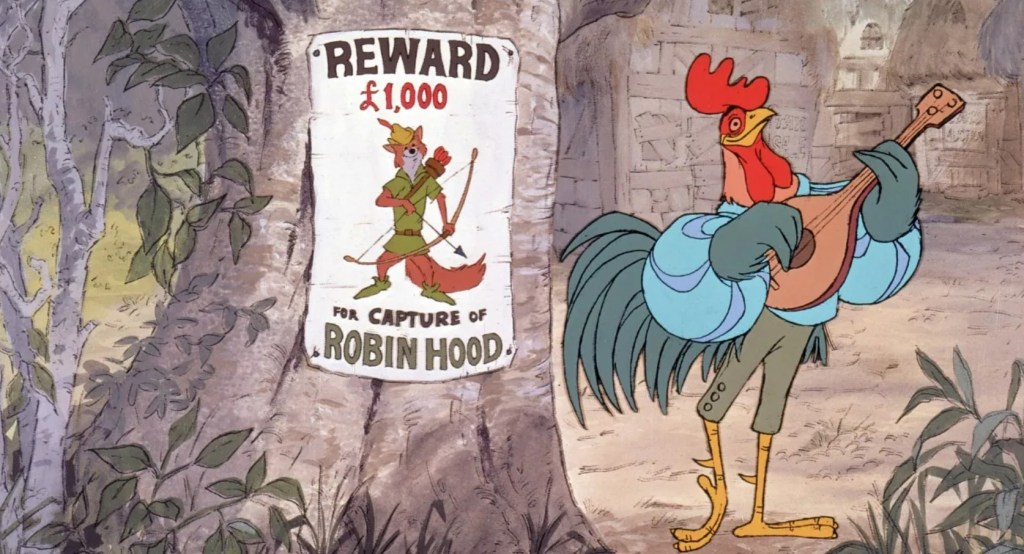
The film that first sparked the desires of a million furries, Wolfgang Reitherman’s Robin Hood is a 1973 animated feature from Walt Disney Productions. It famously recast the popular folk characters as anthropomorphic animals, and was met with commercial success upon release. For many this is a treasured gem from their childhood, whether seen at the time or during its long afterlife on television, physical media, or streaming. It is also not very good.
Robin Hood holds the rather miserable distinction of being the first Disney animated feature to be developed, produced, and released entirely without the participation of studio founder Walt Disney – who died in 1966. Whether or not that was a factor in the film’s somewhat moribund nature is open to debate. It stems from a period where Walt Disney Productions was keeping a very close eye on production overruns. Sleeping Beauty made a loss on its original release in 1959, and that had led to more than a decade of cost-cutting measures and animated short-cuts. Old animation sequences were periodically re-used in new films – something that particularly affected Robin Hood – and this created some uneven styles and scenes that combined old and new animation techniques.
At the same time the labour-intensive process of inking individual frames had been largely replaced with the use of photocopiers to directly replicate pencilled art in high contrast, and this gave Disney features of the period an uncharacteristically rough, “sketchy” look. The technique was introduced for One Hundred and One Dalmatians in 1961 simply to affordably animate its canine characters. It was retained afterwards because it made production much less expensive, and the substandard visual appearance was simply taken as an acceptable price for affordability. It may have been accepted at the time, but decades after the fact it does leave an entire generation of Disney films – Dalmatians, The Aristocats, The Sword in the Stone, and Robin Hood – looking inferior to the generation before it.
Beyond the slightly shoddy aesthetic, there is also a strange sort of disregard for detail that drags the film down. A cast of talking animals is largely par for the course for Disney, however there is apparently little thought in how those animals were selected. Some make tremendous sense – Robin as a Fox, Alan A’Dale as a rooster, and so forth – but others simply feel out of place. The various guards and soldiers of Nottingham for one: it is a seemingly random selection of rhinoceroses, vultures, and elephants. Hardly appropriate animals for medieval England. I cannot help but feel the characters would have been more cleverly developed under Walt Disney himself.
One absolutely outstanding element of the film is the manner in which the villainous sidekick Sir Hiss, whose body is regularly contorted into a range of human-like poses as if he had arms. It is properly clever stuff, and makes him pretty much my favourite character of the piece. British comic actor Terry-Thomas does a marvellous job with his voice.
It is a reasonably strong voice cast all round, including Peter Ustinov as Prince John, Brian Bedford as Robin, and Monica Evans as Marian. Little John’s bear design is ripped directly from The Jungle Book‘s Baloo, and so the same voice actor plays both characters: Phil Harris. He is great in both films, however the second time around it does feel awfully lazy and derivative.
A lot of the Robin Hood mythos gets left out of the picture. Standard supporting players like Will Scarlet and Much the Miller’s Son are nowhere to be found, and the traditional ensemble of Merry Men are replaced by a Robin-and-Little-John double act. Other elements remain, including Robin’s famous archery contest performed in a delightfully designed disguise. It is a remarkably episodic film, without any real structure to build up suspense or engagement. Things happen, and then after an appropriate number of events the film ends. It is hardly Disney at its best. A smattering of American folk songs are performed by Roger Miller, who also voices Alan A’Dale. They do not fit cleanly with the English setting, and are relatively unmemorable.
There are people for whom Robin Hood will be a treasured childhood classic, and that is fair enough. Seen at the right age and circumstance and any film can become someone’s favourite. In the context of Disney’s long string of animated features, however, it cannot help but feel like part of a low point for the company. Better films came before and after. This one just sort of sits there.


Leave a Reply