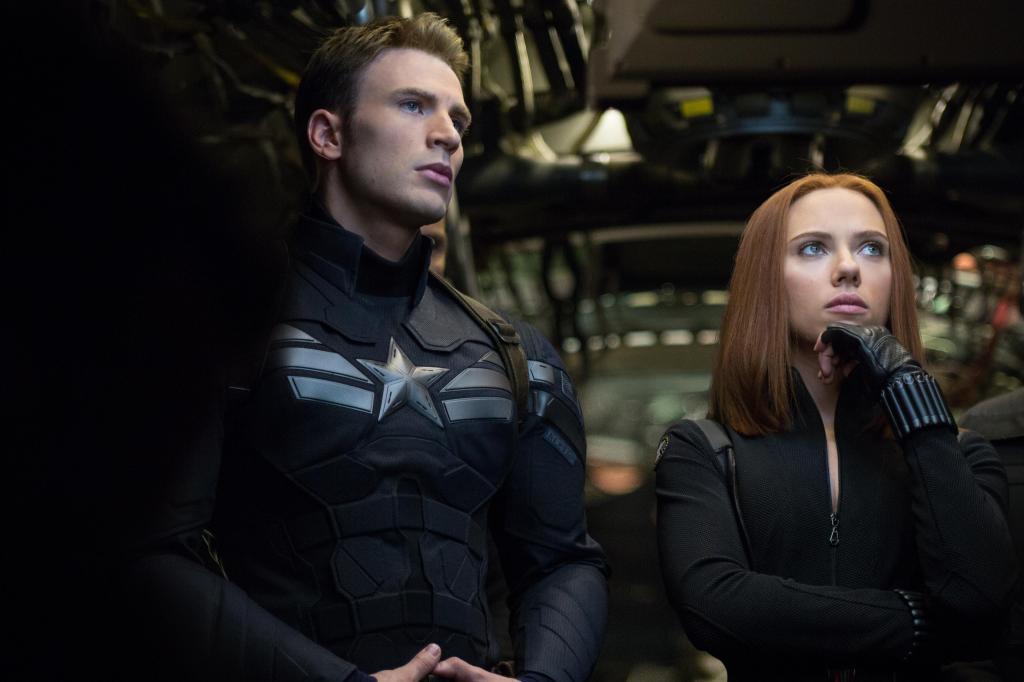
If you watched Captain America: The First Avenger in 2011 and then came back for Captain America: The Winter Soldier in 2014, but did not stop to take in The Avengers (2012) in between, the second Captain America adventure would probably be a little confusing. It is not just the trade-out of writers and directors: Joe Johnston replaced here by Joe and Anthony Russo. The setting has shifted from 1940s Europe to present-day Washington DC, the tone has gone with it, and by-and-large almost the entire cast of the first film are not back for the second.
It is a much better film though. This vision of Captain America as a hero out of time, working for the paramilitary forces of SHIELD and incorporating characters introduced in Marvel’s Iron Man (2008) and Iron Man 2 (2010), fits in neatly as part of a broader fictional universe of superheroes. While it sets up future plot threats again, with its eye on multiple sequels and cross-overs, it does so in a much more elegant fashion. The serialised nature of the Marvel Cinematic Universe is firing on all cylinders at this stage, figuratively speaking. It is testament to how well the broader franchise is working when you notice Marvel Studios released two features in 2014, one The Winter Soldier and the other Guardians of the Galaxy – an action comedy featuring an interplanetary talking tree, and both grossed more than a half a billion dollars worldwide.
The Winter Soldier was particularly well received at the time. With the benefit of hindsight it is clear that this one of the best films Marvel Studios has ever made. It is pretty impressive when you consider all three of its directors’ previous works were modestly budgeted comedies.
SHIELD is about to launch a pre-emptive strike network to combat international terrorism. When SHIELD director Nick Fury (Samuel L. Jackson) realises something is going wrong with its implementation, assassins violently take him out of the picture. His last words are to Captain America, who subsequently finds himself on the run from his own government, aided only by fellow Avenger Black Widow ( Scarlett Johansson) and a Afghanistan War veteran named Sam Wilson (Anthony Mackie).
There are pretty clear parallels to be drawn between The Winter Soldier and Christopher Nolan’s Batman sequel The Dark Knight (2008). Both take a well-established, presumably secure foundation from an earlier film and the smashes that foundation to pieces. Both are intentionally long, almost gruelling works. Both use their respective crises to better define their lead characters. By the end of The Winter Soldier SHIELD has been broadly dismantled – you would think Marvel would keep it around for longer, American national security is in disarray, and the film’s various super-powered characters are all apparently headed off in different direction. It represents a monumental act of toy-breaking, but it works spectacularly well because it removes the safety net above which the first “phase” of Marvel features operated. It leaves the MCU as a less predictable and more dangerous place – at least running through the Russo brothers’ epic two-part finale of Avengers: Infinity War and Endgame.
Chris Evans and Scarlett Johanssen act as tremendous head-liners during this film. They share great chemistry, represented as close friends rather than romantic partners – and that’s almost always more interesting to do. Johanssen gets so much to do, in fact, that it’s difficult to work out why Marvel took until 2021 to spin Black Widow off into her own movie.
As with The First Avenger the film is stacked with a hugely effective supporting cast. The appearance of Robert Redford as SHIELD overseer Alexander Pierce is a massive shift in the level of casting for these films, and Redford gives the character enormous weight and charm. Anthony Mackie delivers a strong, engaging debut as Sam Wilson, aka the Falcon. Other actors, including Sebastian Stan, Emily VanCamp, and Frank Grillo are all excellent. This is a film without a single fault in the casting.
The action sequences are shot incredibly well, managing to keep a lot of the intensity you get from post-Bourne shakycam thrillers but pulling the camera back enough for the audience to actually see what’s going on. When the over-the-top climax arrives it is almost a disappointment, since the film had been going so well on more conventional punch-ups and shoot-outs up to that point.
The Winter Soldier ends with numerous narrative threads floating into the distance, but unlike other MCU productions it has a very deft ability to move chess pieces around a board in a way that does not reek of sequel planning. This is a big, cleverly developed, and hugely entertaining blockbuster. It is the ninth instalment of the Marvel Cinematic Universe, and easily surpassed the other eight in terms of quality, smarts, and entertainment value.


Leave a Reply