It is no secret that I am attracted to film studio hubris like a fly to a rotten carcass. There is something deeply addictive about the inescapable combination of wealth, power, fame, and glamour that makes accountants think they are valued creatives and studio heads want to insert their own bad ingredients into recipes that should never have been thought up in the first place. It is like rubber-necking a car crash; I cannot move past a Hollywood farrago of incompetence without slowing down to check it out.
Long-time readers will know of my extraordinary fondness for David Fincher’s Alien 3, a poorly conceived sequel improbably made fantastic by some astonishingly good direction and acting – and then rendered back into ruin by studio indecision and interference. I think some of the same thoughts about Tim Pope’s 1996 sequel The Crow: City of Angels, although I do not rate Pope’s work anywhere close to as highly as Fincher’s and the end result is vastly substandard to it. At the same time there are obvious parallels: a wrong-headed initial premise, a music video director making their feature debut, studio executives interfering in the creative process, and a general failure in the final result.
There is no reasonable case for City of Angels being a good film. There is barely a case for claiming it is even watchable. As failures go, however, it is at least a somewhat interesting example. I feel this piece is less of a review and more of a post-mortem.
The Crow (1994) was an adaptation of James O’Barr’s hit comic book, directed by Alex Proyas and starring up-and-coming action star Brandon Lee. It presented a straight-forward tale of supernatural revenge, with Lee’s character Eric Draven rising from the dead to kill those responsible for both his and his fiancée’s brutal murder. It combined effective gothic-styled production design with a winning alternative rock soundtrack, and benefitted enormously from Lee’s charming, charismatic lead performance. Its success and legacy are of course tied inalienably to Lee’s accidental death during production. One cannot discuss the film without also discussing its star. Real-life and fictional tragedy were permanently blended together.
It is not widely known that, in signing on to star in The Crow, Lee was required to sign onto two potential sequels as well. It is difficult to imagine planning a follow-up to such a closed narrative, but the intention was there from the outset. Paramount Pictures forged the deal, but Miramax inherited it when they bought the rights to the film following Lee’s death. That first sequel hit cinemas in America on 30 August 1996, just 27 months after the original: that is precious little time to develop and produce a sequel, and strongly suggests there was little hesitation on Miramax’s part to further exploit the material.
Director Alex Proyas clearly wanted nothing to do with financially exploiting Brandon Lee’s legacy with a sequel. Replacement director Tim Pope was, all things considered, an interesting and logical choice of replacement. The music of The Crow was an innate element of the property, and as a director of numerous music videos – chiefly for the Cure – Pope seemed a suitable appointment. O’Barr was granted a first pass at the screenplay, and pushed for a female protagonist. Miramax insisted on a male one, just like the original. Screenwriter David Goyer, who was credited with the final screenplay, proposed both a female protagonist and a 19th century setting. Miramax insisted on a present-day setting, just like the original. When Pope completed directing the picture and returned to the UK, Miramax ordered reshoots and a complete re-edit in his absence to make as much of the film resemble the original film.
The bottom line is that we will never know what sort of a film Pope envisaged. We can only judge what sort of a film notorious Miramax head Harvey Weinstein wanted us to see.
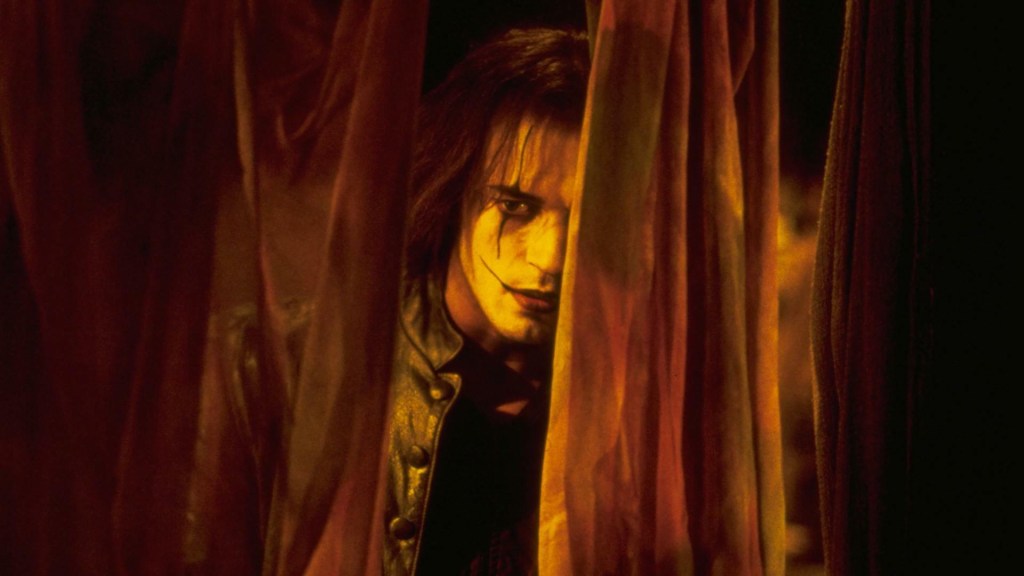
Briefly: motorcycle mechanic Ashe Corven (Vincent Perez) and his son witness a murder and are tortured and executed for their troubles. Ashe then rises from the dead and, with the assistance of tattoo artist Sarah (Mia Kirschner), seeks revenges against gang leaders Curve (Iggy Pop), Spider Monkey (Vincent Castellanos), Kai (Thuy Trang), and their leader Judah (Richard Brooks).
It is, in many ways, a distinctive-looking and pretty film. The whole thing is coloured a garish sort of yellow-green, as if its largely deserted and desolate vision of the Los Angeles docks has been liberally soaked in urine. The best sequences, such as Ashe’s killing of Curve, are easily as beautifully composed as anything Alex Proyas directed in The Crow. Other scenes really struggle to stand out, which make me curious if they are the ones that were anonymously shot without Pope’s involvement.
There are some decent actors here – Perez and Kirschner, for example – with nothing of great value to do. There are also a handful of non-actors – Iggy Pop, for one, and the Blockheads’ Ian Dury – that manage to be charismatic but unconvincing. There is also some egregious over-acting by the likes of Brooks, in a telltale “let me assure you I am in a piece of shit” manner perfected by Jeremy Irons in films like The Time Machine and Dungeons & Dragons.
The story is clearly sculpted to resemble its predecessor: a man and someone he loves are killed, the man returns to life, hangs out with a supernaturally enhanced bird, and kills all of the bad guys one by one. He leaves crow imagery at the crime scenes: Eric Draven did this out of a sense of poetry, and Ashe Corven does it because Eric Draven did it. The villain is obsessed with gaining supernatural power, with a female witch sidekick, just like in The Crow. It is not an interesting story; it is a photocopy of one.
The script, however, feels a little different. It is noticeable by its absence, in large parts, as if someone keeps hitting “skip” on the DVD player. Things happen very abruptly, and most often without explanation or context. It is a telltale sign of a furious studio-led edit, where as much dialogue as possible has been shorn off and abandoned. There is a clear hope – always misplaced – that a breakneck pace and a string of action scenes will distract the viewer from what’s missing. Instead the film lacks tools with which engage them.
Every few years I get drawn back to this film, not because it is any good, but because there is the indelible shadow of another, much more interesting film that is cast over the whole picture. You can almost perceive it among the trash, and the formulaic elements, and the just incredibly lazy presentation of it all.
The soundtrack, all things considered, is actually pretty great. While I cannot recommend anybody rush to watch the film itself, I would recommend tracking down the CD.
Ultimately this feels less than a film to watch than a vandalised wreck to observe. What is particularly surprising is that another three Crow films followed after it.


Leave a Reply