Sometimes a film can be worth watching regardless of their actual quality. In other words, one can be fascinating without actually being good. Old propaganda pictures certainly fit within this category: they were never made with quality in mind, but rather with communicating a political message – often during wartime – to the general public. By viewing such films in their historical context, a viewer can recognise the concerns of national governments in their original context.
Sayon’s Bell is certainly an example of this sort of a film. It was directed by Shimizu Hiroshi, one of Japan’s most effective filmmakers of the pre-war period, and was released in 1943. At that time Japan was at war with the USA in the Pacific, and violently occupying much of East and Southeast Asia. One of its colonial holdings was the island of Taiwan, ceded to Japan by the Empire of China in 1895 as part of Sino-Japanese War reparations. It was Japan that constructed much of the infrastructure that modern Taiwan still relies upon today; visit the capital Taipei today and you will find most of the older buildings were made by the Japanese.
Governing the island included governing its indigenous peoples, which in a sadly commonplace colonialist process meant both supplanting local traditions and language as well as violent suppression. It is this process that is profiled in a propagandist fashion in Sayon’s Bell.
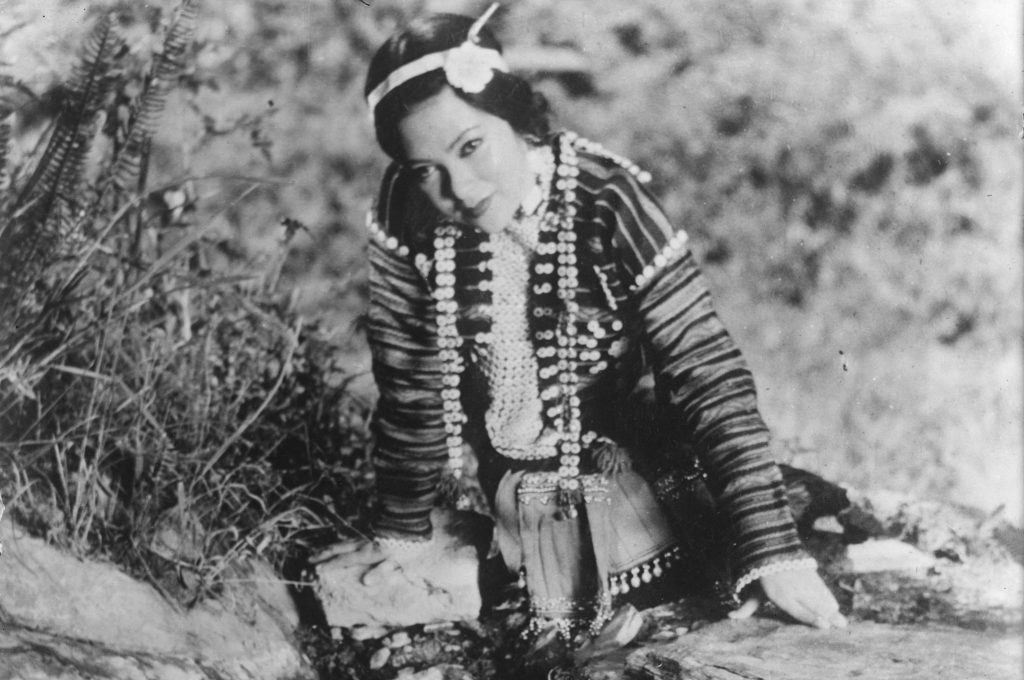
Sayon is a teenage girl living in a Tayal community in northern Taiwan. The village, while self-governed, is enthusiastically obedient to the local Japanese force – which provides both leadership and instruction on 1940s technology, culture and language. Sayon is fiercely enthused about Japan, and her boyfriend Saburo has been studying hard to be accepted into the Imperial Army.
Sayon’s Bell is briskly populated with incident, but remains remarkably light in actual plot. Story elements are teased regularly – there are some romantic misunderstandings, a pregnant pig, and a forbidden excursion to a holy lake – but rarely is one of them resolved or even extensively developed. Patriotic songs are dropped into the narrative at regular intervals; so much so that one could argue for the film being a musical rather than a simple drama.
The film portrays the Tayal with a deeply paternalistic attitude. They are represented not simply as backwards and primitive, but actively superstitious, foolish, and childlike. The local police presence is showcased as a voice of reason and progress, and appear unconditionally loved by the local population. Every young man in town is desperate to go to the Pacific War, and every young woman seems excited about sending them there. It is blunt, one-sided messaging that – like a lot of propaganda – feels deeply odious from a modern-day perspective.
Sayon is played by Yamaguchi Yoshiko, using an early career stage name of Li Koran – under which she regularly played Chinese women in Japanese films. She spends the bulk of the film in a sort of up-tempo happy mania, singing songs, playing with children, and enthusing wildly about her Japanese colonisers. Hatsu Shimazaki plays Saburo well enough. It is honestly a challenge to tell the difference between moribund performances and limited characters. Shimizu Hiroshi’s direction is particularly listless and formulaic compared to his work both before and after the war. Sayon’s Bell is intellectually interesting, but dramatically very easily avoided.
Some English language reviews have speculated that the film might have been shot in location in Taiwan. Given the ongoing war with the USA at the time, this seems deeply unlikely. Wherever it was shot, it does boast a surprising amount of location footage. Other war-time films – like Kurosawa Akira’s The Men Who Tread on the Tiger’s Tail – were not afforded location shooting at all.





Leave a Reply