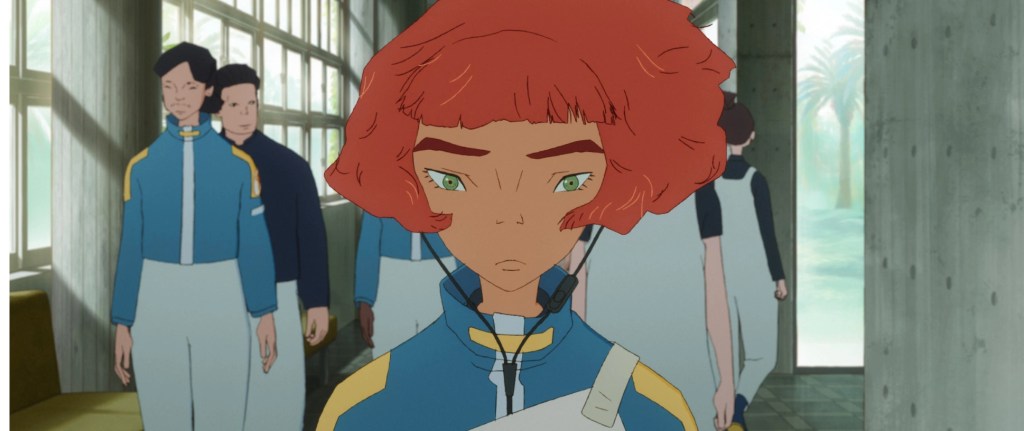
During an alien invasion of Earth, one individual finds themselves trapped in a time loop – living the same day over and over as they learn how to fight back. If the premise of the anime feature All You Need is Kill (2025) seems vaguely familiar, that is because it probably is. Sakurazaka Hiroshi’s science fiction novel was adapted to the screen in 2014 under the name Edge of Tomorrow, directed by Doug Liman and starring Tom Cruise and Emily Blunt. This new adaptation comes from Studio 4°C (Children of the Sea, Poupelle of Chimney Town) and marks the directing debut of long-time anime artist and designer Akimoto Kenichiro. If there is a temptation to herald this as the more ‘authentic’, it should be resisted: Akimoto’s version takes liberties with the novel just as Liman’s did, but they are different changes in the name of making the best possible film. It makes for a different hybrid of the book, a stunning work of feature animation, and the best science fiction film I have seen this year.
Rita Vrataski (Mikami Ai) is a young employee of the United Defence Force (UDF), one of many hired to dismantle Darol: a massive alien plant that landed on the Japanese coasts one year earlier. Darol has been dormant, however one day it unexpectedly blooms: monstrous creatures sprout from the ground killing the human crew entirely. Rita is killed as well, but inexplicably wakes on the same morning a second time. She dies that day as well, but then wakes, and wakes, and wakes.
The time loop narrative employed by All You Need is Kill is by now a very familiar one, made famous by Harold Ramis’ 1993 comedy Groundhog Day but having been employed in fiction since at least the early 20th century. It is well employed here for dramatic purposes, as Rita uses her unique situation to learn more about why Darol has erupted, what its purpose is, and why she is trapped in a seemingly endless loop. They are, as one might anticipate, connected. What might seem a slightly worn set-up becomes palpably more arresting when Rita learns she is not the only person trapped in the time loop.
One can use the time loop narrative for numerous reasons: Groundhog Day does it for humorous purposes, and All You Need is Kill does it to develop a suspenseful mystery. Both films ultimately use it to express existential despair. Here Rita keeps track of the days by writing the number on her hand with a marker: as the number rises, so does the level of frustration, dread, and hopelessness. It is powerfully done.
The film’s greatest asset is honestly its aesthetic. The animation – a combination of CGI and hand-drawn characters – is distinctive and insanely colourful. The approach accentuates scenes of action, of which there are many, and enhances the sense of emotion. It is a far more abstract approach in visual terms than, say, the various iterations of Anno Hideaki’s Neon Genesis Evangelion – of which I was reminded more than once while watching Akimoto’s film.
Japan’s anime industry produces numerous films each year, and it is inevitable that some rise to the surface and find an international audience while others – for varying reasons – fail to make the journey. I desperately hope All You Need is Kill is one of them films to find broader exposure – and even a mainstream audience. It absolutely deserves it. It is outstanding science fiction cinema.





Leave a Reply