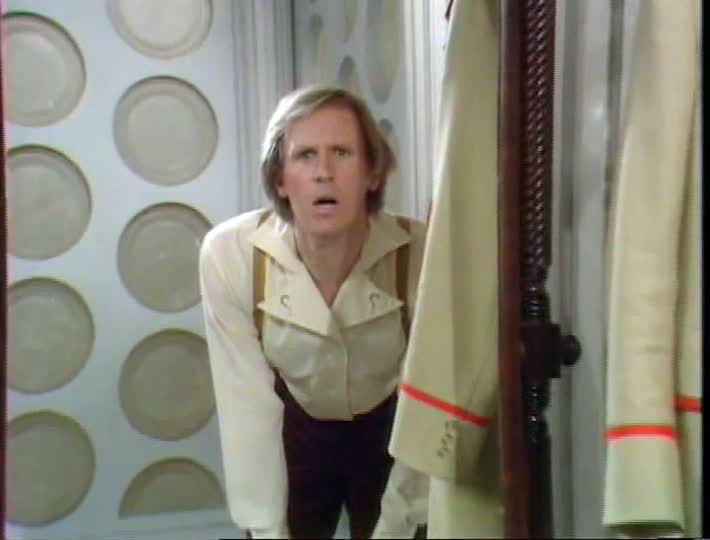
First broadcast 4 January 1982.
Doctor Who has been, since 1966, been a series partially defined by its changes of lead actor. When original star William Hartnell was forced to retire due to ill-health, his character simply transformed into a new person. After all, the Doctor was a mysterious alien; who knew what strange abilities they may have had? With the debut of Patrick Troughton, Doctor Who was effectively given a license for its ridiculous longevity. When one actor leaves, bring in another to replace them. It guaranteed a refresh to the series every couple of years, and ‘regeneration’ became a core element of the series mythology.
“Castrovalva” marks the debut serial of the fifth Doctor, played by Peter Davison. It was one of the more critical changes in the series’ history: Davison’s predecessor Tom Baker had filled the role for an unprecedented seven seasons, and to make the change as impactful as possible producer John Nathan-Turner cast what was essentially Baker’s opposite: younger, less comedic, and almost unprecedentedly earnest in character. It also coincided with a critical shift in broadcast scheduling, taking the series away from its traditional Saturday tea-time slot and into a twice-weekly weeknight one instead.
Events pick up from the end of 1981’s “Logopolis” Part 4. The Doctor (Peter Davison) has regenerated following a fall from a radio telescope. He is helped into the TARDIS by his companions Tegan (Janet Fielding) and Nyssa (Sarah Sutton), but Adric (Matthew Waterhouse) is kidnapped by the Master (Anthony Ainley). While the Doctor seeks to recuperate, the TARDIS controls have been set to certain destruction inside the Big Bang.
“Castrovalva”, written by the series’ outgoing script editor Christopher H. Bidmead, has a comparatively odd structure to it, and one wonders if it was written deliberately to fit the twice-weekly broadcast. The serial essentially splits into two: a second half set in the titular village of Castrovalva, and this first section set almost entirely inside the Doctor’s TARDIS.
One thing that is very obvious viewing the episode decades after its broadcast is just how amateurish some of the acting is. Performances in general are geared much more towards the theatrical, and also with a mind towards children’s television. The dialogue pushes the actors into melodramatic territory, and with a fair amount of over-explaining the plot. It seems the only actor immune to this is Davison himself, who pretty much emerges fully-formed as a particularly thoughtful, much less flippant variation of the Doctor than Baker’s. “Castrovalva” was aired first, but recorded fourth: a canny move that let Davison cement his portrayal before making his debut.
It is immediately clear that one of the innovations of the period – giving the Doctor three companions for the first time since 1965 – is a mistake. With a 25-minute running time – including opening and closing credits and a replay of the last episode’s cliffhanger – there is not enough room to provide material and action for four lead characters. It is noticeable here that Adric is taken out of play within minutes, and Tegan and Nyssa paired together, to simplify the plot threads. This problem will plague the series off and on for the next two years, when the number of companion characters is mercifully reduced.
It must have been a relief for audiences to only wait one day for the second part of the story: precious little actually happens in this episode, bar the pleasure of seeing Peter Davison – a deeply underrated Doctor – making his grand entrance. It is a testament to director Fiona Cumming that it is as interesting as it is.


Leave a Reply