“They don’t make them like they used to,” goes the oft-quoted line. Usually this is not actually true; nostalgia is a hell of a thing. Despite knowing the potential risk of such sentiment, I have lately found myself watching an awful lot of American films from the 1990s. 21st century Hollywood has famously bifurcated into every expensive studio-funded films, and very cheap independent films, and the middle ground – reasonably budgeted, mainstream comedies and dramas – have by-and-large fallen away. My growing cravings for straight-forward, well-crafted, but comparatively undemanding fare have me scouring thrift and charity shops for old DVDs of films I have not seen before. I am generally enjoying what I find, but am also aware I am likely overrating these films at the same time: a craving for a certain type of food does not mean one necessarily eats good food, and it turns out the same can be true of cinema.
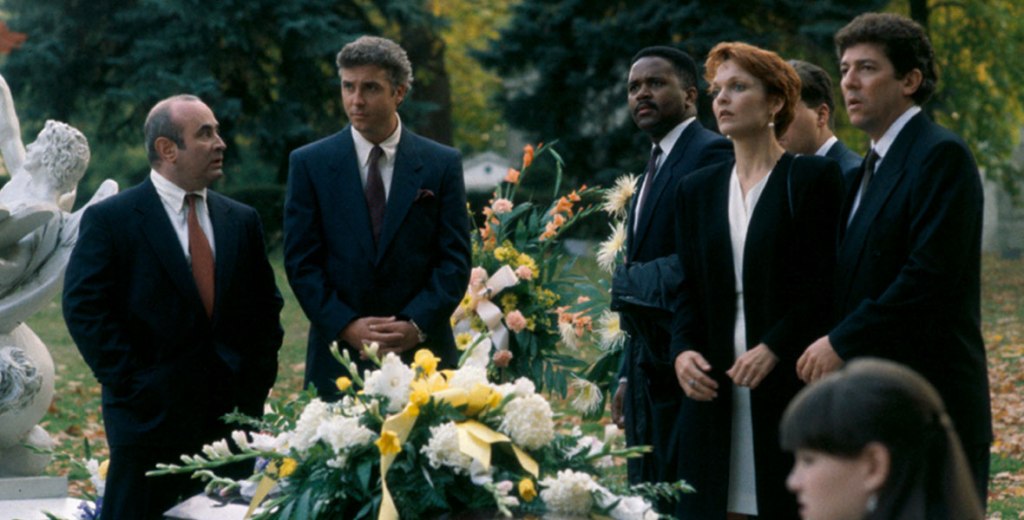
Passed Away is a 1992 ensemble comedy about an Irish-American family coming together after the death of the family patriarch. The film is written and directed by Charlie Peters, a career screenwriter who only directed twice: here and in 1998’s Music from Another Room. There is little in Peters’ screenplay that feels original, but the familiar beats and routines have a comforting sense. Almost all of the film’s enjoyment comes not from the story but how the cast plays it. There is a great cast here – most of them sorely under-used – and they lift the material admirably. I am not sure I would find time to watch the film again, but it was certainly sufficiently enjoyable the one time around.
That’s a pull quote for advertising if ever I saw one: ‘sufficiently enjoyable’. Honestly we do not rate such films highly enough. Between the pressures on modern cinema to find an audience and the rise of prestige television, I sometimes feel we are all severely lacking in just reasonably decent entertainment. Passed Away certainly suits that requirement for me.
Bob Hoskins plays eldest son Johnny Scanlan, who drops his elderly father Jack (Jack Warden in cameo) off at his office right before a surprise party leads the old man to immediately die of a heart attack. The remainder of the film seems Johnny’s siblings dutifully assemble at the mother’s house for the funeral and the wake. Hoskins slips directly into the gruff, loveable mode he employed back in Mermaids (1990), and given he is sadly no longer with us it was wonderful to see him perform again. Johnny’s siblings are very effective played by William Petersen – who knew he could do comedy?, Frances McDormand as a radically-minded nun, and Pamela Reed (Kindergarten Cop) as a dancer hiding her divorce from her gay ex-husband (Tim Curry). They are all great to watch, with Reed a particular highlight. Curry, however, is sorely underused, although to the film’s credit his character’s homosexuality is never mocked or used as the butt of jokes.
At the viewing of Jack’s body, Johnny spies a mysterious woman in black (Nancy Travis) at the back of the room. Suspecting she might be a previously undiscovered mistress of his father’s, he begins an odd, flirtatious friendship with her. He, of course, takes things too far and becoming besotted with her. She, a more patient person that I would be, politely will not have a bar of it. There is an odd balancing act being played out in the screenplay: Johnny is already married to Amy (Blair Brown), but dissatisfaction with his day-to-day life sees his sorely tempted to stray. It is partly Peters’ script and partly Hoskins’ performance that manages to play these story out and keep the character identifiable and sympathetic at the same time.
When Passed Away was originally released, it was met by general disinterest by the critics of the time. The prevailing assessment was that of mediocrity, and I feel with the benefit of 30 years or more that is a little unfair. This is a decently performed, entertaining comedy with a knockout cast elevating its faults admirably. It really is okay that it is sufficiently enjoyable.


Leave a comment