First broadcast 18 May 2013.
Some of the best ideas that Steven Moffat ever had for Doctor Who are played out in this, the final episode of its seventh season. Saul Metzstein directs with flair, but the execution of Moffat’s concept wobbles terribly. The best bits of “The Name of the Doctor” feel exceptional, but it does keep pulling its punches. To confuse things even further, Moffat then drops the single-biggest cliffhanger in Doctor Who history. What is a fan to do?
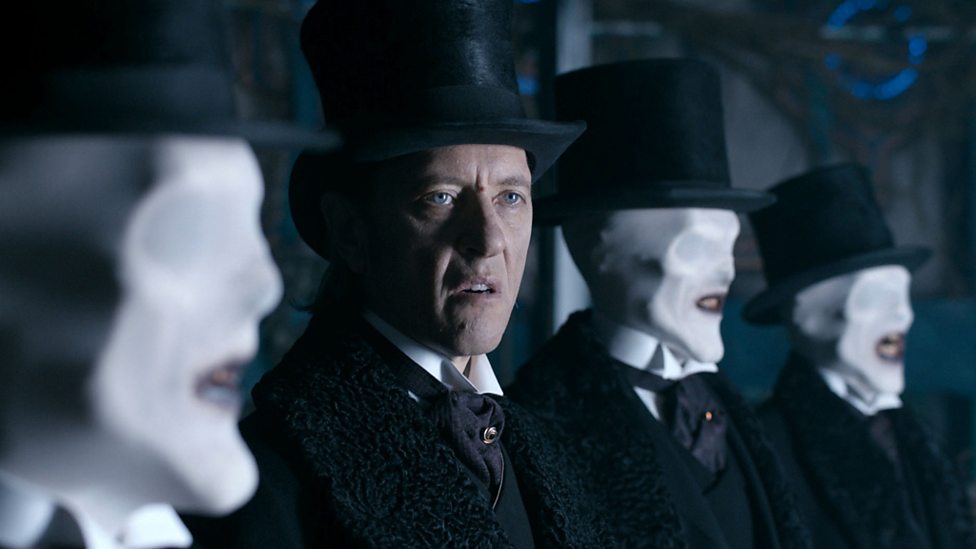
An incarcerated serial killer in 19th century London sends the ‘great detective’ Madame Vastra (Neve McIntosh) on a mission to assemble the Doctor’s closest friends – including companion Clara (Jenna Coleman) and deceased wife River Song (Alex Kingston) – and warn him that his greatest secret is uncovered. On the planet Trenzalore the Doctor (Matt Smith) must venture into his own tomb from his future and stop the Great Intelligence (Richard E. Grant) once and for all.
Trenzalore – the site of the Doctor’s final battle – was foreshadowed back during the sixth season in 2011. To have it suddenly emerge as an actual destination, and one that moves the Doctor to tears, is incredibly effective stuff. It is played out in a brilliant fashion as well. Of course the TARDIS would become his tomb. Of course the body of a Time Lord would be so much more complicated that a simple corpse. It feels evocative, and imaginative, and terribly bold. It also feels remarkably climactic. It just oozes importance and gravitas.
What a shame, then, that Moffat fails to develop a wholly satisfying episode around it. There is a lot of talking in “The Name of the Doctor”, and not a great amount of incident. There are a lot of gestures in the direction of a story, without one actually forming in a fully-fledged structure. The episode introduces a lot of elements, but does not really explore or explain them. An incarcerated killer who has learned the Doctor’s deepest secret is revealed, and then entirely ignored. The Great Intelligence returns, still in the body of the late Dr Simeon from “The Snowmen”, but there is still no clear explanation to flesh out the character, link its appearances from there to here with “The Bells of St John” in between, or even how this hollow ‘in-name-only’ antagonist links to the Great Intelligence seen in the 1960s. The Intelligence also now seems capable of time travel without any elaboration.
There is a marvellously creepy scene early on, where recurring character Jenny (Catrin Stewart) appears to be murdered. Moffat immediately backs away, revealing her – somewhat unconvincingly – to be alive. The episode’s climax gives an explanation to the seventh season’s ‘impossible girl’ story arc, and decent closure for Clara’s character. The smart and satisfying thing to do would be to kill her off, but again Moffat flinches and deflates all emotional power in favour of neat – if inexplicable – endings.
And then, just when the episode seems neatly tied up and somewhat disappointing, it throws in a last-minute reveal of screen legend John Hurt as a previously undisclosed incarnation of the Doctor. It is probably the boldest creative choice Moffat ever made running Doctor Who, and powers a tremendous cliffhanger, and of course leads straight into the 50th anniversary special in November 2013.




Leave a Reply