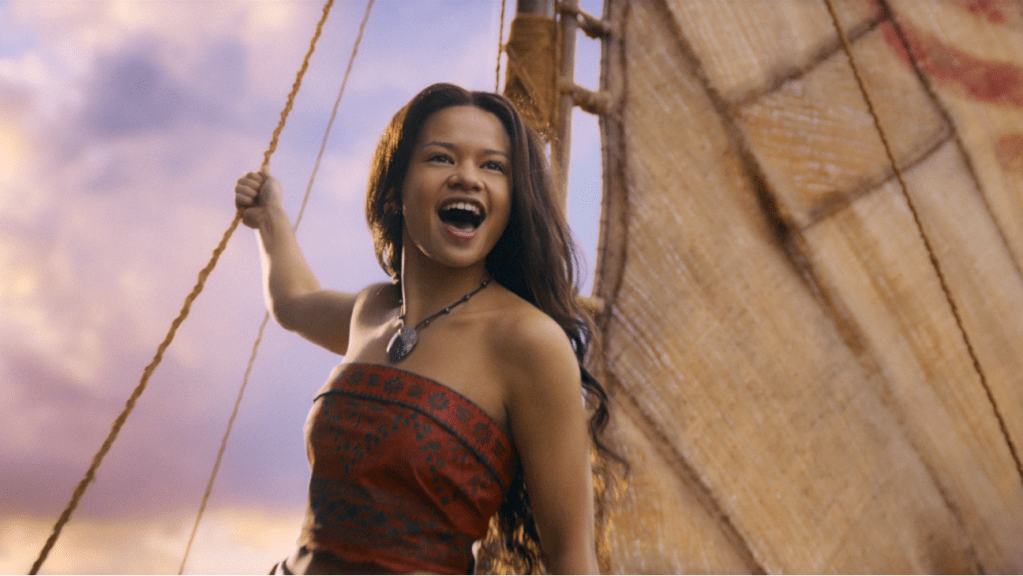
It must be difficult for the creatives hired to remake Disney’s animated features to find opportunities to be inventive. By and large they simply duplicate the popular original films with a combination of live-action and CGI, in many cases on a shot-for-shot basis. Certainly they are becoming difficult for critics to continue reviewing them: how many times must we write the same piece, condemning the company’s imagination-free, mercenary approach? How many different ways are there to bemoan art’s latest beating at the hands of commerce?
In the 1960s Walt Disney Productions started using photocopiers on a high contrast setting to bypass the time-consuming process of inking their animated films frame by frame. Initially it was done to affordably animate the massive cast of One Hundred and One Dalmatians, but the technique was kept around for well over a decade. The result was a generation of Disney films like The Sword in the Stone, The Jungle Book, and Robin Hood, all cursed with a loose, sketchy look that made them look inferior to the older works from the 1940s and 1950s. These days it feels like the company is not photocopying frames but entire motion pictures.
Thomas Kail’s Moana is Disney’s latest act of artistic duplication, remaking John Musker and Ron Clements’ 2016 animated classic. One could see the profit motive behind earlier remakes like The Little Mermaid and The Lion King: films old enough that the children who saw them in cinemas could now bring children of their own to see the new versions. Moana is just 10 years old: who are those original children bringing this time? Younger siblings?
Moana sees its titular Polynesian princess venture across the Pacific Ocean to restore a magical gem – the Heart of Te Fitti – to its proper resting place. To achieve this goal she must enlist the help of the demigod Maui – the same mystical trickster who stole the gem in the first place. Dwayne Johnson, who voiced the original animated Maui, returns to perform the role again in live-action. Auli’i Cravalho, who voiced the original Moana, has been replaced by Australian Catherine Laga’aia. The new film’s plot duplicates its namesake precisely: if you have seen the 2016 Moana, then you know exactly what you are going to get from the 2026 one.
If one can temporarily put the original film aside, and sample the new Moana on its own merits, there is actually a reasonably enjoyable film here. Johnson and Laga’aia have a pleasing chemistry together, and both deliver more grounded performances befitting the live-action medium. There is a fair amount of well-staged CGI-heavy action sequences, and a number of very entertaining and well-performed songs. Rena Owen is a particular highlight as Moana’s mischievous grandmother Tala, and John Tui and Frankie Adams are excellent as Moana’s parents.
The problem is that while these elements all pull together to make a reasonable three-star film, every part that works does so because it cribs liberally from a five-star film. Musker and Clements’ Moana is honestly one of Disney’s finest animated features ever, and every part of the new film that entertains was much more entertaining the first time around. Matters are not helped by the new film’s extensive reliance on CGI for its backgrounds and settings. It is a constant problem with the tendency to label these remakes as “live-action”: they are so soaked in a virtual sheen of artificiality that any benefit from using real actors is negated by the unreality of their environment. If Moana spent even one day shooting on the open ocean, it was a day wasted since there is honestly no moment that feels touched by actual sunlight.
Young children that have not seen the animated Moana might get a lot of value from this new iteration, but I cannot imagine many others will. There is simply no supplanting the original, which remains freely available – not to mention perennially popular – on Disney+.
Prior to Melbourne’s premiere screening there was a theatrical trailer for Hexed, a new Disney animated feature opening worldwide this November. Or, if current trends continue, in live-action by 2030.



Leave a Reply