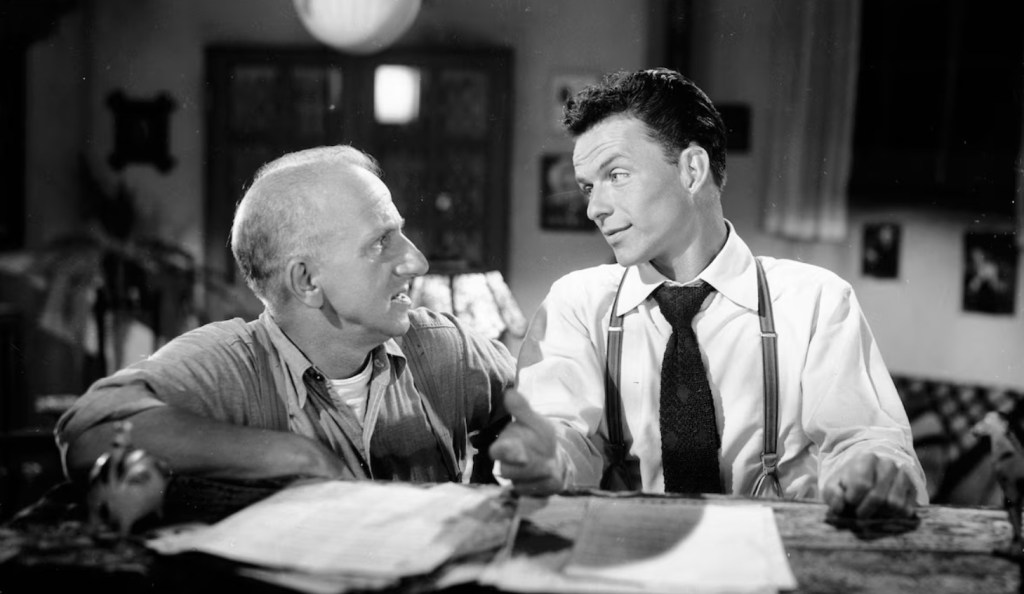
Richard Whorf’s It Happened in Brooklyn, released in 1947, is one of a string of Hollywood musical features about returning servicemen looking for romance after World War II. The film stars Frank Sinatra, whose contract with RKO Radio Pictures was bought out by MGM in 1945 to put him into George Sidney’s Anchors Aweigh opposite Kathryn Grayson and Gene Kelly. That film’s popular success cemented Sinatra’s status as a major musical film lead, and after appearing in the 1946 ensemble picture Till the Clouds Roll By he was given It Happened in Brooklyn as a star vehicle. It was intended for George Sidney to direct the film as well, but the task was ultimately taken by Till the Clouds Roll By‘s Richard Whorf instead.
The film re-teams Sinatra with Kathryn Grayson, and throws in comic performer Jimmy Durante and English-American Peter Lawford for good measure. Sinatra plays Danny Miller, returning home to Brooklyn after the war, and keen to find employment and a steady girlfriend. He returns to the high school where he first enlisted in the army, where he meets both janitor Nick Lombardi (Durante) and music teacher Anne Fielding (Grayson). Before long he is also living with the under-confident pianist Jamie Shelgrove (Lawford), who has arrived in New York to gain some worldly experience.
The film was not a hit at the time, perhaps because it lacked a standout musical number. There are six of them in total, all by Sammy Cahn and Jule Styne, and while they work effectively in context none of them managed to find popularity outside of the film itself. It is also a black-and-white picture, released at a time when MGM’s own most successful films were produced in colour. The appeal of It Happened in Brooklyn comes not from its music, but from its characters and story. It is a surprisingly effective and warmly presented work, with enough highlights and narrative wrinkles to make it something of an underrated gem.
The film plays something of a twist with its central romance, setting up one budding relationship in the first half before subverting it in the second. It also gives Grayson her own storyline and ambitions beyond providing a love interest for her male co-stars. Sinatra and Durante play off one another wonderfully, and express a quiet Italian-American theme through the whole picture. It helps to give a sense of not just a New York setting but a specific Brooklyn one.
There is also a pleasing use of a teen ensemble of young actors, essentially Anne’s high school students, who give an energetic and then-contemporary edge to the music. Their love of faster-paced boogie woogie music, at least in comparison to the adult characters, pre-figures the rock’n’roll scene of the 1950s. Child actor Bobby Long makes his only feature film appearance here, tap dancing his heart out with Sinatra and Durante in the lively “I Believe” sequence – a scene distinctive enough to make it into the MGM anthology feature That’s Entertainment II in 1976.
There are more famous MGM musicals and less famous ones, and while the best-known are adored for good reason it is often the second-string musicals that prove the most interesting. This is a great example of that, and a modest delight waiting for viewers to discover its charms.



Leave a Reply