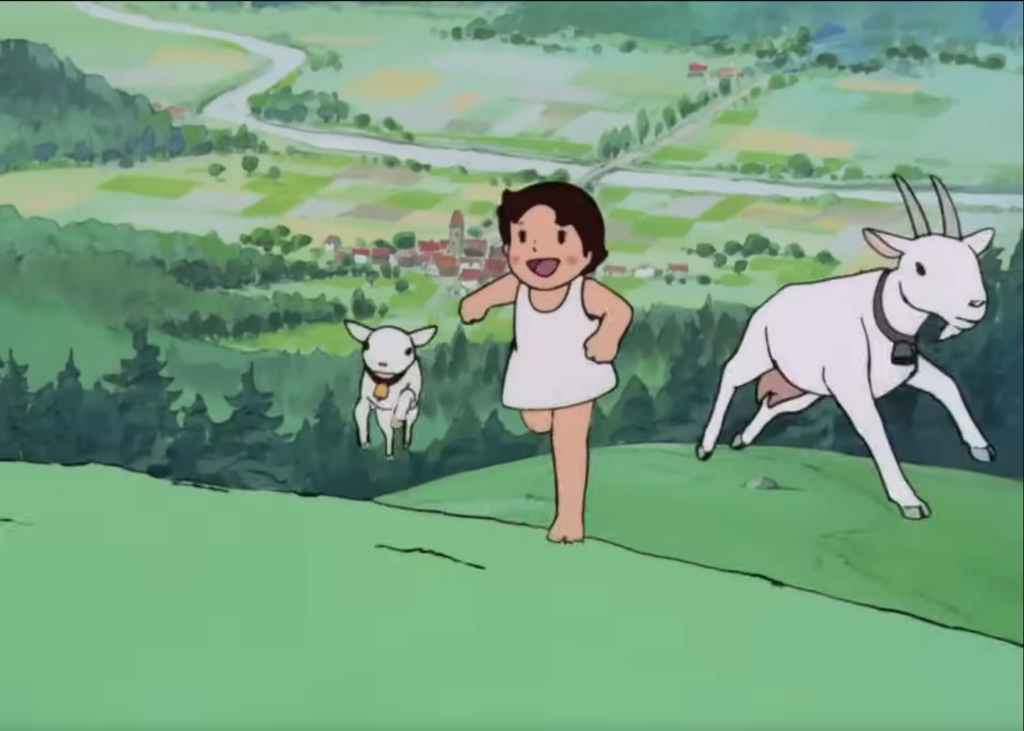
Released direct-to-video in 1993, Mt Alm is an edited feature comprising multiple episodes of the 1974 anime serial Heidi, Girl of the Alps. That series adapted the Johanna Spyri children’s novel Heidi (1880) across 52 half-hour episodes. The edited version is one of two compilations that streamlined those 52 episodes down to a pair of 90-minute parts, and redubbed the dialogue in stereo. It is perhaps not the most authentic way to experience the series, but it is certainly a rather efficient one. One can experience the style, the tone, and the visual design work, and skip almost 19 hours in the process.
Asides from being a very popular and fondly remembered anime series, Heidi, Girl of the Alps represents one of several classic fiction adaptations by director Takahata Isao. Before this period, in which he also directed 3,000 Leagues in Search of Mother and Anne of Green Gables, Takahata was best known for directing the feature The Great Adventure of Horus, Prince of the Sun and the Panda, Go Panda shorts. 10 years after Heidi, he would join Suzuki Toshio and Miyazaki Hayao in establishing the production company Studio Ghibli, and direct films including Grave of the Fireflies, Pom Poko, and The Tale of the Princess Kaguya.
Miyazaki Hayao, who was six years younger than Takahata, also worked on Heidi as a scene and layout designer and contributing writer. One can see the influence these early television works had on Miyazaki’s own aesthetic as well as on Ghibli more generally; in Heidi herself, one can see My Neighbor Totoro‘s Mei, the titular Ponyo, and Grave of the Fireflies‘ Setsuko. Adorable little girls are, at the end of the day, rather universal.
It is the first act of Mt Alm that seems the most effective, largely because it takes its time in setting up Heidi’s new home with her grandfather, her friendship with the shepherd boy Peter, and her love for the goats that Peter herds around the mountainside. Later scenes take Heidi to Frankfurt to be companion to a young disabled girl named Clara. In this section the film tends to accelerate a little top quickly, and the result is a narrative that feels less grounded and involving. Including more footage from fewer episode would have been a better approach, and resulted in a better viewing experience.
The design work is charming, but of course the animation itself is rather limited – a legacy of its television origins. Watanabe Takeo’s musical soundtrack is a small delight, and reflects the story’s European origins; Watanabe would later compose for Mobile Suit Gundam.
This is passable entertainment, but unavoidably dated even when it was edited together in its 1993 form. Its worth is in its historical position – not just a strong example of a popular anime from a time before giant robots, but a notable step on the road to Studio Ghibli – still the world’s premier production house of animated features.



Leave a Reply