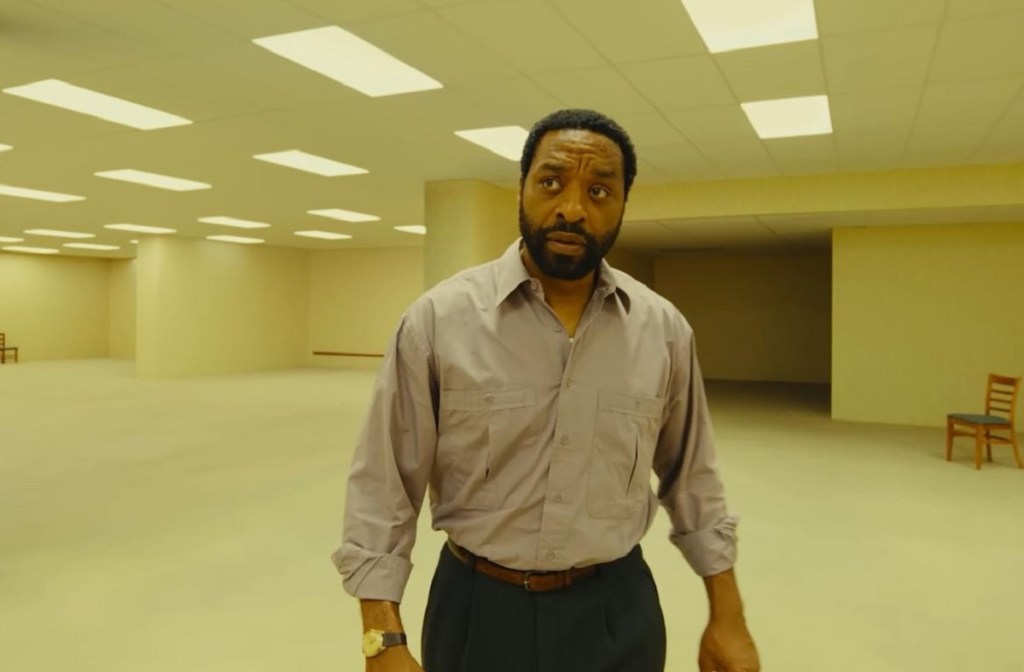
Backrooms is probably the most widely hyped horror film of 2026, but thanks to a combination of fresh and established talent, strong ideas, and a keen understanding of genre it actually matches the reputation that precedes it. The film marks the feature debut of 20-year-old YouTube filmmaker Kane Parsons; with any luck we will be seeing more of his work in future.
Clark (Chiwetel Ejiofor) is a middle-aged failed architect who owns a low-quality suburban furniture store. An abrasive personality and temper have cost him his marriage, and he has taken to living in the store after losing his house in his divorce. Clark is in therapy, with a psychologist named Mary (Renate Reinsve) who appears to be quietly dealing with trauma of her own.
Clark then discovers an invisible hole in his store’s basement wall, leading to an inexplicable yellow room packed with discarded furniture. That room leads to another room and corridor, and they lead to let more rooms and corridors, and ultimately to a seemingly infinite maze impossibly squeezed underneath the store. He also hears sounds, and sees shadows – and realises he is not alone in the labyrinth.
Every film critic with a literary bent is going to come to Backrooms and name-check House of Leaves, Mark Z. Danielewski’s acclaimed and deeply cine-literate horror novel from 2000 whose central premise – an infinite maze appearing beneath a conventional building – appears to be duplicated here. While Danielewski’s work is a clear antecedent to Parsons’ film, I am not sure it follows that it is a direct precedent to it. Instead, Backrooms reflects a wide array of potential influences and echoes earlier film works including the found footage anthology franchise V/H/S, John Erick Dowdle’s As Above So Below (2014), Spike Jonze’s Being John Malkovich (1999), Tsukamoto Shinya’s Haze (2005), Matsumoto Hitoshi’s Symbol (2009), as well as a healthy dose of David Lynch. Backrooms may be influenced by some, all, or none of these things, but it represents a striking key part of the creative conversation, and to my mind an immensely satisfying part at that.
The film also has its direct origins in Youtube shorts made by Parsons as a teenager, and they in turn draw on “Creepypasta” Internet memes, urban myths, and online chat groups. I am not particularly qualified to talk on these links, but they are there for the exploring.
There is always a risk in the horror genre of striking the best balance between mystery and explanation. Make things too oblique, and the viewer can find the film too frustrating and arbitrary. Explain events and phenomena in too much detail, and it can feel anti-climactic or absurd – the wonderful creepiness Parsons generates (with screenwriter Will Soodik) is at a constant risk of being deflated. An appearance by Mark Duplass late in the film is a superb example of walking that tightrope; a seemingly innocuous line about MRI machines contains a world of worrisome potential.
Technically the film does betray Parsons’ comparative inexperience. Relatively banal photography favours middle and two-shots for much of the picture, and the film’s pacing is arguably a little on the leisurely side. There is perhaps an unnecessary reliance on found footage techniques as well; particularly since the film’s more conventionally framed scenes are generally more effective. Individual moments and set pieces show off some remarkable creativity. A key moment of descending repeatedly through the floor of a gradually transforming living room is both highly creative and pit-of-the-gut disturbing.
Backrooms benefits from a particularly strong cast, and their performances both enhance the emotion of the piece and give it a valuable grounded vibe. Protagonist duties are essentially shared, with Ejiofor leading the first half and Reinsve the second. Supporting actors Finn Bennett and Lukita Maxwell make the most of their comparatively brief appearances.
Parsons has a keen handle on the traditional jump scares, but the real strength of Backrooms is in its rising dread, and creeping paranoia. Themes of memory and regret dominate; the film is even set in 1990, as if to accentuate its over-arching focus on memories and regrets. This is a slick, hugely effective work – and one of films most likely to dominate conversations this year.




Leave a Reply