It begins with a patch of dry, cracked earth, upon which a pair of scarab beetles fight over a rolled-up ball of clay and dung. The next two-and-a-half hours, captured perfectly in miniature.
There was a time when Hollywood went all in on lavish historical epics. Even today, decades after the fact, the most famous of them remain extraordinarily iconic. Ben-Hur (1959). Spartacus (1960). Lawrence of Arabia (1962). With this in mind, learning that there was a 1966 epic film made about the exploits of ancient Egyptian Pharaoh Rameses XIII brings to mind a certain style of film and a particular period of American film history.
Only this film is not American. It is Polish, released 19 years into a period of communist rule, and depicts a socialist Pharaoh attempting to lift the lives of his subjects and redistribute unimaginable wealth from a powerful theocracy back to the people.
When viewed superficially, or read about on the Internet, Jerzy Kawalerowicz’s film seems like a parody of what a communist movie epic would be like. When actually watched in practice, it is brilliantly staged and inventively shot. It adapts the popular novel by Boleslaw Prus in a particularly visual fashion. The performances are strong, the locations evocative. It is a masterful work of cinema. It remains, even today, one of the most popular Polish features of all time.
Jerzy Zelnik stars as Rameses, heir to the throne, who seems set to inherit an Egypt far below the heights at which it once maintained. The age of the pyramids is long gone, his armies are bolstered by foreign mercenaries, and the real power behind the nation lies not with its king but with its ruling class of priests. Much of the film details a political dance between Rameses and the high priest Herhor – played with a sort of ambivalent, calm menace by Piotr Pawłowski. The film also packs in storylines surrounding Rameses and his ailing father (played by Andrzej Girtler), love and sex involving a Jewish wife (Krystyna Mikołajewska) and an Egyptian lover (Barbara Brylska), and border wars with Assyria.
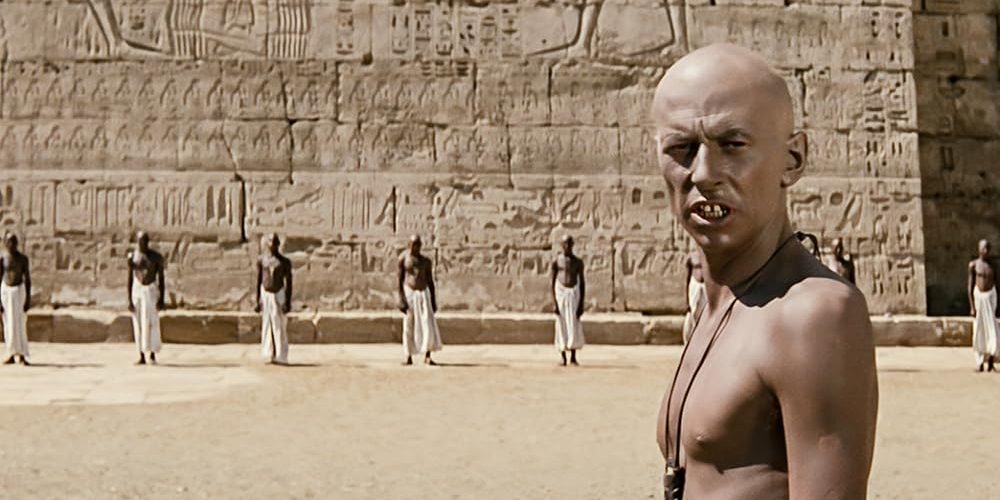
Where the film excels is not in its story but in its style. It is presented in an appropriately epic Cinemascope ratio with a massive cast of extras and an awesome sense of scale. It is dominated by a stripped-back, somewhat severe aesthetic. The film was largely shot in location in the Uzbekistan desert, which apart from enabling some production assistance from Russia’s Mosfilm also lends the picture a rather grim, grey patina. It is a colour film, but that colour feels bluntly constrained. It is a miserable vision of Ancient Egypt that dominates Kawalerowicz’s film, which makes for a major difference from its Hollywood equivalents.
Jerzy Wójcik’s cinematography belies the wide frame with consistent, often extreme close-ups and handheld photography. The story and setting may resemble the Hollywood epic, but there is a much more intimate and personal point of view dominating the film. In key scenes it becomes positively claustrophobic. Similarly, Adam Walaciński’s musical score is used sparingly, with an unexpected amount of action taking place without any non-diegetic sound at all. It is altogether a film of remarkable contrast, both small and great, personal and expansive. It ends as strikingly as it begins, and even decades after the fact leaves the viewer uncertain and unsettled.






Leave a comment