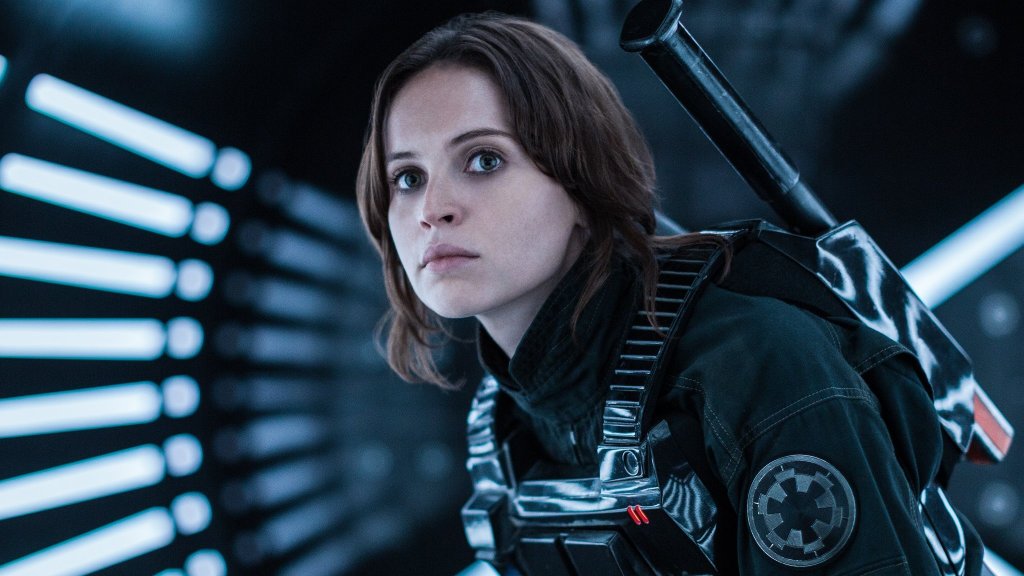
A long time ago in a galaxy far, far away, the Galactic Empire nears completion of its planet-killing space station the Death Star. At the same time the Rebel Alliance rescues a young woman named Jyn Erso (Felicity Jones) from an Imperial labour camp in order to user her to get to her father: the scientist who helped design the Death Star.
Or, in other words, Rogue One: A Star Wars Story recounts how the plans to the Death Star wound up in Princess Leia’s possession at the beginning of the original Star Wars back in 1977.
Rogue One was the first of Lucasfilm’s intended bi-annual range of Star Wars Story films, which purported to tell side-stories in the same fictional universe as the main trilogies but that would not exclusively follow the Skywalker family. This gave it a lot to achieve in two hours: it needed to be an entertaining movie, certainly, but it also needed to demonstrate that Star Wars could be a worthwhile franchise once expanded beyond the limits of Luke, Han, Leia and their various offspring.
It is now almost 10 years since Rogue One‘s theatrical release. The much-hyped Star Wars Story line only lasted one more film – 2018’s Solo – but the general approach of filling in narrative gaps has continued. A raft of streaming serials on Disney+ have been set between pre-existing Star Wars films. The Mandalorian and Grogu, currently in cinemas, is a feature sequel to one of those serials. Even Rogue One, already a prequel, received its own prequel in the shape of the two-season Andor. There has not been a work set in the “present day” of Star Wars in seven years – not since 2019’s The Rise of Skywalker – and while that looks set to change with next year’s Starfighter film, for now Star Wars looks backwards and inwards.
That is still the elephant in the room when it comes to Rogue One, which was a massive commercial hit for Disney. Before considering any other aspect of the film, it remains the case that the film tells an unnecessary story. Nothing in the original Star Wars of 1977 required further information. It was more than sufficient to know that the Rebel Alliance had secured top-secret plans to the Death Star. If the most interesting part of the narrative was how the rebels found the plans, that – and not Luke Skywalker’s story – would have formed the basis of the film. No matter how interesting a back story can be developed, or how entertaining a set of characters are created to steal the plans, Rogue One never quite overcomes its own redundancy. It is an enjoyable but ultimately unnecessary film – but of course that also arguably describes 90 per cent of all sequels and remakes ever made. It certainly at least partly describes George Lucas’ own Star Wars prequels from 1999 to 2005. The bottom line is that while stories exist to generate drama, prequels primarily exist to deliver trivia. Even when they generate decent works, such as this very film, those works are battling their own format from the get-go.
Tonally speaking, director Gareth Edwards has developed a film that sits very comfortably within the milieu of the Star Wars movies but which also manages to dig into some fresher, and slightly darker territory. Upon its release quite a few people cited The Empire Strikes Back as comparable, which feels about right. It is certainly a less child-friendly film than, say, The Force Awakens, but at the same time it is not so adult that children can’t enjoy it – although they may need some consoling and debriefing afterwards.
Edwards’ aim was always to make a film that emphasised the “wars” in Star Wars, and he comfortably succeeds. It is not a film about Jedi and individual heroes saving the galaxy, but rather an ensemble piece in which small victories are treasured and success comes with a significant body count. Despite the science fiction setting there is a sense of The Guns of Navarone, The Dirty Dozen, and even The Magnificent Seven as it goes: all of them being films about a disparate group of fighters working towards an almost-unwinnable cause.
The film works best when it is focusing on new characters. While some pre-existing figures turn up in supporting roles – and part of the joy for a hard-core Star Wars fan is likely seeing them as they arrive – Rogue One focuses primarily on Jyn Erso and rebel spy Cassian Andor (Diego Luna). Andor is a wonderful sort of morally grey character, one who has no hesitation in shooting someone dead if it means completing his mission. As the film’s protagonist Jyn is mildly unsuccessful: there is something in Felicity Jones’ slightly mannered and arch performance that robs the character of any grit or realism. Compared to the previous year’s Rey (Daisy Ridley), she definitely comes off second-best.
The supporting cast is packed with strong actors playing hugely enjoyable roles, and this is where Rogue One really gathers up a lot of its appeal and energy. Ben Mendelsohn is marvellous as Krennic, the Imperial official in charge of the Death Star’s construction. He represents classic middle management: an overly ambitious schemer doing a fairly poor attempt at his job. Mendelsohn makes him a very enjoyable villain through his embittered mannerisms and awkward attempts at authority. Out of all the film’s creations, he is definitely the key stand-out after the passage of time.
Other highlights include Alan Tudyk as K-2SO, a reprogrammed Imperial droid who gets most of the film’s best lines, and Riz Ahmed as Bodhi, a nervous and somewhat traumatised shuttle pilot who defects to the rebels. The rest of the cast is filled with great actors – Donnie Yen, Jiang Wen, Mads Mikkelsen, Forest Whitaker and others – but with a finite running time and an ensemble cast they don’t really get much time to fully develop or explore their characters. That’s okay, obviously, since that’s how this sort of ensemble-based action film works, but with the calibre of actor involved it’s much more noticeable than usual.
An element I did not mention in my original 2016 review was the inclusion of a computer-generated simulacrum of the late Peter Cushing as Star Wars‘ Moff Tarkin. It is certainly the most dated part of the film today, representing a deeply creepy example of “the uncanny valley” – not to mention an ethical nightmare in resurrecting a deceased actor without their direct consent. What seems particularly jarring is that he is – asides one small cameo – the only character resurrected in such a fashion. Return of the Jedi‘s Mon Mothma, for example, simply got recast.
The film’s narrative is structurally uneven, with an over-long and rambling first act, a weirdly under-cooked second act, but then a beautifully paced and structure finale with a significant but smooth shift in tone towards the conclusion. It is this third act that I think gives the film so strong a reputation. Audiences, and particularly fans, will forgive and forget a lot of the film’s first half once they’ve been given some space battles, shoot-outs, and Darth Vader in his prime.
An earlier version of this review was published on The Angriest. It has been amended following a 2026 rewatch.



Leave a Reply