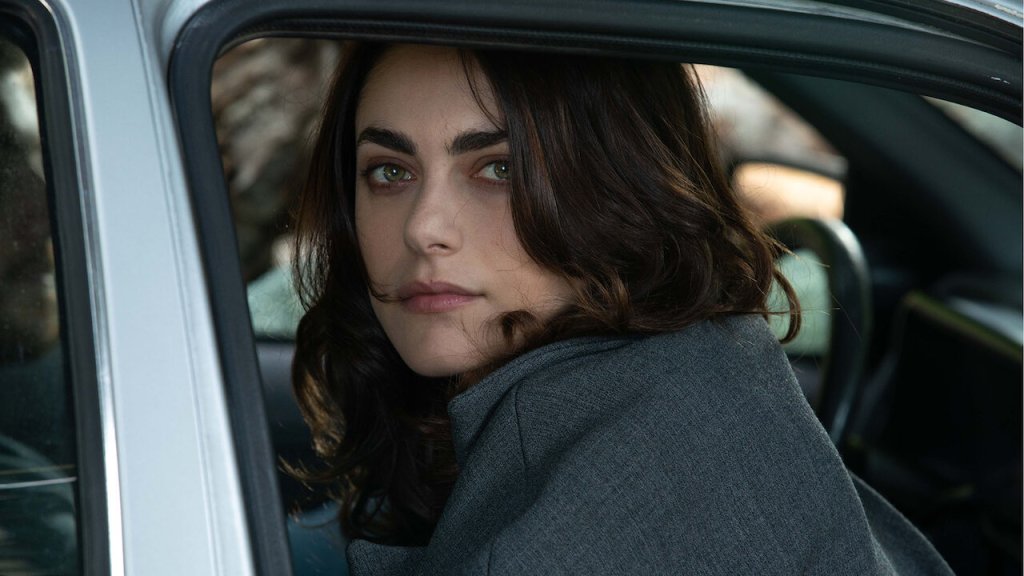
Italian technology entrepreneur Adriano Doria (Riccardo Scamarcio) waits in his luxury apartment while under suspicion of murdering his lover Laura (Miriam Leone). Doria maintains he has been framed. A legal specialist arrives to double-check his story, and ensure his testimony will stand up against Milan’s district attorney. It soon becomes clear that Dorio has not been telling the whole truth.
The Invisible Witness is a 2018 Italian thriller directed by Stefano Mordini, and a remake of Oriol Paolo’s 2016 Spanish thriller The Invisible Guest. The original film has been remade six times to date: in Italy, South Korea, China, and three times in India. That strongly suggests a winning commercial model for Paolo and Lara Sendim’s original screenplay. I have not seen the original film; a quick survey of reviews of Mordini’s Italian version suggests it is close to a shot-for-shot duplication.
The film adopts a framing narrative of Doria being interviewed by expert Virginia Ferrara, and his testimony being played out via a series of flashbacks. His affair with the photographer Laura Vitale is played out, as well as a terrible accident on an isolated country road that leads both to conceal a man’s death. It soon becomes apparent that Doria is a classic ‘unreliable narrator’; he is hiding the full truth from Ferrera, and it is only her relentless interrogation that begins to slow pick his story about and replace it with the truth. The process develops into a series of twists, re-visiting events over and over and revealing further complexity and constant surprises.
It is possible, as The Invisible Witness (and presumably its six sister films too) demonstrates, to have too many surprises. The constant twists and swerves of the narrative eventually come so thick and fast that it genuinely becomes difficult to remember which flashback was true, partially true, or entirely false. It is a maddening patchwork of tense conversations, menacing moments, and shock revelations. While most of them work in isolation, they accumulate into a particularly exhausting whole. Matters are not helped by the film’s most shocking revelation being so easy to recognise and so early that much of the 102-minute runtime may be spent waiting for the movie to catch up to its audience.
Mercifully the film is atmospherically shot and reasonably well paced, and the performances by-and-large ring true and entertain. Riccardo Scamarcio is remarkably stoic at the film’s centre, although the difficulty in reading his emotions does help with the uncertainty over his story. Miriam Leone is more vibrant and arresting as Laura, and she does an excellent job playing a constantly shifting and unreliable character. We never encounter Laura for real. She is only ever witnessed as part of Doria’s flashbacks, and as we know from the outset that he may be lying. It is a particularly challenging role as a result; Leone does incredibly well. Also particularly strong is Fabrizio Bentivoglio as Tommaso Garri, a man with a particular connection to Doria’s case.
There is so much talent spent on this film, but the end result disappoints because it simply offers too much to the viewer and at too frantic a pace. It is all sturm und drang, giving high emotions and ratcheted tension without clarity, patience, or logic. It offers gaudy thrills in the moment, but as soon as the credits roll the viewer’s lingering questions will blow the house of cards to pieces.



Leave a Reply