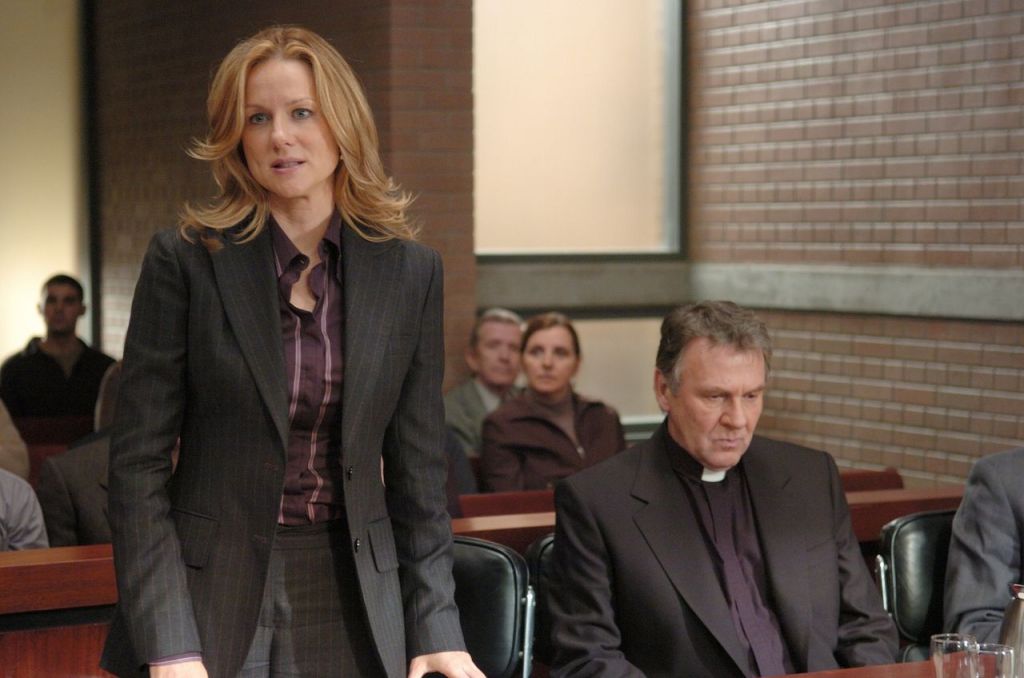
There is always an issue with horror films that claim to be based on true stories. In Hollywood the poster child of recent years has been the hugely successful but ethically dubious Conjuring franchise, which has made popular demon hunters out of the notorious real-life Ed and Lorraine Warren. Pre-dating The Conjuring by a full eight years is Scott Derrickson’s The Exorcism of Emily Rose. It is a thoughtful and innovative film, blending elements of supernatural horror with a courtroom drama. It also purports to be based on actual events, and again there is a bit of an ethical quandary to be unravelled there. Real events may have inspired its writing, but The Exorcism of Emily Rose is pure fiction – but even taken an inspiration for popular entertainment, it is hard not to forget that a real woman died.
Anneliese Michel was a young German woman in 1976 who was diagnosed with epileptic psychosis and bipolar disorder. When conventional medical treatments failed to improve her condition, her parents – believing her to be possessed by demons – enlisted a Catholic priest to perform an exorcism. After 67 exorcism sessions Michel died of severe malnutrition and dehydration, and her parents and the priest were found guilty of negligent homicide. These events were the basis of the German drama Requiem (2006), starring Sandra Hüller, and of course they are also the basis for Emily Rose, which relocates the action from 1970s Germany to present-day America.
This is very much a film of two halves. The titular Emily Rose (Jennifer Carpenter) is as good as dead when the film begins, and Father Richard Moore (Tom Wilkinson) is already facing criminal charges over her death. The Catholic diocese is seeking a religiously faithful lawyer to defend him, and they land on Erin Bruner (Laura Linney) – not a Catholic, but at least a Christian. Bruner’s first challenge defending her client is that Father Richard wants to use his trial as a soapbox from which to reveal the dangers of demonic possession.
The courtroom set-up automatically lends any film a theatrical, innately dramatic sense, and it is no different here. Linney and Wilkinson are sensational actors: Linney performing a woman in a crisis of faith, and Wilkinson adopting a slightly manic intensity that he will perfect in 2008’s Michael Clayton. Also contributing to these sequences is a talented line-up of supporting actors including Mary Beth Hurt, Campbell Scott, Colm Feore, and Shohreh Ashdagloo.
The other half of the film, told in flashback, is an archetypal but hugely effective possession thriller. It centres on a fantastic performance by Jennifer Carpenter, and is well developed with key moments of dread, rising tension, and blind terror. Presented in isolation and it would represent a broadly watchable and entertaining horror film. Interweaved with the more realistic and grounded legal drama, and the two sides elevate one another to make a film better than either half on its own.
Director Scott Derrickson has gone on to helm a number of effective and enjoyable supernatural and horror pictures, including Sinister (2012), Deliver Us From Evil (2014), and The Black Phone (2021). None of them quite match this, his sophomore feature, for inventiveness and dramatic weight. It is a hugely effective and original thriller. Am I troubled by its manipulation of a true story? A little, for sure, but it is also an effective piece of work.




Leave a Reply