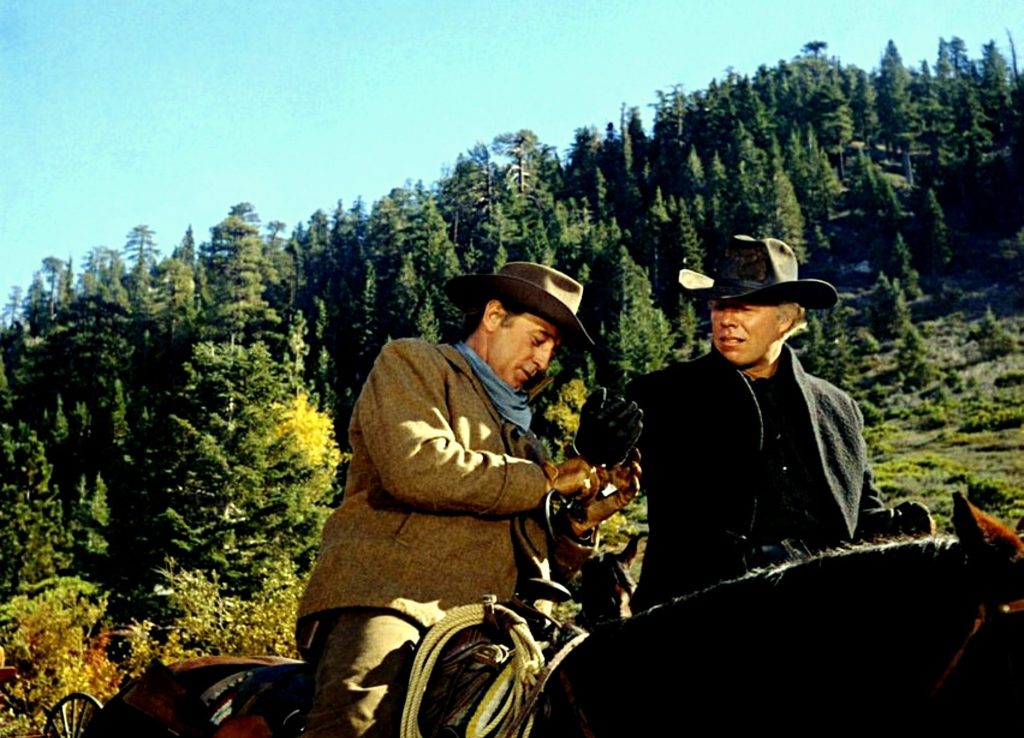
Burt Kennedy’s light-hearted western The Good Guys and the Bad Guys did not do too well with audiences or critics back in 1969. Viewed in retrospect decades after the fact, and it seems that perhaps everybody was just a little too harsh, or at least mistook a failure to match viewers’ tastes at the time for a lack of quality. While no forgotten classic, it is nonetheless an appealing caper with a lot more to recommend than to criticise.
Robert Mitchum plays ageing Marshall Jim Flagg, finally facing a chance to capture lifetime rival and outlaw “Big John” McCay (The Dirty Dozen‘s George Kennedy). When he tries to warn locals of McCay’s impending bank robbery, an unappreciative mayor (Martin Balsam) forces Flagg into retirement. When Flagg ultimately tracks down McCay, he discovers the once-feared criminal has been kicked out of his own gang – and together the former enemies unite to prevent the impending robbery’s success.
Mitchum was a great hard man in a string of successful westerns, but here he shows a likeable warmth and a keen sense of comic timing. There is plenty of action in The Good Guys and the Bad Guys, in expected forms of showdowns, shoot-outs, and horse chases, but it is all exercised with a lightness of touch. In Mitchum’s hands Flagg’s weary cynicism simply makes him more appealing to watch. There is a strong feeling that everything in Flagg’s way is simply one too many of him to bear: whether a needless complication, an officious local government, or yet another idiot failing to trust in his wisdom and experience.
It is not surprising, then, that the one man most appreciative of him is the same one he has been tracking for so many years. George Kennedy has demonstrated wit and comic skill – he provided much of the best humour in The Dirty Dozen – and he shapes McCay with a surprisingly enjoyable manner. There is a tremendous spark between Mitchum and Kennedy at the film’s centre and a strong cast in support as well, including Balsam, Dick Peabody, and Lois Nettleton.
The film, which was written by Ronald M. Cohen and Dennis Shryack, has a novel 1900 setting. The ‘old west’ setting that dominates the genre is largely dead and gone. There is greater law and order, a vast and orderly railway network, and the introduction of early motor cars to the landscape. For both Flagg and McCay it represents how time is moving on, and how both men are growing too old for their former way of life.
It all falls comfortably into a broad theme for American westerns in 1969. The heat of the genre had shifted to the Italians and their lusty ‘spaghetti’ westerns. Meanwhile Hollywood was playing with how westerns might come to an end, in the likes of Butch Cassidy and the Sundance Kid, True Grit, and The Wild Bunch. Compared to those widely well-regarded classics, it is no surprises The Good Guys and the Bad Guys came across as a little inconsequential or lightweight. There is an entertaining film here though, with merits that passed its original audience by.



Leave a Reply