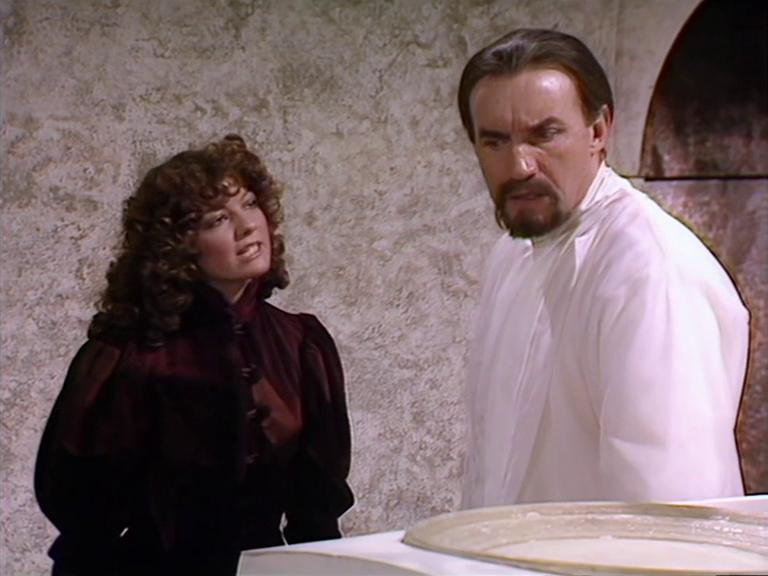
First broadcast 12 January 1982.
The village of Castrovalva has been transformed into a nightmarish recursive trap, with the streets folding in on themselves and the Doctor (Peter Davison) and his companions trapped inside.
Something that became very apparent in writer Christopher Bidmead’s tenure as Doctor Who‘s script editor, and it is apparent here in his own story, was a love for rambling pop science as an inspiration for stories. Here he seems obsessed with the concept of “recursion”, and name-checks the concept several times over the course of the serial. He is also obviously inspired by the artist M.C. Escher, whose career was typified by logic-defying drawings of impossible architecture. Escher’s work “Castrovalva”, featuring a mountain-side village, inspired both the title and the setting of this story.
While the constant talk of recursion feels slightly silly, the physical twisting of Castrovalva in on itself is a wonderful, and quite terrifying, idea. Particularly effective are the scenes of the town’s various inhabitants – Shardovan, Mergrave, and so on – intellectually realising their predicament despite not being able to see it. They are part and parcel of the artificially generated trap, and therefore cannot perceive anything wrong with the town at all. Of course the episode struggles to visualise such a twisted set-up, and while director Fiona Cumming does her best she is really betrayed by an impossible script. When the episode was first broadcast, BBC audiences were dab hands at taking television drama at its word rather than at what it presented. It is necessary for a 21st century viewer to keep that in mind.
The Portreeve is, of course, revealed as the Master (Anthony Ainley), using Adric’s mathematical skills to construct the physical town and its people out of thin air. It follows on from the Season 18 finale “Logopolis”, which was largely based on the concept, and ties in this season premiere rather nicely. It is, of course, bizarre nonsense papered over with science-sounding words, but that is largely Bidmead’s approach. My advice is to simply run with it.
What is much more difficult to ignore, however, is how the series is treating its re-imagined and resurrected Master. The original iteration, played famously by Roger Delgado, was an urbane arch-enemy – a deliberate Moriarty to the Doctor’s Holmes – with a wonderfully self-aware interplay between the two whenever they shared a room. I have commented in the past that the genius of Delgado’s Master – one largely developed by writer Terrance Dicks and producer Barry Letts – was that he never really came across as a man genuinely wanting to take over the world or murder the Doctor. Instead his sole motivation appeared to be to give the Doctor the absolute shits, like an intergalactic younger brother waving his hands up and down in front of the Doctor’s face shouting “I’m not touching you”. There is the sense of a game about Pertwee and Delgado, and a very strong sense of shared history and a former friendship.
Under Season 19 producer John Nathan-Turner, who was instrumental in bringing the Master back, this relationship is abandoned almost entirely. There is an obvious dislike between the Doctor and the Master, and the Doctor shows no humour or tolerance of the Master at all. In this episode the Doctor even describes the Master as ‘the most evil force in the universe’, which in retrospect seems an exaggeration. The Master, in turn, is maniacally obsessed and utterly demented. His lines are sneered and cackled like a pantomime villain. It is difficult to care about him because his plans are so overly intricate and ridiculous.
Take his plan for Castrovalva, which involves kidnapping Adric, creating a detailed simulation of an entire village and each of its inhabitants, situating it somewhere so that it is physically difficult to enter, writing an entire multi-volume history of the place so that it can be reproduced in 500-year-old replica hardcover books, and somehow forcing Adric to insert fake records of the village into the TARDIS databanks so that it will recommend going there. And this is his backup plan, in case the attempt to direct the TARDIS into the Big Bang fails.
During the climax of “Castrovalva”, the Master is holding a gun while the Doctor literally stands four feet in front of him. For a murderous obsessive, he is arguably the least effective one ever.
The return of the Master in Season 18’s “The Keeper of Traken” was a brilliant resurrection. His presence in the following story, “Logopolis”, is smartly developed and achieves some genuinely interesting things with the character: improvising a plan for intergalactic supremacy and disintegrating a quarter of the entire universe by mistake. “Castrovalva” really feels as if it was written, produced, and performed by entirely different people. Frankly, the character never quite recovers.


Leave a Reply