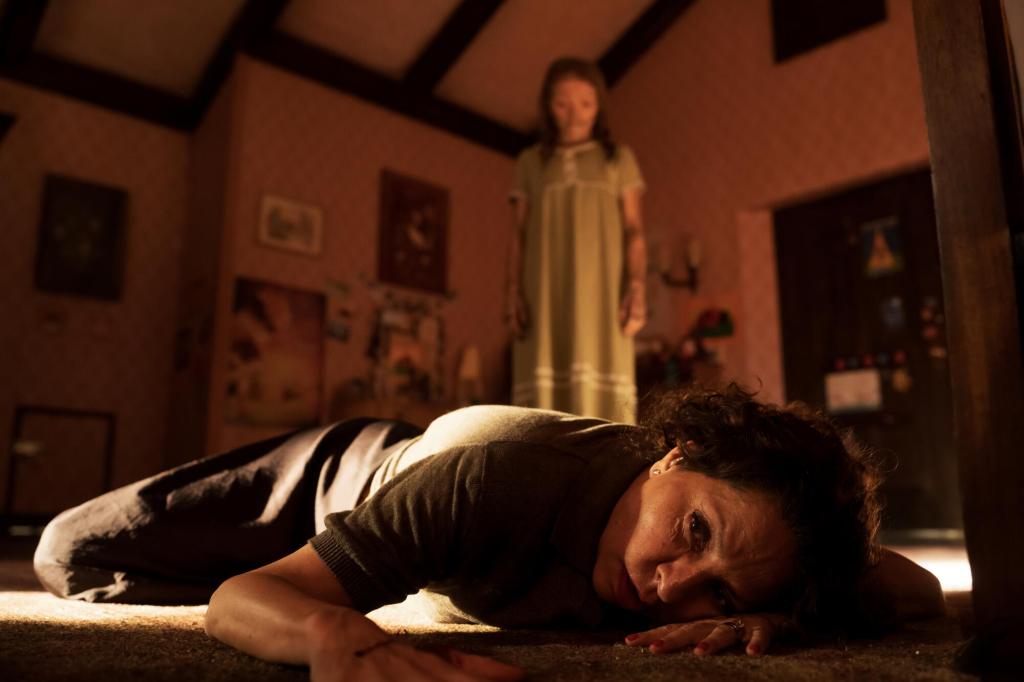
Lee Cronin’s The Mummy seems a glaring case of false advertising. The director’s name was added to the title so as not to confuse it with the then just-announced third sequel to The Mummy (1999) coming from Universal Studios, but really the title alone was always going to confuse people. Anybody that watches this film expecting an Egyptian-themed story of a bandage-wrapped undead monster is likely to feel short-changed by the wholly derivative possession movie that they actually get. Cronin’s film seems weirdly designed to make the viewer narrow their eyes at him in contempt: it is altogether too deceptive, too revolting, and too derivative to enjoy.
Journalist Charlie Cannon (Jack Reynor) and his pregnant wife Larissa (Laia Costa) live in Cairo with their children Katie and Sebastián. Katie is kidnapped from their garden, and despite their best efforts the Egyptian police are unable to find her.
Eight years ago, and still bearing the emotional scars of their loss, Charlie and Larissa have moved to New Mexico with Sebastián, third child Maud, and Larissa’s mother Carmen. Back In Egypt, a cargo plane crashes with an ancient sarcophagus onboard. Inside, the investigators find Katie: partially mummified, still alive, and traumatised into catatonia. Charlie and Larissa brings Katie home to care for her, but soon discover that something supernatural has possessed her body and has violent designs on the Cannon family.
Horror films about mummies have run a century-long course through popular cinema, kicking off with Universal’s The Mummy in 1932 – directed by Karl Freund – and following on through both American and British efforts and into the widely loved Stephen Sommers-directed action fantasy franchise of 1999. There is a long-held cultural fascination with Egypt’s mummies, although they were by no means the only civilization to mummify their dead. It is a complicated relationship, all tied up in issues of Orientalism, colonialism, and a general Western discomfort with confronting mortality. Despite the complexity, it is a subject matter rich with potential for a canny filmmaker to tackle those deep-seeded racisms head on and generate a properly innovative and effective horror piece.
Sadly Lee Cronin simply does not do that. There is a partial Egyptian setting, for sure, and the appearance of an ancient sarcophagus and a bit of mummification, but at the end of the day Lee Cronin’s The Mummy is simply one more possession thriller. It is sub-genre over-loaded with examples, and with new attempts appearing in cinemas multiple times a year. There is a superb idea at the film’s centre – finding your eight-years-missing daughter inside a 3,000-year-old sarcophagus is wild – but when it comes to the actual execution Cronin falls back on his previous horror film Evil Dead Rise (2023).
This is the horror of revulsion: everything that bleeds, oozes, suppurates, or festers does so with force and detail. In one key scene a character eats open the face of a dead body and then laps at the mixture of blood and embalming flood that comes out, while onlookers openly vomit into their wine glasses. There is space for this kind of horror imagery, but it has to be paired with an appropriate tone. Cronin’s is oddly cruel and mean-spirited, very low in suspense and plot but high in making the film an ordeal. It is a challenge in more ways that one: the film runs more than 130 minutes in length, and that is honestly a torture in itself.
What a waste of a neat conceit. What a way to deny an audience their expectations. What a chore.


Leave a Reply