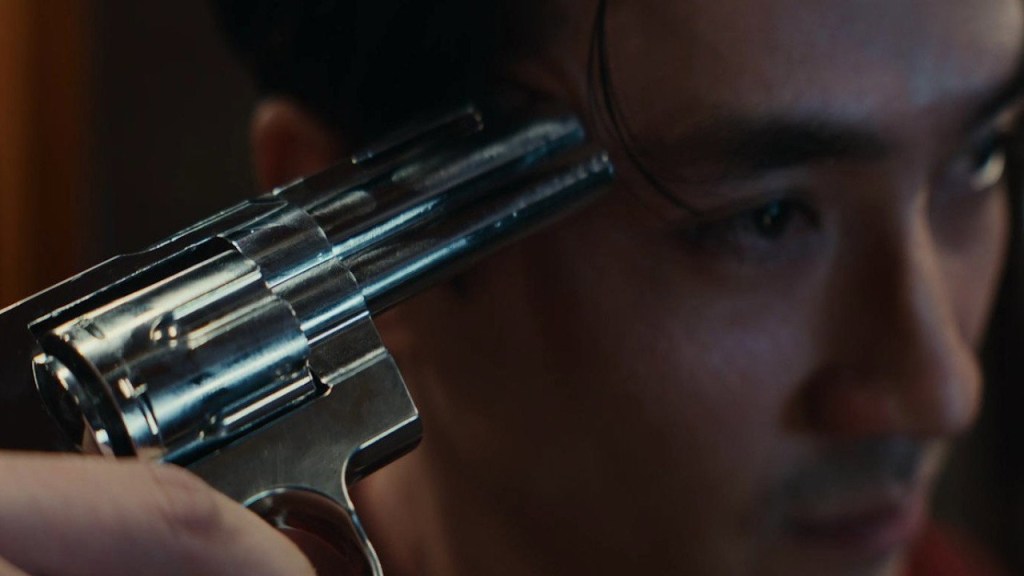
Han Yan’s new crime film V is an outstanding two-hour thriller wedged uncomfortably inside a bloated 160 minutes. While the bulk of its cues seem drawn from Christopher Nolan’s The Dark Knight, and effectively so, the inevitable restrictions of Chinese censorship click the wings of its more interesting and provocative elements. The result is a curate’s egg: individual scenes and sequences are great, but the film as a whole can be a tiring watch.
Working class farmer Man Tsz-keung (Zhu Yilong) illegally immigrates from mainland China into Hong Kong, where he expects to make himself rich. As he languishes in poverty, and is drawn into the city’s organised crime scene, he resolves to take matters into his own hands. Teaming up with flight attendant Lok Ka-yuen (Michelle Wai), he masterminds a record-breaking heist. Still unsatisfied, he decides to target Hong Kong’s wealthiest man: the popular tycoon Chan Fai-yin (Tony Leung Ka-fai).
The Dark Knight similarities come not just from the muscular, Hollywood-style production values, but from the close resemblance of Man’s character to Heath Ledger’s Joker in the earlier film. They are both represented as agents of chaos, ultimately disinterested in money for its own sake and driven more powerfully from a sense of play. For Man, his heists and hijinks are part of a game with the Hong Kong police department, and particularly with Qi Honggang (Tan Jianci) – a mainland police officer on exchange to Hong Kong. He is effectively this film’s Batman: dogged, analytical, and incorruptible.
It is no coincidence that the hero is from the mainland. V commences in 1994, three years before the city’s handover to China. Captions make it clear that this Hong Kong, still under British sovereignty, is a lawless war zone ruled by crime syndicates and corrupt police. It is only when 1997 passes, and China takes control, that the Hong Kong police begin to seem competent and threatening to Man’s schemes. It is also not a coincidence that the immensely wealthy Chan is portrayed as a deeply cynical and exploitative character: runaway wealth is forcefully demonised in Han’s film, in favour of a socialist egalitarian attitude on the mainland.
It is all propaganda of course, and that is not unexpected from a state-approved Chinese feature. It is also no different from the propagandic pro-American attitudes depicted in your average Hollywood blockbuster. It is easy to imagine a few judicious cuts could change V into a more potent and entertaining feature, but at the same time the requirements for a Chinese release – chiefly that criminals must be always be seen to lose – does rather cut V off at the knees.
Zhu Yilong delivers a superb, showy performance packed with humour and oozing with charisma. He is well balanced by Tan Jianci, and the two actors share a classic sort of Hong Kong homo-eroticism dating back to the ‘heroic bloodshed’ films of the 1980s. Michelle Wai is strong in the film’s first half, but in the second her character is unfortunately side-lined as the narrative expands and bloats out of proportion. Selena Lee makes a distinctive impression as Guan Suchen, seemingly Hong Kong’s one effective pre-handover cop. Tony Leung Ka-fai is, of course, easily entertaining and constantly effective as Chan, and his scenes with Zhu are among the film’s very best.
There is a great Hong Kong crime thriller in V, and it can be enjoyed with patience and effort, but too much story is packed in and it loses focus on its strongest parts. I suspect it may play better at home than in cinemas, where the viewer can pause the action and take a break from time to time. Taken all at once, it’s a bit of a slog.





Leave a Reply