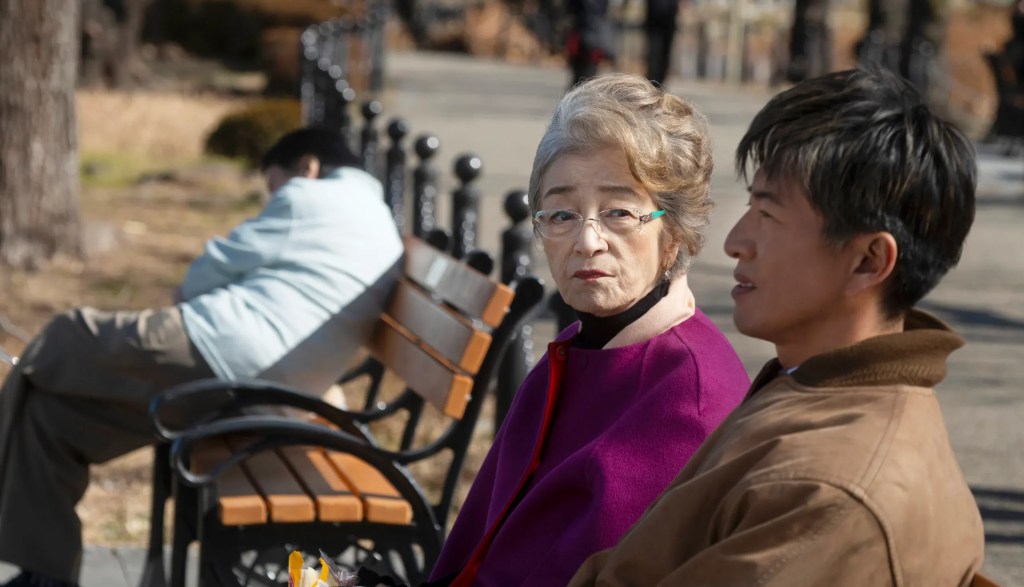
Usami Koji (Kimura Takuya), a Tokyo taxi driver facing growing financial pressures, agrees at the last minute to take on a colleague’s booking: driving an 85-year-old from her old home in Shibamata to a nursing home. When he arrives to collect the elderly Takano Sumire (Baisho Chieko), however, he discovers that not only is the nursing home in Hayama – some 90 kilometres away – but that Ms Takano is insistent on making numerous stops around Tokyo on the way.
Tokyo Taxi remakes the French-Belgian film Driving Madeline (2022) with a strong and obvious focus on 20th century Japanese history. The elderly Sumire has packed up her home and purchased a place in an assisted living facility, and she is using the journey to revisit and re-experience the various Tokyo locations of her childhood, early adulthood, and marriage. In doing so she makes a growing personal connection with her driver Koji, who is much more comfortable driving his passengers in a respectful silence. It is very familiar, comfortable stuff. The narrative is extremely easy to predict, and the various flashbacks and anecdotes detailing Sumire’s life have a warm familiarity about them. This is not challenging cinema by any measure, but for audiences craving something gentle and pleasant it certainly hits the spot.
If it feels old-fashioned, it is because its director Yamada Yoji is himself a remarkably old-fashioned filmmaker. Yamada was 94 years old when Tokyo Taxi was released in Japanese cinemas last year. It represents his 91st film as director. He has been making these comfortable, easy-going blends of comedy and drama for his entire adult life. Some times he directs something genuinely transcendent, such as The Twilight Samurai (2002). Some times he sticks to a well-established, near-mechanical routine; his Tora-San series ran to 48 films between 1969 and 1995. Most of the time he presents his audience with something like this: well-crafted, perfectly enjoyable, mainstream entertainment. He is, in many ways, the safest bet in Japanese cinema. It is clear that, with only a few years left before his 100th birthday, that there are only a handful of new films he is likely to make. That, for me at least, makes every new release something to treasure.
The film is structured to play out mostly as a two-hander between its leads. Kimura Takuya plays a naturalistic, easily recognisable working father and husband. He is not entirely articulate with his feelings, and a little awkward in sharing his life with his elderly passenger. Kimura does a charming job with a clear understanding of what the film requires from him: a sympathetic point of view from which the audience can hear Sumire’s life story.
Kimura has worked with Yamada before on the 2006 samurai drama Love and Honor but the director shares a much longer relationship with Baisho Chieko, who famously played Tora’s sister Sakura across the entire Tora-San series. In a knowing joke, this new film even has Koji pick Sumire up from the Tokyo suburb of Shibamata – the home of Baisho’s Tora-San character. It is a pity Koji picks her up from the temple rather than the train station, where a bronze statue of Baisho has been standing since 2017. There is a dignified, slightly theatrical quality to Baisho’s performance here: she holds court over the film, as she deserves to given her long and distinguished screen career.
The chemistry between the two leads is the film’s most wonderful part. It also acts as something of a reunion for them, since they also performed the leads in Miyazaki Hayao’s animated film Howl’s Moving Castle back in 2004.
Comfort seems a key watch-word with Tokyo Taxi. Two actors and a director with a palpable familiarity with one another. There are few surprises, but a great amount of satisfaction. If this is to be Yamada Yoji’s final film, it will form a perfect epilogue. Then again, he is only 94: I would not put it past the old master to squeeze out another two or three films by decade’s end.



Leave a Reply