Some years ago I had the opportunity to visit the Ho Chi Minh City Museum of Fine Arts. Among its exhibits was a series of loose sketches made during the Vietnam War by a member of the Viet Cong armed forces. They depict various men and women in the forest, some eating and talking with one another, some simply waiting. They present a sharp contrast to the anonymous angry masses depicted in countless American war films. They showcase ordinary people forced into a great and terrible conflict.
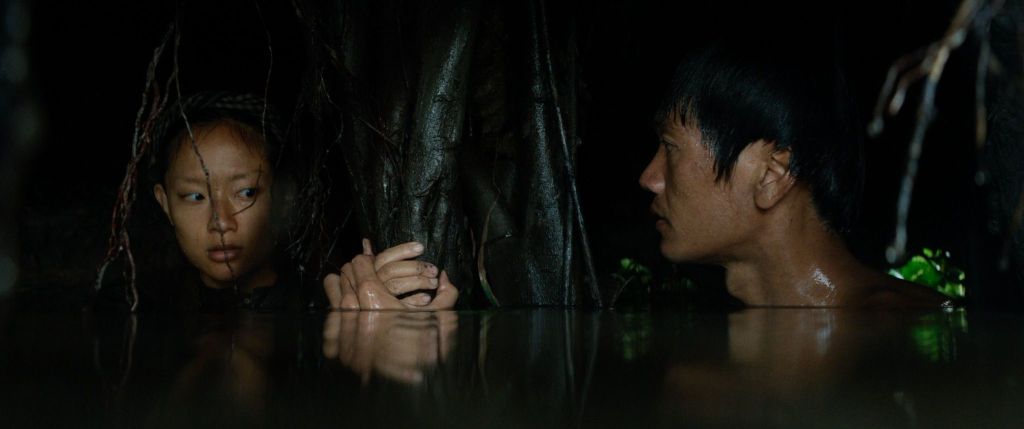
I am reminded of those sketches when watching Bùi Thạc Chuyên’s Tunnels: Sun in the Dark, a 2025 Vietnamese war film. It too showcases the Viet Cong as desperate people, both men and women, fighting a guerilla war against a vastly over-powered American military. While the film is packed with tense scenes of armed combat, surveillance, and evasion, it smartly keeps one eye permanently trained on its human characters. For many Vietnamese audiences, I am sure it is a stirring and powerful experience. For those watching who, like me, live in a country that fought against the Viet Cong and the North Vietnamese, it is a powerful reminder that wars generally have two sides. One film cannot balance our popular memory against more than sixty years of American Vietnam War cinema, but it helps.
Technically it is an impressively staged work, making use of extensive historical research and shooting inside actual tunnel complexes used during the war. It is a deeply claustrophobic place: difficult to navigate, at constant risk of tunnel collapse, short on fresh air, and under constant aerial bombardment. Inside this nightmarish environment, a guerilla unit of young and inexperienced soldiers are tasked with defending a critical communications unit from attack.
The focus on characters benefits from strong performances by Hồ Thu Anh, Thái Hòa, Quang Tuấn, and others. Hồ is particularly strong, and performs the closest role the film has to a protagonist as well as its emotional heart. While much of the film follows the same sorts of narrative beats familiar to the war genre, Bùi – who also co-wrote the screenplay – finds room for moments of genuine humanity. Scenes of friendship, eating together, singing, and romance pepper the story and elevate it beyond the procedural. Perhaps it becomes a little bit propagandist, but what war film doesn’t? It is hard to reflect conflict without picking a side, and it is a credit to Bùi and Nguyễn Thị Minh Ngọc’s script that the Americans – when they emerge in person – are treated with a proper sense of dignity.
There is a heightened emotional tone to Tunnels reminiscent of popular Chinese cinema: the same earnest quality and sense of self-sacrifice is everywhere. Like Chinese cinema, it also guarantees that not every character is likely to survive. This is immensely satisfying cinema, and a valuable alternative perspective to our dominant representations of the Vietnam War.
Tunnels: Sun in the Dark received its North American premiere at the 2026 Fantasia Film Festival. Click here for more information.




Leave a comment