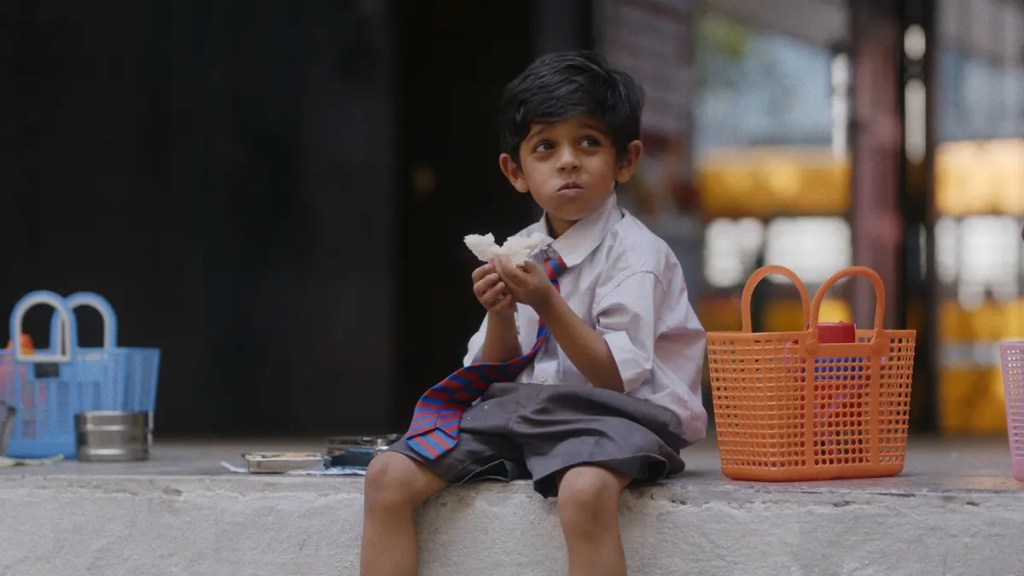
Anoop Lokkur emigrated from India to Australia in 2007. Now he has briefly returned home to Bengaluru to direct his debut feature, the semi-autobiographic and deeply evocative family drama Don’t Tell Mother. Whether that properly makes this an Australian film, and Indian one, or a mixture of the two, when a film is this well-crafted we Australian critics should put our Indian counterparts on notice: we are claiming him.
Nine-year-old Akaash (Siddarth Swaroop) lives in 1993 Bengaluru (then named Bangalore) with his younger brother Adi (Anirudh P Keserker) and his parents – whom he knows as Appa (Karthik Nagarajan) and Amma (Aishwarya Dinesh). Appa works at his own father’s firm of investment brokers, behaving as a dutiful son despite the friction it causes with his wife. Meanwhile Amma chafes badly against her domestic role, desperately craving a career or vocation of her own outside of the family home.
Further elaborating on specific incidents in the film would risk ruining what is a deliberately slight, delicate narrative. This is family drama in the vein of Kore-eda: light of touch, gently expressed, and grounded in realism. It is the sort of low-stakes, warmly composed work that requires a world of talent and effort to look as simple as it does.
Of course low stakes for the adult viewer can feel like life or death for a child protagonist. Akaash is under-performing at school, and receiving merciless beatings by his mathematics teacher. He is under pressure to study hard and exhibit good behaviour by his mother, but an overly permissive father constantly confuses matters. His younger brother Adi is a constant companion and a never-ending irritant at the same time. Lokkur’s screenplay has crafted a snapshot of childhood that feels innately familiar while maintaing an incredible specificity of culture. It is the sort of international feature that makes watching foreign films so captivating.
While Akaash performs as the audience’s viewpoint, much of the film winds up being about his mother. Lakshimi (Dinesh), her actual name, is both restricted by a patriarchal culture and formed by it. She clearly loves her husband Raju (Nagarajan) but is constantly frustrated by his laziness, and his inability to challenge or step beyond his domineering father. At the same time, the very cultural forces that inhibit her she passes onto her children: “Girls cry, boy’s don’t” she remarks, while admonishing an upset Akaash, showing that however she resents the everyday sexism around her she continues to perpetuate it herself. It never feels polemical. It simply feels very real and believable. Aishwarya Dinesh delivers a wonderful turn as Lakshimi as well, ably providing an emotional core around which her family orbits.
Don’t Tell Mother belies its limited budget with a genuine sense of early 1990s India. Despite many modern conveniences of the developed world, electrical power consistently burns out. Families make and share traditional snacks and engage in old-fashioned folk songs, but still head out to the local cinema to see Jurassic Park (the best clue for a 1993 setting). A limited musical score only plays when it would be most effective, and largely stays out of the audience’s way. As a small, independent feature Don’t Tell Mother is excellent. As a debut feature it is remarkable.
Don’t Tell Mother is screening at the 2026 Sydney Film Festival. Click here for more information and session times.





Leave a Reply