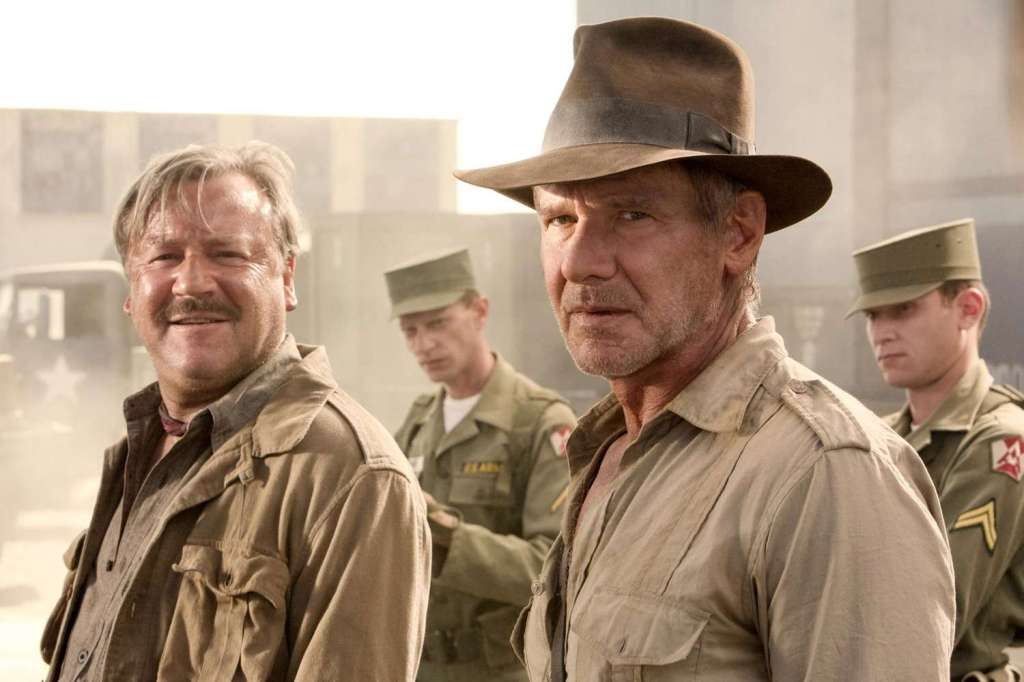
It is rather strange to return to Indiana Jones and Kingdom of the Crystal Skull (2008). Upon release it was a divisive, long-delayed legacy sequel to a widely acclaimed and commercially popular trilogy of 1980s action films. In retrospect it was always going to disappoint viewers, not simply because of shortfalls in production but because it was never competing with the original trilogy so much as competing with nostalgia for those films. Of course in 2023 Lucasfilm released a fifth film in the series, in which all of the criticism levelled at the fourth (Harrison Ford is too old, it has been too long between sequels, the magic formula is gone) seemed even more emphatic and pointed. Crystal Skull is now 18 years old, almost as long a gap as there was between it and 1989’s Indiana Jones and Last Crusade.
Ultimately the two-post 1980s films feel very much of their own style and tone, compared to the popular originals. Both feature a game and compelling Harrison Ford at their core, and both include a talented and relatively prestigious supporting cast filling all of the key roles. At their best, they work brilliantly. For the most part they struggle with replicating the original look of cinematographer Douglas Slocombe, the innate old-fashioned tone of the previous works, and the old sense of pace. Honestly, neither film taints the legacy of Raiders of the Lost Ark (1981). At the same time, neither film has a chance to maintaining the same nostalgia or influence. I don’t really feel the moviegoers of 2026 talk about Crystal Skull at all.
The film picks up in 1957, where 58-year-old archaeologist and college professor Henry “Indiana” Jones Jr (Ford) is pitted against a Soviet expedition to uncover the mythical South American city of Akator, and the mysterious power of its elongated crystal skulls. He is accompanied by rebellious teenager “Mutt” Williams (Shia LeBeouf) and former lover Marion Ravenwood (Karen Allen), while fighting against Ukrainian Colonel Doctor Irina Spalkov (Cate Blanchett). Ray Winstone, John Hurt, and Jim Broadbent co-star in various supporting roles.
The film is actually reasonably good for its first hour or so. Ford embraces the title role ably and with enormous charm. A lengthy prologue begins with Russian soldiers invading Area 51 and ends – rather infamously – with Indy surviving a nuclear explosion inside a refrigerator (I love it). Subsequent scenes nicely reflect the ‘reds under the beds’ atmosphere of late 1950s America, introduce Indy to Mutt, and sets them off on their adventure.
There is a specific point where the film suddenly falters, and it is when the pair go to explore a Peruvian cemetery that things effectively fall apart. Once inside a secret Spanish tomb the films works well. Before that, the cemetery is unconvincingly presented on a soundstage with an obvious computer-generated background. Later scenes attempt to replicate the Amazon jungle on sets and with extensive green-screen substitution of locations and backdrops. It looks terrible, and is deeply unconvincing, and it is in these scenes that Crystal Skull simply stops resembling an Indiana Jones film at all. One of the appeals of the original films was their glamorous locations, shot like a James Bond picture across multiple countries and continents. In making Crystal Skull Spielberg, older and with a large family, simply elected to shoot the entire production in the United States. It is strange seeing a movie from 2008 looking visibly cheaper and less convincing than one shot in 1981.
For whatever reason, the screenplay also sinks as the production values do. Weak jokes pepper the dialogue rather than the witty and clever one liners of earlier scripts. Events grow silly and over-the-top. Characters that at first seemed smart and entertaining grow tiresome and formulaic. New characters introduced in the second half – such as John Hurt’s Harold Oxley – do not really get characters at all.
When the time comes to pull the action scenes and car chases into an actual plot, Crystal Skull flounders. An over-complicated science fiction story combines mind control, UFOs, the lost city of El Dorado, the Nazcan lines, and – improbably – inter-dimensional travel. The idea of replacing the 1930s occult fantasy of the original films with 1950s flying saucers is a bold one, but in developing the story George Lucas over-complicates it. The original films were plotted and produced by Lucas of Star Wars and its simpler set-ups. The Lucas who plotted Crystal Skull is the Lucas of Clone Wars, pod races, and midichlorians; it’s messy stuff, and fails to match the iconic imagery of its much-adored predecessors.
Ultimately Crystal Skull feels like its director simply got bored. The more grounded first half still works because it feels closer to the adult drama Steven Spielberg had come to prefer. The second half, where the production process grows more time-consuming and stressful, is the result of a filmmaker who simply resents having to bother. It is no surprise Spielberg declined to return for Indiana Jones and the Dial of Destiny (2023). I think he simply did not have another one in him.
Honestly I cannot think of another film where I enjoy the first half so much, and then dislike the second with the same enthusiasm. It is the most frustrating kind of Hollywood blockbuster: the kind that could have been great with just a little more focus and effort. Instead it is cursed forever to disappoint, then be forgotten.


Leave a Reply