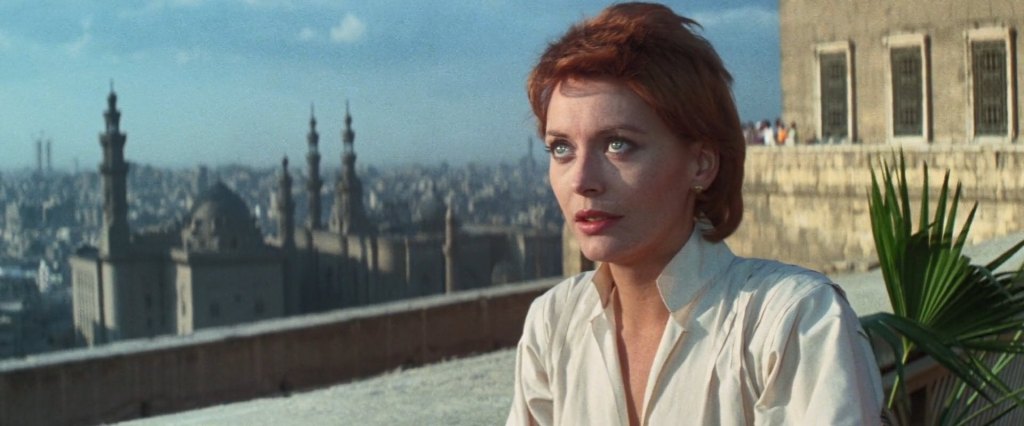
It is rather remarkable that there are two American films, both released in 1981, that feature an archaeologist travelling to Egypt and getting shot at while on the hunt for legendary antiquities, and which co-star Welsh actor John Rhys-Davies. One of those films is Steven Spielberg’s Raiders of the Lost Ark, to this day widely considered one of the best – if not the best – action film of all time. The other film is Franklin J. Schaffner’s Sphinx, released in American cinemas four months and one day earlier.
If you are straining to recall Sphinx, that is because it was not a commercial hit. It was produced by Orion Pictures and distributed by Warner Bros, and was based on the 1979 Robin Cook novel of the same name. Its premise promises much: an American Egyptologist Erica Baron (Leslie-Anne Down) travels to Cairo to research Seti I’s chief architect, only to get mixed up in the illegal trade of Egyptian antiquities. She is soon tied up in a web of intrigue, involving a French journalist (Maurice Ronet), a Greek smuggler (Rhys-Davies), and the dashing United Nations representative Akmed Khazzan (Frank Langella).
Sphinx feels curiously old-fashioned, even for 1981, with its melodramatic plot and an array of Caucasian actors playing Arabic characters from beneath a mountain of bronze make-up (even Sir John Gielgud makes a rather unedifying brief appearance). It is slightly odd to consider that, while Raiders of the Ark actively aimed to emulate adventure serials of the 1930s and 1940s, it is Sphinx that feels tired and woefully out of date.
Leslie-Anne Down is saddled with a terrible leading character, who is hurled from one crisis to another without ever gaining sufficient agency on her own. Instead she is saved by one romantic suitor after another, almost always the victim, perennially one step away from a remorseful sobbing fit. The film’s primary suitor is Frank Langella’s handsome and brooding Akmed, who never seems particularly romantic or even mildly intrigued in his new lover. His and Down’s charmless romance is the centre of the film, and dreadfully poor writing not only lets down both actors it renders the overall feature a hollow shell.
Some handsome location footage at least showcases Egypt’s most famous historical sites, however the bulk of the shoot was done in studios in Budapest. Franklin J. Shaffner was a talented director, having helmed such classics as Planet of the Apes (1968) and Patton (1970). Sphinx arrives at the tail end of his career, and suggests a filmmaker whose enthusiasm for their art has gone. The core problem with Sphinx might be its screenplay (by John Byrum), but Schaffner does nothing to alleviate or sidestep its problems.
Some films can be poorly made but still offer a modicum of entertainment through individual performances or impressive visuals. Sphinx offers nothing of that nature. Its plot is overly fussy and complex, and poorly presented. It is always worth sampling older, more obscure films, to discover the occasional underrated gem, or ‘diamond in the rough’. Sadly there is no diamond hidden in Sphinx – there is only the rough.






Leave a Reply