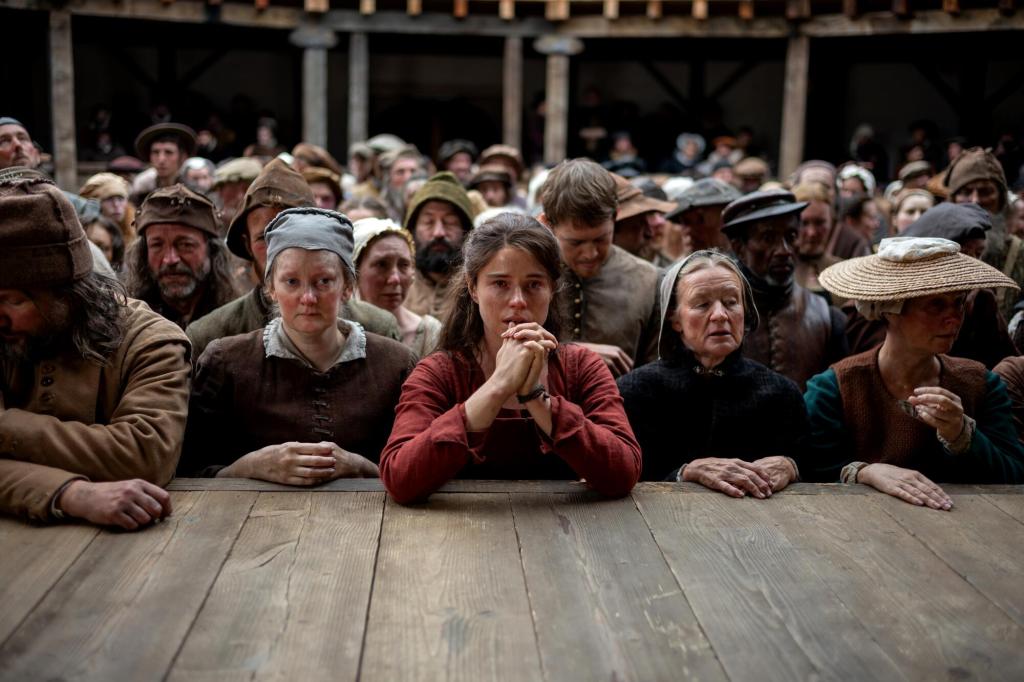
In many ways, the most remarkable thing about Chloé Zhao’s Hamnet is not what it is but what it is not. The premise – playwright William Shakespeare and his wife Anne Hathaway mourn the death of their son – suggests an entirely different film to the one Zhao actually delivers. Any viewer expecting a biographical focus on Shakespeare will potentially be disappointed, but the emotional and highly resonant meditation on motherhood and grief that Zhao does offer up is remarkable.
The film adapts a 2020 novel by Maggie O’Farrell, and O’Farrell collaborates with Zhao on the screenplay. Agnes (Jessie Buckley) lives in Stratford-Upon-Avon with her step-mother (Justine Mitchell). She is soon seduced by William (Paul Mescal), a glover’s son hired to tutor her step-siblings, and falls pregnant with their first child. Before long she gives birth again – this time to twins – and while her new husband moves to London to work for the theatre, she is left behind to raise their children. When the plague hits Stratford she almost loses her daughter Judith, only to suddenly lose her son Hamnet instead.
Of course it does not play out so simply. There is an evocative seam of magical realism underlying Hamnet. Agnes is represented as a child borne of the forest with a witch for a mother and a deep connection to both the woods and animals. She appears gifted with an ability to sense the future, with strong impressions rendered on both destiny and being supernaturally cursed for her actions. It is enchanting stuff, and richly imaginative, and adds a strong framework that surrounds the film’s core concern: the shattering grief that comes with losing a child.
Jessie Buckley deservedly won an Academy Award for her performance as Agnes. There is a palpable bravery to her acting here, which is encouraged through Zhao’s scene structures to push further than these sorts of stories tend to go. Sobbing grief is allowed to continue beyond where a typical film might cut to something or someone else, and is instead left to deeply affect both Agnes and her audience.
The use of the name Agnes – the name applied to the real Anne Hathaway in her father’s will – is a clever choice, not simply because it avoids reader or viewer thinking of the popular 21st century actor of the same name but also because it pushes the story one step away from William Shakespeare’s shadow. We see remarkably little of Shakespeare’s professional life and legendary works here, and what we are exposed to is deliberately held back for the climax. Paul Mescal is excellent as William, in part because he plays the role in such an understated and slightly distant manner. This is, through and through, Agnes’ story.
The supporting cast are excellent. Bodhi Rae Breathnach and Olivia Lynes are charming as Agnes’ two daughters, while Jacobi Jupe is extraordinary as young Hamnet. Cleverly, Jupe’s elder brother Noah Jupe (A Quiet Place) plays the actor playing Hamlet in Shakespeare’s play during the final act. Emily Watson, always a beautifully grounded actor, stands out as Shakespeare’s mother Mary.
As with most films, there are imperfections. Sticklers for historical accuracy will be quick to note some of the dialogue and trappings of key scenes, while Max Richter’s score is slightly dented by the use of his own “On the Nature of Daylight” – already used to similar effect in Arrival (2016), Shutter Island (2010), and The Last of Us (2023). Despite these flaws, Hamnet remains a powerful piece of work. It has an emotional impact that is almost transcendent.





Leave a Reply