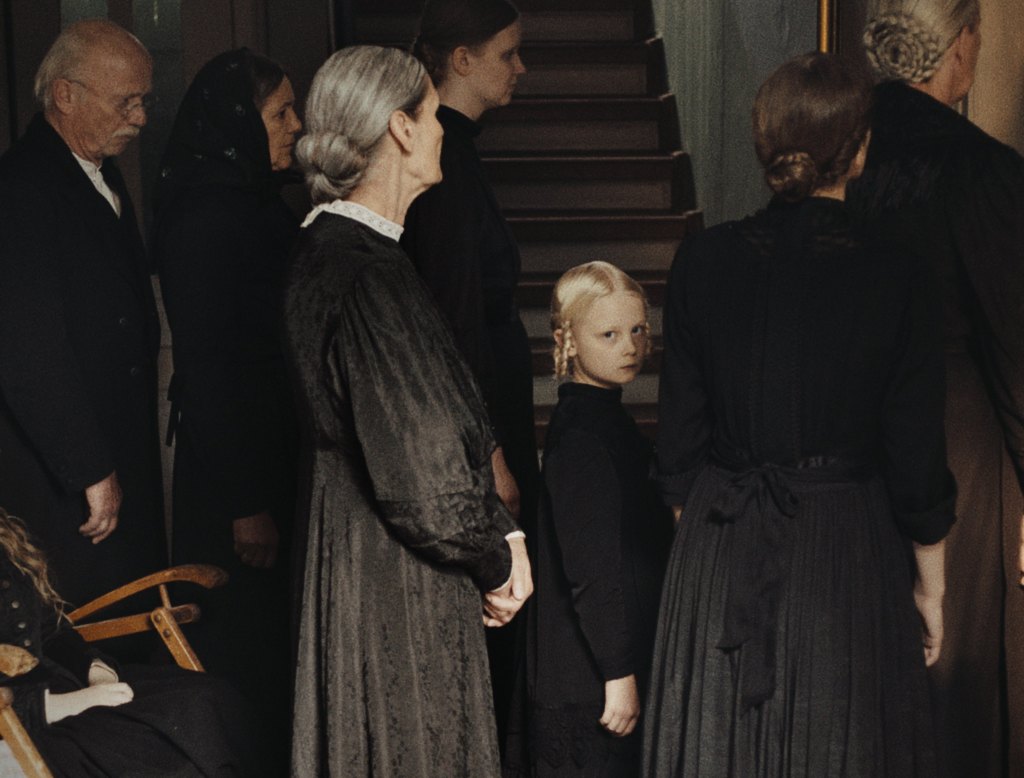
I am not sure that I could sit through Sound of Falling a second time, but I am absolutely grateful that I watched it once. Mascha Schilinski’s artful multi-generational drama is evocatively composed and languidly staged, but it also both long and glacially slow – intentionally so – and patiently explores the subjugation and enveloping abuse of young women. Viewers who embrace cinema in search of popular entertainment and straight-forward storytelling are absolutely not the target audience. Arthouse audiences, who delight in unconventional framing, non-linear narrative, and rich symbolism, will find much to digest and talk about here. That Schilinski’s film is a masterful work of art is not really in question: you simply need to embrace which half of the audience is your best fit.
Four different generations of women and girls inhabit the same farmhouse in northern Germany. Seven-year-old Alma (Hanna Heckt) is confronted by death and funerary traditions in the mid-1910s. In the 1940s, the teenage Erika (Lea Drinda) grows obsessed over her amputee Uncle Fritz (Martin Rother). In the 1980s, Erika’s now-adult sister Irm (Claudia Geisler-Bading) lives on the farm with her daughter Angelika (Lena Urzendowsky). In the present day, the farmhouse is renovated by a family whose elder daughter Lenka (Laeni Geiseler) forms a close bond with neighbour Kaya (Ninel Geiger). The four narratives interweave and jump back and forward, showing links between characters and generations, thematic echoes, and slowly building to a conclusion. It rather feels like watching four Michael Haneke features at once, with the expected tragedies that ensue. It is like a Love, Actually for miserable people: in both films women fail to get what they want or deserve, but at least here no one is pretending to be funny.
The film is shot in a 4:3 academy ratio, with a variety of digital cameras, lens, and even a pinhole camera to achieve Schilinski’s desired effect. Some scenes feel like documentary, and others like memory. It has an obfuscatory effect, and in its most abstract moments goes a step too far, but it also provides the film with a distinctive and memorable visual style. More important than the visual aesthetic is the sound design, which is sharp and provocative. It links scenes and periods in a non-realist fashion, with individual elements recurring like a tone poem.
In a film with such a large ensemble cast, it almost feels unfair to single out individual actors above their peers. That said, it is still worth highlighting Ninel Geiger’s cool, ambivalent performance as the modern-day neighbour Kaya, as well as Lena Urzendowsky’s prominent and emotionally effective turn as Angelika – the closest thing the film has to a protagonist.
It is a long film, and is infused with a constant sense of low-level dread. Its violence is not just subtle and insidious but all-encompassing. When it punctures the surface, it can be breath-taking and even actively upsetting. It presents bleak situations without any solutions or answers – after all, if we have not fixed anything in more than a century, why should Schilinski?
I may not plan to watch Sound of Falling again, but some films you only need to see once. Its most powerful imagery will linger for ages.
Sound of Falling opens in Australian cinemas on 3 June 2026.



Leave a Reply