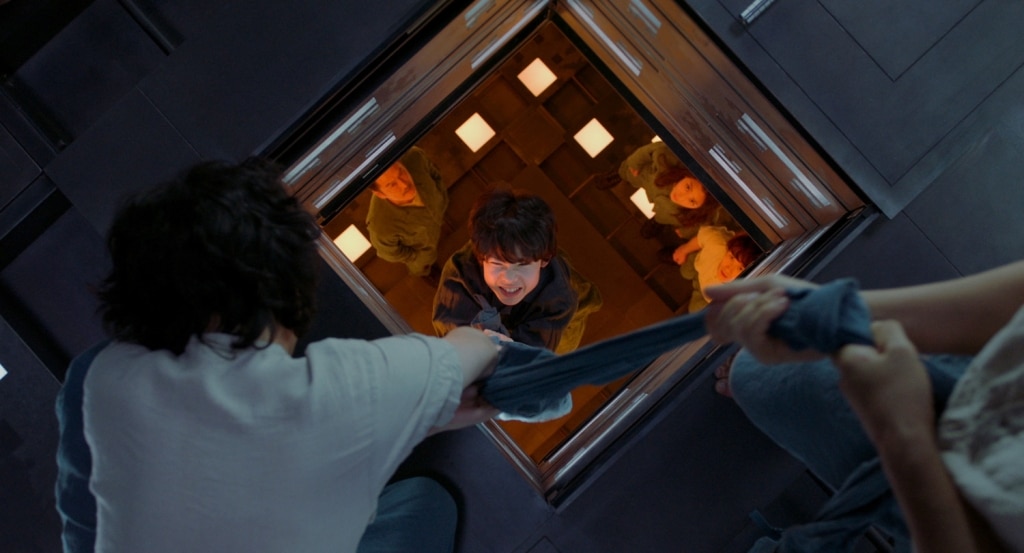
A group of strangers wake inside a mysterious cube-shaped room. Hatches on each surface lead to other, near-identical rooms. As they make their way through an apparent maze, some cubes turn out to be safe and others to contain deadly traps. While searching for an exit, the survivors must learn to trust one another – or learn if they can trust one another at all.
Cube (1997) was a great science fiction thriller written and directed by Canadian filmmaker Vincenzo Natali. It exploited a single redressed set and a limited budget to create something daring, original, and claustrophobic. Lionsgate Films produced a sequel and a prequel, neither of which managed to develop the impact or popularity of Natali’s original. How could they? Cube‘s core appeal was in the elegant set-up and simple premise.
In turns out there is a fourth film, also titled Cube. In 2021 Japanese studio Shochiku produced a remake, written by Tokuo Koji and directed by Shimizu Yasuhiko. The film features a very similar group of strangers waking up in a very similar cubic maze.
Foreign remakes of films are a fairly common phenomenon in cinema, although historically they have been dominated by American remakes of non-English language films. There are essentially two approaches to developing a foreign remake. The first takes a film from overseas with a strong narrative or original idea, and reshapes it to a fresh cultural context. Take, for example, Martin Scorsese’s The Departed (2008), which grabs Hong Kong triad thriller Infernal Affairs (2002, directed by Alan Mak and Andrew Lau) and repositions its story among the Irish mob of Boston. Or take Gore Verbinski’s enormously effective The Ring (2002), which layers an effective North American sheen over Nakata Hideo’s decidedly Japanese horror film Ring (1998).
There is, of course, another approach, which is to duplicate the original film in a new language to attract viewers that cannot stand subtitles. It is within this much lazier milieu that Shimizu’s Cube takes place.
The film is, in large sweeping gestures, a duplicate of Natali’s film. It looks the same, for the most part features very similar characters, and follows identical narrative beats. It is true that there are some differences, but they are for the most part relatively minor and unlikely to be picked up by viewers unless they are particularly familiar with or fond of Natali’s film. To its credit, the Japanese version removes a mentally disabled character from the original – a sort of Rain Man-style savant – and replaces them with an intelligent, socially withdrawn thirteen-year-old. The plot function remains the same, but it lacks the risible quality Natali’s character had.
Other additions resolve around character motivations and flashbacks, and while they are reasonably developed they add nothing to significant improve this Cube over the last one. The film’s conclusion is slightly different, but discussing it at length risks spoiling it for viewers. Is it interesting? Sure. Better? Debateable.
Performances are generally more heightened, which simply reflects the cultural differences between Japanese and Canadian drama. A reasonably talented ensemble includes Suda Masaki (Cloud), Okada Masaki (Confessions, Villain), Takumi Saito (13 Assassins), and Yoshida Kotaro (Brave Father Online). Anne Watanabe, daughter of Ken Watanabe, is the film’s only female cast member, and feels sorely under-used.
If viewed independently, and particularly without having seen its source beforehand, Shimizu’s Cube is an effective and tense small-scale science fiction thriller. It is questionable whether it has any strong creative thrust of its own, but if you like the concept and are bored watching the Canadian version I suppose it may have some novelty appeal?




Leave a Reply