Some films you read about on paper and cannot quite believe they exist. Others you see and cannot quite believe they turned out as bad as they did. It is amazing how many times both scenarios wind up describing the same movie.
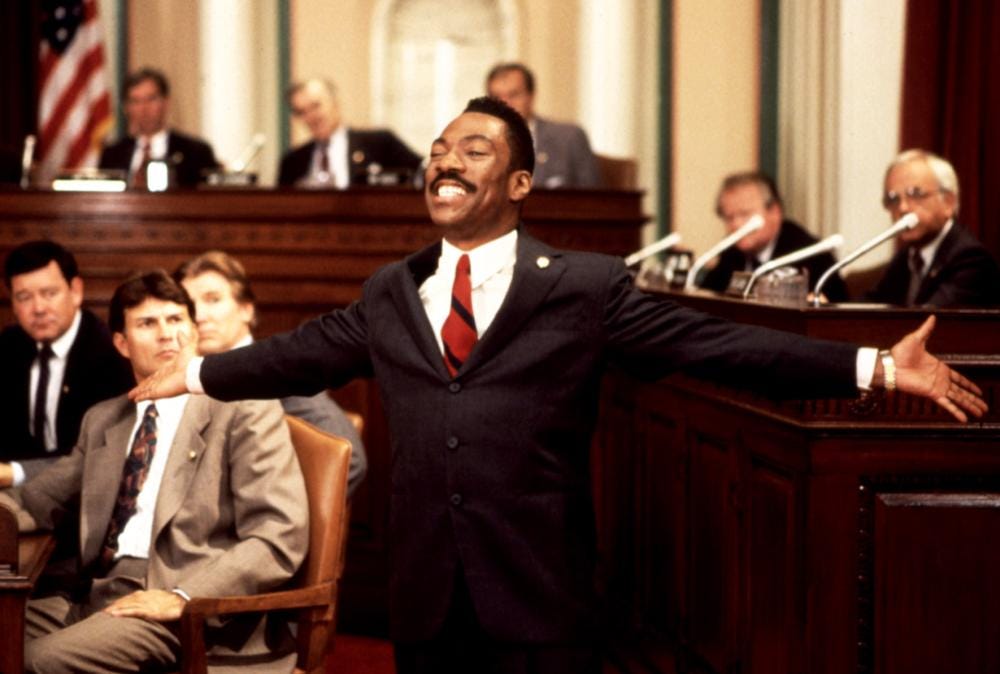
The Distinguished Gentleman is a 1992 political satire released by Disney’s Hollywood Pictures. On the one hand it stars Eddie Murphy, who famously broke from a long partnership with Paramount Pictures to make it. On the other hand it is directed by Jonathan Lynn, noted co-creator and writer of the BBC’s legendary television comedy Yes, Minister. I am not certain that Eddie Murphy and political satire necessarily pair together well. I am also not certain that the same dry intellectual wit that powered Yes, Minister‘s conflict of politicians and bureaucrats could also effectively serve the more heightened and energetic chaos of the United States Congress. What I can confirm is that all three thrown into the same mixture, and then shepherded to the screen by a commercially-minded and a relatively risk-averse movie studio, is a firm and unavoidable recipe for disaster.
To its mild credit, the first 40 minutes or so are at least watchable, if not particularly funny or enjoyable. Murphy plays Thomas Jefferson Johnson, a con artist who sees an opportunity to run for Congress under the same name as a recently deceased Senator (James Garner in an extended cameo). Once there he takes the opportunity to profit wherever he can from Washington’s elaborate culture of political money, grift, and corrupt lobbyists.
There is a nicely played cynicism in these early scenes, although they do jar immediately with Murphy’s then as-good-as-patented rapid fire delivery. The genius of Lynn’s comedies – with his traditional partner Antony Jay – was that the actors largely benefitted from standing back and letting the comedy work for itself. That does not happen here; indeed, Jonathan Lynn only directs the picture, from a screenplay by former political operative Marty Kaplan. One senses that Murphy knew during production that the film had problems; despite shifting to Disney for a better quality of screenplay, he is left with little decent material and winds up riffing in a familiar way over what he has been given. It is a mess of tones, and a sad pudding of weak jokes. There is some visible potential, but it is only ever the possibility of comedy. Real laughs never arrive.
Whatever of that potential did exist is quickly ushered out of view by the time the film hits its second act. Faced with too cynical a view of the American political process, the film immediately pivots to an idealistic love interest for Eddie Murphy (Victoria Rowell) and neatly ring-fences its villains, so that what seemed the ills of an entire political class can be neatly disposed as a few individual no-gooders. Not only is the remainder of the film not funny, it is not even passably interesting.
A year later Warner Bros charted similar territory with Ivan Reitman’s Dave, a political comedy that – while flawed – retained a much more consistent tone and likeable spread of characters. That film proved that a heart-warming, populist political satire could easily exist. The Distinguished Gentleman is an instruction manual on how to screw it up: hire the wrong people, eliminate all the jokes, and make whatever is left egregiously boring.





Leave a Reply